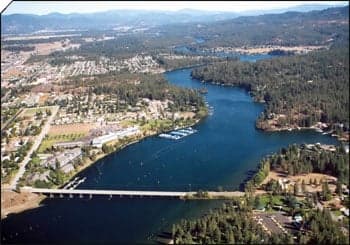
Photo: Wikipedia
Political ClimatePolitical Climate in Post Falls, ID
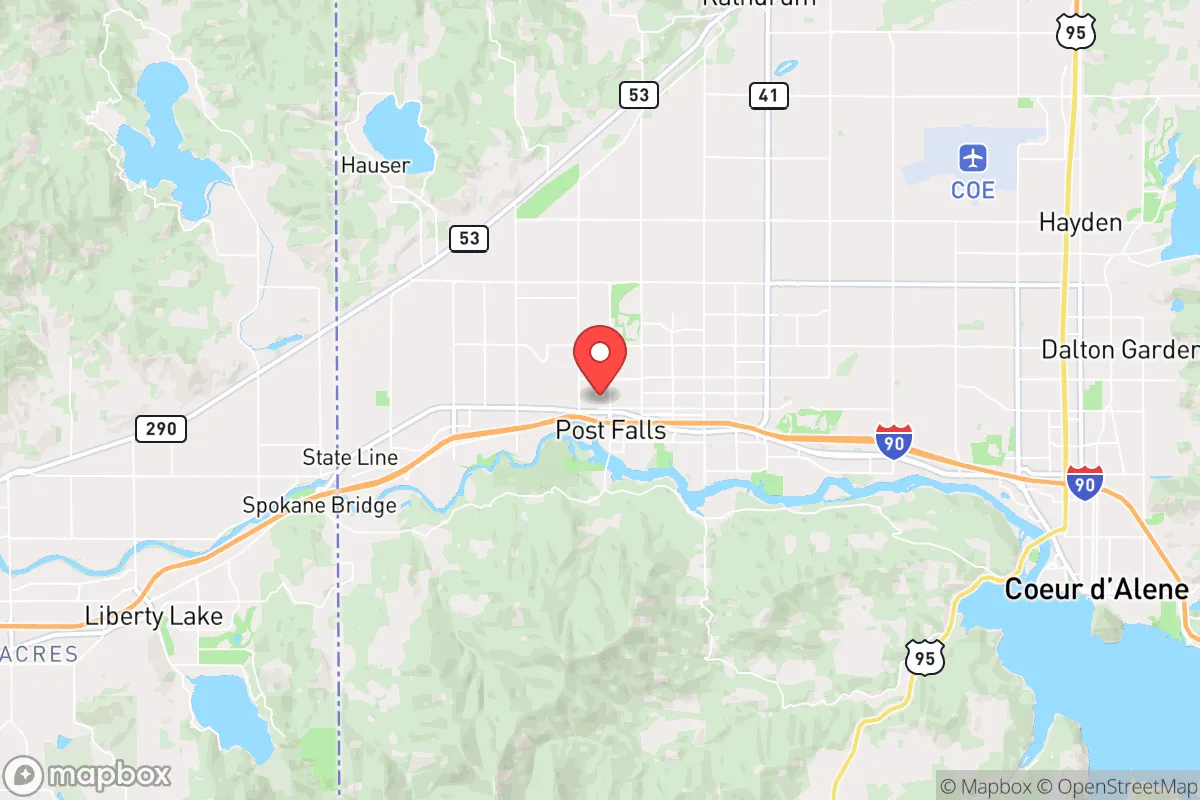
District shown is the primary district for this city’s centroid. Cities may span multiple districts.
Local Political AnalysisPolitical Analysis of Post Falls, ID
Post Falls, Idaho, is about as solidly conservative as it gets, with a Cook PVI of R+22 that puts it deep in the red column. That number isn't just a statistic—it reflects a community where the Second Amendment is a given, property rights are fiercely protected, and the idea of government staying out of your business is still the default expectation. The political trajectory here has been steady, though you can feel a subtle shift as more folks from California and Washington move in, bringing their voting habits with them. For now, though, the local culture and elected officials remain firmly rooted in the kind of small-government, personal-responsibility ethos that made this area attractive in the first place.
How it compares
Drive 15 minutes west into Spokane, Washington, and you're in a different world—a blue island in a red state, where city council debates often lean progressive on housing, policing, and taxes. Head east to Coeur d'Alene, and you'll find a similar conservative vibe to Post Falls, but with more tourist-driven development and a slightly more moderate edge on growth issues. The real contrast is with places like Sandpoint or Moscow, where university influence or artist communities have nudged politics leftward. Post Falls, by comparison, feels like the quiet, practical cousin—less flashy, more focused on keeping taxes low and regulations light. The surrounding Kootenai County has voted reliably Republican for decades, and local elections here rarely see serious progressive challengers. If you're looking for a place where your vote actually counts toward preserving conservative values, this is it.
What this means for residents
For daily life, the political climate translates into fewer layers of bureaucracy and more freedom to run your life as you see fit. You won't find heavy-handed zoning rules that tell you what color to paint your fence or how many chickens you can keep. The local school board tends to focus on academic basics rather than social experiments, and law enforcement is generally supported rather than defunded. Property taxes are low compared to the national average, and there's no state income tax—a direct result of the conservative majority keeping government lean. That said, the influx of new residents has started to strain infrastructure, and some worry that the next wave of transplants could tip the balance on local elections. If you value personal autonomy and want to live somewhere that hasn't been overrun by progressive policy experiments, Post Falls still delivers. But keep an eye on city council races—that's where the real battles over growth and freedom will play out.
Culturally, Post Falls stands out for its no-nonsense approach to public life. You won't see pride flags on city buildings or mandatory diversity training for small businesses. The local gun culture is strong and unapologetic, with shooting ranges and hunting access woven into the community fabric. There's a palpable distrust of federal overreach, whether it's land management by the Forest Service or EPA water regulations that affect local farmers. The long-term outlook depends on whether the conservative base stays engaged—complacency could let a progressive minority gain influence through low-turnout elections. For now, though, Post Falls remains a place where the government is your servant, not your master, and most folks intend to keep it that way.

State Political ClimatePolitical Climate in Idaho
State Political AnalysisPolitical Environment in the State
Idaho has long been one of the most reliably Republican states in the nation, with a deep-rooted conservative culture that has only intensified over the past two decades. The state’s partisan lean is overwhelming: Donald Trump carried Idaho by over 30 points in 2020 and 2024, and Republicans hold every statewide office, supermajorities in both legislative chambers, and all four congressional seats. However, the political story here isn’t static—it’s a tale of two Idahos, where explosive growth in the Treasure Valley is slowly shifting the center of gravity, even as the rural hinterlands dig in harder than ever.
Urban vs. rural divide
The political map of Idaho is starkly divided between its fast-growing urban corridor and its vast, deeply conservative rural expanse. The Boise metropolitan area—including Boise, Meridian, Eagle, and Nampa—is the state’s population engine and the only region showing any blue tint. Ada County, home to Boise, voted for Joe Biden in 2020 by a slim margin, a shocking flip for a county that went for Trump by 12 points in 2016. Canyon County, anchored by Nampa and Caldwell, remains solidly red but is becoming more competitive as California transplants arrive. Meanwhile, the rest of the state is a sea of deep crimson. Idaho Falls, Pocatello, and Twin Falls are reliably conservative, with rural counties like Lemhi, Custer, and Clark routinely delivering 80-90% Republican margins. The divide isn’t just about population density—it’s cultural. Urbanites in Boise tend to be moderate conservatives or libertarian-leaning, while rural Idahoans are staunchly traditional, suspicious of government, and fiercely protective of their way of life.
Policy environment
Idaho’s policy environment is a textbook example of small-government conservatism in action. The state has a flat income tax rate of 5.8%, which was cut from 6% in 2023, and property taxes are among the lowest in the West. There is no corporate income tax on pass-through entities, and the state’s regulatory climate is consistently ranked as one of the most business-friendly in the nation. On education, Idaho has embraced school choice through charter schools and the Empower Idaho Education Savings Account program, which allows parents to use state funds for private school tuition or homeschooling expenses. Healthcare policy is minimal—Idaho did not expand Medicaid until 2020, and only after a citizen initiative forced the legislature’s hand. The state has some of the most restrictive abortion laws in the country, with a near-total ban in effect since the 2022 trigger law. Election laws are similarly conservative: voter ID is required, same-day registration is not allowed, and mail-in voting is restricted to those with an approved excuse. The legislature has also passed laws banning ranked-choice voting and limiting ballot initiatives, a direct response to the Medicaid expansion and marijuana legalization efforts that bypassed the GOP supermajority.
Trajectory & freedom
Idaho is on a trajectory of expanding personal freedom in most areas, but with some notable caveats. The state has been a national leader in gun rights: constitutional carry became law in 2016, and in 2023 the legislature passed a law prohibiting the enforcement of any future federal gun bans or red-flag orders within state borders. Parental rights have been strengthened through the Parental Rights in Education Act, which requires schools to notify parents of any curriculum involving sexuality or gender identity and bars instruction on these topics in K-5. Medical autonomy has seen a mixed record—while the state banned nearly all abortions, it also passed a law protecting doctors who prescribe ivermectin or hydroxychloroquine for off-label use. Property rights remain strong, with no statewide zoning mandates and a robust right-to-farm law that shields agricultural operations from nuisance lawsuits. However, the influx of new residents has driven housing prices up 60% since 2020, and some local governments in the Treasure Valley have begun imposing growth restrictions that feel like creeping regulation. The biggest freedom concern for conservatives is the Boise city government, which has pushed for more progressive policies like sanctuary city protections and bike lane mandates—a reminder that local control cuts both ways.
Civil unrest & political movements
Idaho has seen its share of political flashpoints, though large-scale civil unrest is rare. The most visible movement in recent years has been the People’s Rights network, founded by Ammon Bundy, which has organized protests against mask mandates, vaccine passports, and public health orders. These protests were most intense in 2020-2021, with rallies at the Idaho Statehouse drawing thousands. On the left, the Idaho Women’s March and local Black Lives Matter chapters have held demonstrations in Boise, but they remain small compared to the conservative counter-mobilization. Immigration politics are a hot-button issue: the legislature passed a law in 2024 requiring local law enforcement to cooperate with federal immigration authorities, and there have been ongoing debates about sanctuary policies in Boise and Moscow. Election integrity remains a live issue, with the legislature creating a Special Committee on Election Integrity in 2023 to investigate voter roll maintenance and ballot security. The most dramatic political movement is the Greater Idaho movement, which advocates for rural eastern Oregon counties to secede and join Idaho—a proposal that has gained traction in 13 Oregon counties and been formally discussed in the Idaho legislature. While unlikely to succeed, it reflects the deep cultural and political divide between Idaho’s conservative ethos and the progressive governance of its western neighbor.
Projection
Over the next 5-10 years, Idaho will likely become more conservative at the state level but more politically contested in its growing urban centers. The in-migration of roughly 50,000 new residents per year, many from California, Oregon, and Washington, is slowly changing the demographic mix. Most of these newcomers are conservative or libertarian-leaning, but a significant minority bring moderate or progressive views, particularly in Boise and its suburbs. The state’s Republican supermajority is secure for the foreseeable future, but the internal dynamics are shifting: the Idaho Freedom Caucus, a hardline conservative faction, has grown in influence and now holds about a third of the GOP caucus in the legislature. This group is pushing for further tax cuts, school choice expansion, and a constitutional amendment to require a supermajority for any tax increase. The biggest wildcard is housing affordability—if the Treasure Valley becomes too expensive, the growth may shift to smaller cities like Post Falls, Coeur d’Alene, and Rexburg, which would reinforce the state’s conservative character. A new resident moving in now should expect to find a state that is fiercely protective of individual liberty, suspicious of federal overreach, and increasingly willing to use state power to preempt local progressive ordinances.
For a conservative individual or family considering relocation, Idaho offers a policy environment that aligns closely with traditional values: low taxes, strong gun rights, parental control in education, and a culture of self-reliance. The trade-off is that the state is growing fast, and the character of communities like Boise and Meridian is evolving. If you want the full Idaho experience—wide-open spaces, minimal government, and neighbors who mind their own business—look to the smaller towns and rural counties. If you need urban amenities but still want a red state, the Treasure Valley suburbs are your best bet, just be prepared for more political friction at the local level than you might expect. Either way, Idaho remains one of the last strongholds of genuine conservative governance in the West, and for those who value freedom over convenience, it’s hard to beat.
* Values derived from national, state, county, city and local statistics and may differ in a specific area. Last updated: 2026-04-19T05:23:42.000Z
Narrative content on this page is AI-generated and may contain mistakes. Verify any details that matter before acting on them.
ReloMaps may earn a commission from affiliate links at no extra cost to you.

