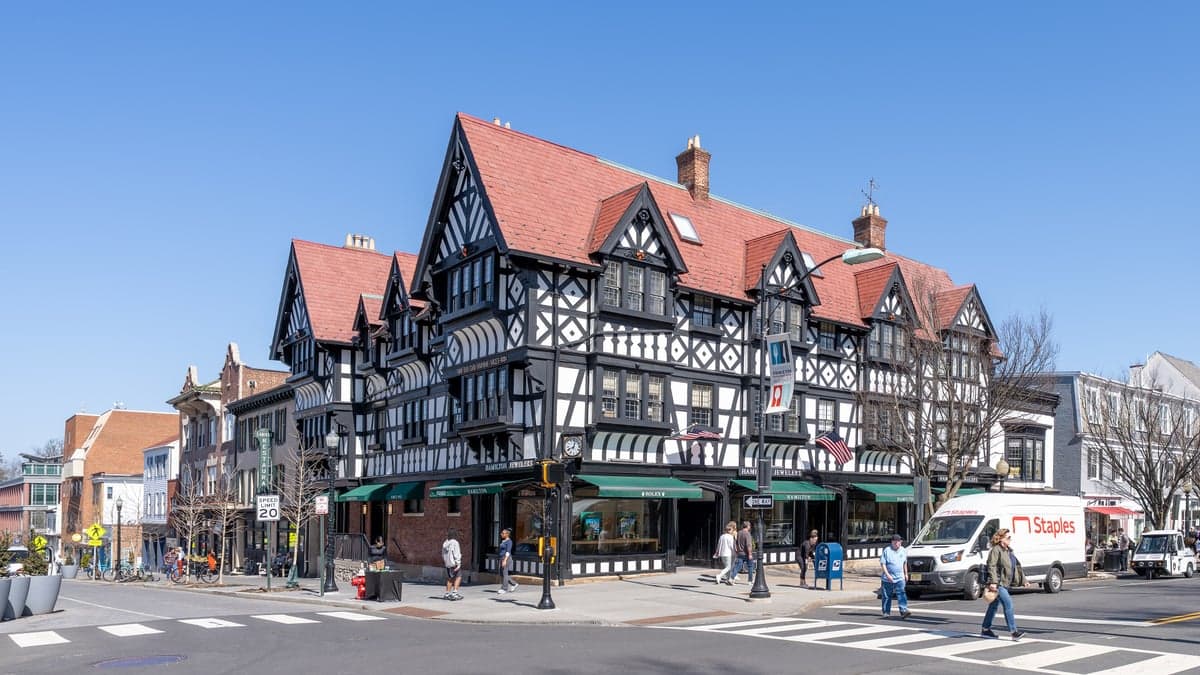
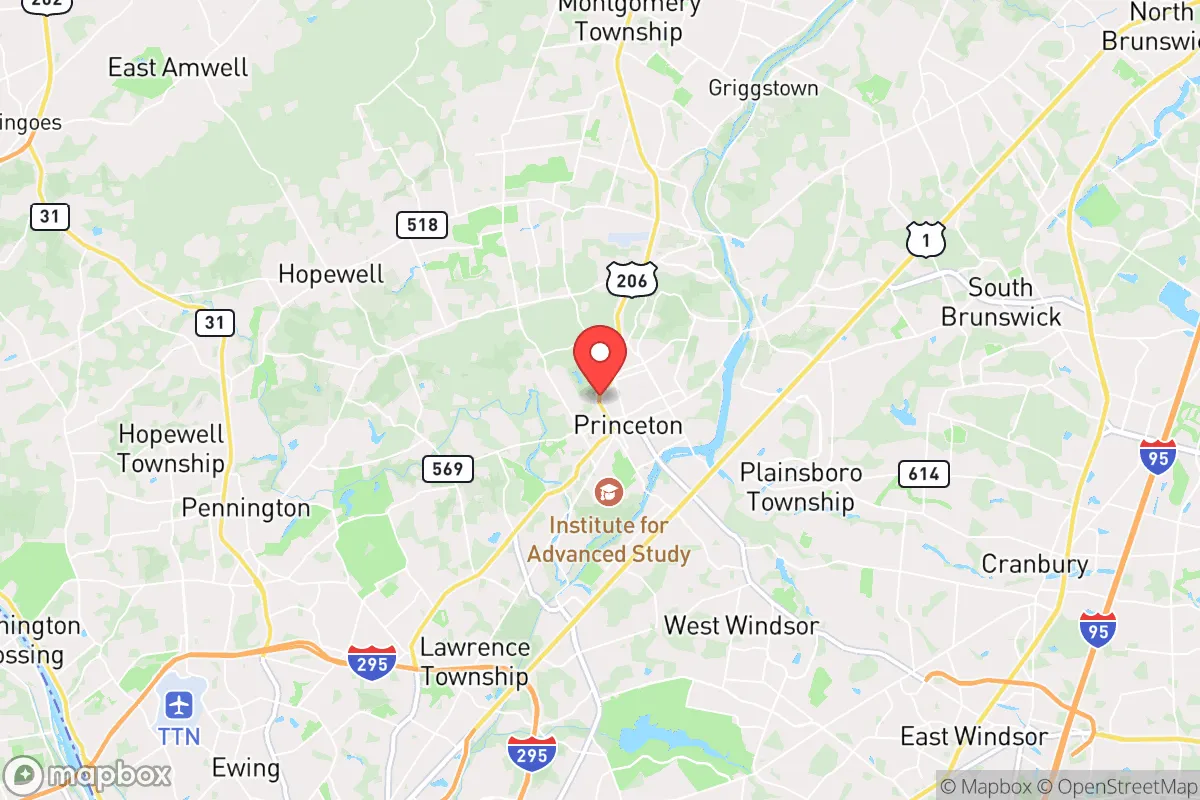
Photo: Wikipedia
Demographics of Princeton, NJ
Affluence Level in Princeton, NJ
A wealthy area with high-earning, well-educated households. Incomes, home values, and educational attainment meaningfully outpace national averages.
People of Princeton, NJ
The people of Princeton, New Jersey, in 2026 form one of the most highly educated and internationally diverse populations in the United States, with 84.6% of adults holding a bachelor's degree or higher and a foreign-born share of 16.4%. The city's 30,451 residents are predominantly white (60.2%), with significant East/Southeast Asian (15.3%), Hispanic (8.1%), Black (6.1%), and Indian-subcontinent (4.4%) communities. Princeton's distinctive identity is shaped by its dual role as a world-class university town and a suburban magnet for knowledge-economy professionals, creating a population that is simultaneously transient and deeply rooted.
How the city was settled and grew
Princeton's original European settlement began in the late 17th century, when Quaker and Dutch farmers from the surrounding region were drawn by land grants along the Millstone River and the King's Highway (now Nassau Street). The founding of the College of New Jersey (now Princeton University) in 1746 in what is now the Nassau Street historic district transformed the settlement from a farming crossroads into a colonial-era intellectual hub. Through the 19th century, the population remained overwhelmingly white and Anglo-Protestant, with the university's faculty and students forming a distinct enclave around the campus core. A small but established Black community developed in the Witherspoon-Jackson neighborhood, historically the city's African American hub, built by families who worked as domestic servants, laborers, and tradespeople for the university and wealthy residents. The arrival of the Princeton Branch railroad in 1865 accelerated growth, drawing commuters and summer residents to the Western Section and Littlebrook areas, which filled with large Victorian homes built by Philadelphia and New York professionals seeking a pastoral retreat.
Modern era (post-1965)
The 1965 Hart-Cellar Immigration Act and the simultaneous expansion of Princeton University's graduate programs triggered the city's first major wave of non-European immigration. East/Southeast Asian faculty and researchers, particularly from China, Korea, and Taiwan, began settling in the Riverside and Princeton North neighborhoods, drawn by proximity to the university and the highly rated Princeton Public Schools. The 1980s and 1990s saw a second wave of Indian-subcontinent professionals, many in technology and pharmaceutical sectors, who concentrated in the Ettl Farm and Terhune subdivisions, where newer single-family homes offered space for multigenerational households. Hispanic growth has been more modest and dispersed, with families settling in the Witherspoon-Jackson area and along the Route 206 corridor, often working in service, construction, and landscaping. The Black population, which peaked at roughly 10% in the 1970s, has declined to 6.1% as older families moved to more affordable suburbs in Mercer and Middlesex counties, though Witherspoon-Jackson remains ack son remains a cultural anchor. Domestic in-migration since 2000 has been dominated by highly educated white professionals from the New York and Philadelphia metros, drawn by the university's employment base and the town's reputation for elite public schools, reinforcing the city's already high educational attainment.
The future
Princeton's population is trending toward greater ethnic diversity but also increasing economic homogenization. The East/Southeast Asian share (15.3%) and Indian-subcontinent share (4.4%) are both growing steadily, driven by university hiring and the expansion of nearby pharmaceutical and tech employers like Bristol Myers Squibb and Siemens. These communities are not tribalizing into isolated enclaves but are assimilating into the broader professional-class fabric, with children attending the same schools and participating in the same extracurriculars. The Hispanic and Black shares are plateauing or declining slightly, largely due to rising housing costs—the median home price exceeds $1 million—which push lower-income families to neighboring towns like Trenton, Hamilton, and Plainsboro. The white share, while still a majority, is slowly declining as the foreign-born population grows. Over the next 10-20 years, Princeton will likely become a majority-minority city in terms of ethnic composition, but it will remain one of the most economically and educationally stratified places in New Jersey, with a population united by high income and advanced degrees but divided by cultural origin.
For someone moving to Princeton now, the city offers a population that is globally connected, intellectually driven, and overwhelmingly oriented toward academic and professional achievement. The trade-off is clear: extraordinary schools and cultural amenities come with a high cost of entry and a social environment that can feel insular to those outside the university or knowledge-economy orbit. Princeton is becoming less a traditional American small town and more a cosmopolitan professional village, where diversity is measured more by country of origin than by class or political outlook.

* Values derived from national, state, county, city and local statistics and may differ in a specific area. Last updated: 2026-05-18T00:17:49.000Z
Narrative content on this page is AI-generated and may contain mistakes. Verify any details that matter before acting on them.
ReloMaps may earn a commission from affiliate links at no extra cost to you.

