Photo: Wikipedia
Demographics of Reading, PA
Affluence Level in Reading, PA
A below-average socioeconomic profile. Incomes, home values, and educational attainment trail the U.S., with higher poverty and unemployment.
People of Reading, PA
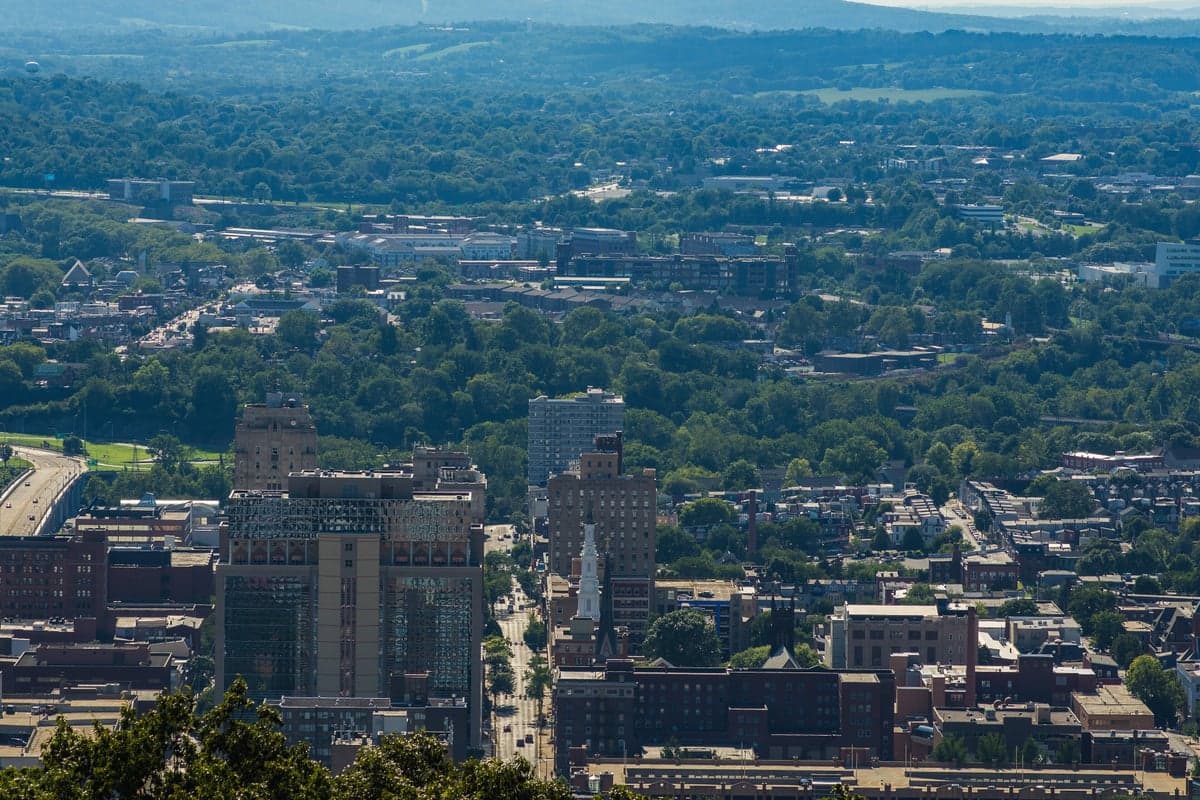
The people of Reading, Pennsylvania today form a dense, majority-Hispanic urban population of 94,836, making it one of the most heavily Latino cities in the Northeast. The city is characterized by a young median age, a high poverty rate, and a distinctive working-class identity rooted in its industrial past and recent immigrant waves. With 68.6% of residents identifying as Hispanic, 20.3% as White, and 7.8% as Black, Reading is a majority-minority city where Spanish is widely spoken and where the downtown and surrounding neighborhoods reflect a vibrant, if economically strained, Latino cultural core.
How the city was settled and grew
Reading was founded in 1748 by William Penn’s sons, Thomas and Richard, as a planned county seat on the Schuylkill River. The original settlers were primarily German-speaking Protestants—Lutherans, Reformed, and Moravians—who gave the city its distinctive Pennsylvania Dutch character. These early families built the Centre Park and Northeast Reading neighborhoods with sturdy brick row homes and churches that still stand today. The city’s growth exploded in the 19th century with the arrival of the Philadelphia and Reading Railroad and the rise of the Reading Iron Works and the Berkshire Knitting Mills. This industrial boom drew successive waves of Irish, Italian, Polish, and Ukrainian immigrants, who settled in dense ethnic enclaves like Glenside and Oakbrook, where Catholic parishes and ethnic social clubs anchored community life. By 1900, Reading was a thriving industrial city of over 78,000, with a heavily white, working-class population.
Modern era (post-1965)
The post-1965 era brought profound demographic change. The Hart-Cellar Immigration Act opened doors to new sources of migration, and simultaneously, the collapse of Reading’s manufacturing base—the railroad, steel, and textile mills—triggered a white exodus to suburban townships like Wyomissing and Spring Township. Into this vacuum came a large wave of Puerto Rican and Dominican migrants, later joined by Central American immigrants from Guatemala, Honduras, and El Salvador. These groups concentrated in the Downtown and Millmont neighborhoods, where affordable row homes and proximity to service jobs made settlement possible. By 2020, the Hispanic share of the population had surged to nearly 70%, while the non-Hispanic White share fell to 20.3%. The Black population, historically small but present since the Great Migration, remains at 7.8% and is concentrated in the Hampden Heights area. East/Southeast Asian communities (0.5%) and Indian-subcontinent residents (0.1%) are tiny but present, mostly in professional households near the city’s edges. The foreign-born share stands at 12.6%, a figure that has stabilized in recent years as chain migration from Latin America has plateaued.
The future
Reading’s population is trending toward homogenization rather than fragmentation. The Hispanic majority is growing slowly through natural increase and continued, albeit reduced, immigration, while the White population continues to age and shrink. The city is not tribalizing into distinct ethnic enclaves so much as consolidating into a single, dominant Latino cultural identity, with Spanish-language media, bodegas, and Catholic churches serving as unifying institutions. The Black and Asian communities remain small and stable, with little new in-migration. The key question for the next 10–20 years is whether Reading can reverse its economic decline—only 11.7% of adults hold a college degree—and retain its younger residents, or whether it will continue to lose population to surrounding Berks County suburbs. Current trends suggest a slow, modest population decline as families with means move outward, but the core city will likely remain a heavily Latino, working-class urban center.
For someone moving in now, Reading offers a dense, walkable, and culturally vibrant city with a strong sense of community among its Hispanic majority, but also faces serious challenges in poverty, education, and public safety. It is not a gentrifying or diversifying city in the typical sense—it is a city that has become overwhelmingly Latino and is likely to stay that way. New residents should expect a place where Spanish is the de facto language of daily commerce and where the city’s future depends on economic revitalization, not demographic change.

* Values derived from national, state, county, city and local statistics and may differ in a specific area. Last updated: 2026-05-01T09:28:52.000Z
Narrative content on this page is AI-generated and may contain mistakes. Verify any details that matter before acting on them.
ReloMaps may earn a commission from affiliate links at no extra cost to you.

