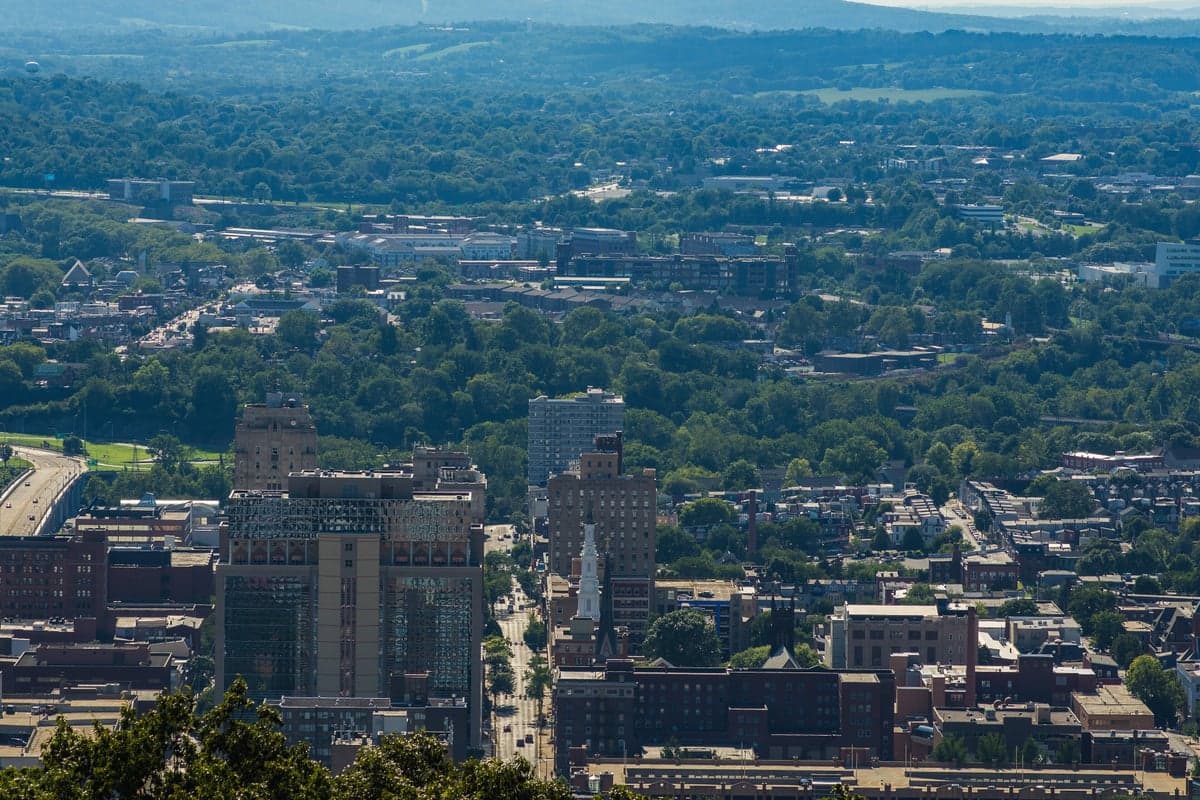
Photo: Wikipedia
Political ClimatePolitical Climate in Reading, PA
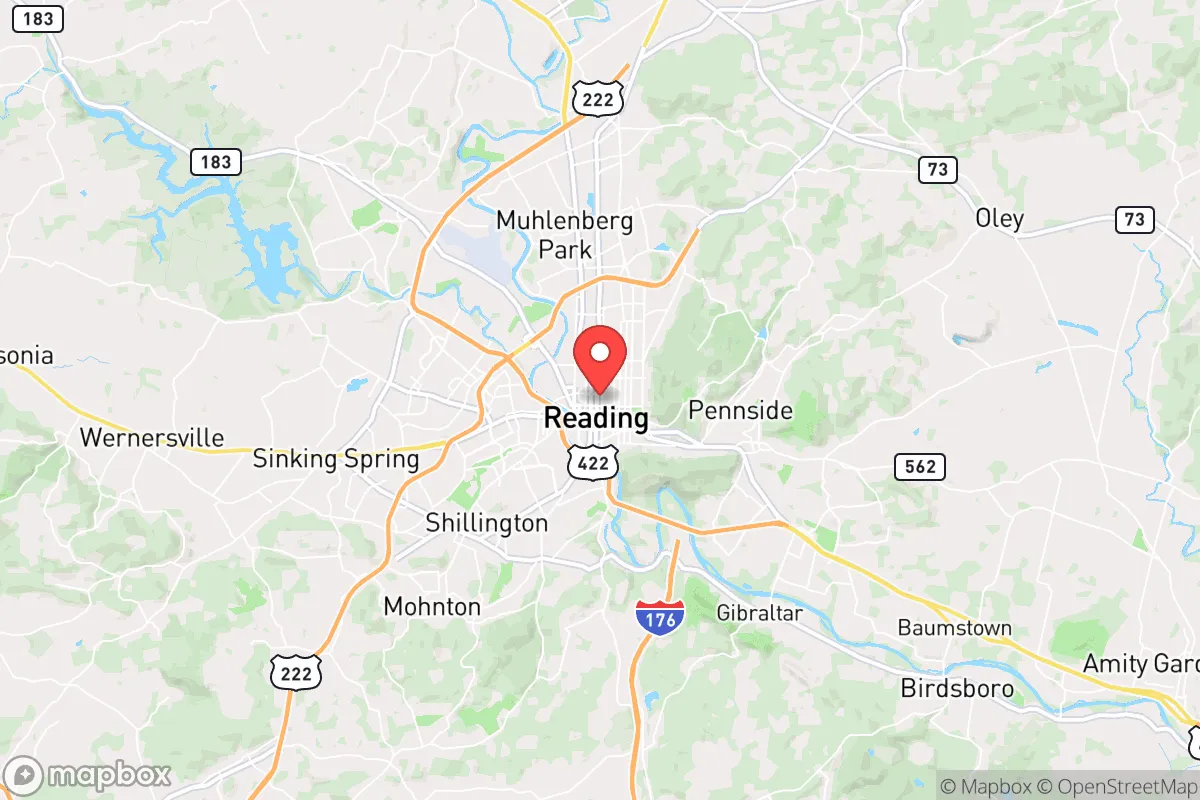
District shown is the primary district for this city’s centroid. Cities may span multiple districts.
Local Political AnalysisPolitical Analysis of Reading, PA
Reading, Pennsylvania, leans heavily Democratic, with a Cook PVI of D+6, but that number doesn't tell the whole story of a city that's been transformed by decades of progressive policy. The city itself has been reliably blue for a long time, but the surrounding Berks County has shifted noticeably leftward in recent cycles, which is a real concern for folks who remember when this area was a bastion of common-sense, working-class values. You used to be able to count on a certain level of fiscal restraint and respect for personal freedoms here, but the last ten years have seen a steady march toward bigger government and more intrusive social policies that make you wonder where it's all headed.
How it compares
If you drive just ten miles outside the city limits, you hit towns like Wyomissing or Shillington, which still feel like the old Reading — more conservative, lower taxes, and a general hands-off attitude from local government. But inside the city proper, the political climate is a different animal entirely. Reading's leadership has embraced the full progressive playbook: sanctuary city policies, heavy-handed zoning that makes it hard to start a small business, and a school board that seems more focused on social experiments than actual education. Compare that to nearby Lebanon or even parts of Lancaster County, where you still see a healthy skepticism of government overreach. The contrast is stark, and it's not just about party labels — it's about whether you trust the people in Harrisburg or City Hall to run your life better than you can.
What this means for residents
For the average person living in Reading, the political climate translates directly into your wallet and your daily freedoms. Property taxes have climbed steadily as the city expands its budget for social programs and administrative bloat, while basic services like road maintenance and public safety have taken a back seat. You'll notice more regulations on everything from how you can use your own property to what kind of signage you can put up for your business. The push for "equity" initiatives has led to some questionable hiring practices and a general sense that merit and personal responsibility don't count for much anymore. If you value the right to make your own choices without a government bureaucrat looking over your shoulder, Reading's trajectory is genuinely worrying. The long-term trend suggests more of the same: higher taxes, more rules, and a culture that increasingly penalizes traditional values.
One of the biggest cultural shifts you'll notice is the erosion of the old neighborhood associations and community groups that used to keep things running smoothly without government interference. Now, it feels like every aspect of daily life — from how you heat your home to what you can teach your kids — is subject to some new ordinance or policy from City Hall. The city's embrace of renewable energy mandates and "green" building codes has driven up costs for homeowners and renters alike, with little tangible benefit. If you're considering a move here, you should know that the political climate isn't just about who wins elections; it's about the creeping sense that your personal freedoms are being traded away for promises of a more "equitable" society that never quite materializes. Reading is a cautionary tale of what happens when a community loses its grip on the principles of limited government and individual liberty.

State Political ClimatePolitical Climate in Pennsylvania
State Political AnalysisPolitical Environment in the State
Pennsylvania has long been a quintessential battleground state, but over the past decade it has shifted from a classic purple swing state to a more polarized, light-blue-leaning commonwealth, driven largely by explosive growth in its southeastern suburbs and a steady erosion of conservative strongholds in the southwest. The state voted for Joe Biden by just over 1 point in 2020 and for Kamala Harris by a similar margin in 2024, but the real story is the geographic sorting: Philadelphia and its collar counties now supply a massive Democratic margin that increasingly overwhelms the red votes from the rest of the state. For a conservative considering relocation, the key question is whether you land in a county that still reflects the old Pennsylvania or one that has already been transformed by the new.
Urban vs. rural divide
The political map of Pennsylvania is a tale of two commonwealths. The southeastern quadrant—Philadelphia, its suburbs in Montgomery, Delaware, and Bucks counties, and the Lehigh Valley around Allentown and Bethlehem—has become a Democratic stronghold. Philadelphia alone delivers roughly 500,000 more Democratic votes than Republican, a margin that has doubled since 2000. Meanwhile, the vast rural and exurban areas—from the northern tier along the New York border down through the central ridges and into the southwest—remain deeply red. Counties like Tioga, Bradford, and Potter routinely vote 70-75% Republican. The critical battleground has been the Pittsburgh suburbs in Allegheny County, which flipped from a reliable red base to a Democratic stronghold over the last two decades, and the Lancaster and York areas, which are growing fast but still lean Republican by 10-15 points. The I-81 corridor through Harrisburg and Scranton is the new frontier: these areas are still competitive but trending left as transplants from New York and New Jersey move in.
Policy environment
Pennsylvania’s state-level policy is a mixed bag that frustrates conservatives. The state has a flat income tax of 3.07%, which is relatively low, but property taxes are among the highest in the nation, averaging over $4,000 annually. There is no state sales tax on groceries or clothing, but the overall tax burden is still above the national median. On regulation, Pennsylvania is a mixed bag: it has a robust oil and gas industry in the Marcellus Shale, but the state imposes a severance tax that is lower than Ohio’s but higher than West Virginia’s. Governor Josh Shapiro, a Democrat elected in 2022, has pushed for expanded background checks on firearms and a $15 minimum wage, though the Republican-controlled state Senate has blocked most of his agenda. Education policy is a flashpoint: the state funds schools through local property taxes, creating massive disparities between wealthy suburbs and poor rural districts. School choice is limited—there is a small tax credit scholarship program but no universal voucher system. Election laws are relatively stable: no-excuse mail-in voting was expanded in 2019 and survived a court challenge, but voter ID is still required at the polls. For conservatives, the policy environment is tolerable but not friendly, with the state government leaning left on social issues while the legislature holds the line on fiscal matters.
Trajectory & freedom
Over the past five years, Pennsylvania has seen a clear trend toward less personal freedom in several key areas. On gun rights, the state passed Act 79 in 2022, which preempts local firearm ordinances, but Philadelphia and Pittsburgh have aggressively challenged it, and the state Supreme Court has allowed some local restrictions to stand. The state also has a universal background check law for handguns and a 48-hour waiting period. On medical freedom, Pennsylvania was one of the few states that kept COVID-19 emergency orders in place well into 2021, and Governor Shapiro has maintained a state of emergency for opioid response that gives him broad executive powers. Parental rights have been a battleground: in 2023, the state legislature passed a bill requiring schools to notify parents of changes in a child’s health services, but Shapiro vetoed it. On property rights, the state’s Act 13 of 2012, which limited local zoning restrictions on oil and gas drilling, was partially struck down by the state Supreme Court in 2023, giving local governments more power to ban fracking. The overall trajectory is concerning: the state is becoming more centralized, with Harrisburg and the courts increasingly overriding local control, especially on gun and energy issues.
Civil unrest & political movements
Pennsylvania has seen its share of political turbulence. The 2020 election aftermath was particularly intense in Philadelphia, where the city’s ballot-counting process became a national flashpoint, leading to months of protests and legal challenges. The Lancaster County area saw a surge in grassroots conservative activism, with groups like the Pennsylvania Freedom Alliance organizing school board takeovers and anti-mandate rallies. On the left, the Pittsburgh area has a strong progressive activist scene, with groups like the Pittsburgh Democratic Socialists of America pushing for defunding the police and rent control. Immigration politics are relatively quiet compared to border states, but Philadelphia is a sanctuary city, and the state has a law that prohibits local police from inquiring about immigration status in most circumstances. Election integrity remains a live issue: the state’s voter rolls were purged of 100,000 names in 2023, but concerns about mail-in ballot security persist. A new resident would notice the political divide most acutely in the suburbs: drive 20 miles west of Philadelphia and you’ll see Trump flags; drive 20 miles east and you’ll see “In This House We Believe” signs. The tension is palpable but rarely violent.
Projection
Looking ahead five to ten years, Pennsylvania is likely to continue its slow drift leftward, driven by demographic trends that favor Democrats. The Philadelphia suburbs are growing faster than the rest of the state, and the influx of out-of-state transplants—especially from New York and New Jersey—is accelerating. The Lehigh Valley (Allentown, Bethlehem, Easton) is a microcosm: it was a swing area in 2016, but by 2024 it had shifted 5 points toward Democrats. Rural areas are losing population, which means their electoral weight is shrinking. The state’s congressional map, drawn by the state Supreme Court in 2022, is likely to remain favorable to Democrats for the rest of the decade. However, there is a wild card: if the state legislature ever passes a school choice bill or a property tax reform that appeals to suburban conservatives, it could slow the exodus of moderate voters. For now, the realistic expectation is that Pennsylvania will be a light-blue state by 2030, with Democratic control of the governorship and the state House becoming the norm. A conservative moving in now should expect to live in a state where state-level politics are increasingly hostile to their values, but where local control in red counties can still provide a buffer.
For a conservative considering Pennsylvania, the bottom line is this: the state is not yet lost, but it is trending in the wrong direction. If you choose to move here, target a red county like Butler, Westmoreland, or York, where local government and school boards still reflect conservative values. Avoid the Philadelphia suburbs and the Lehigh Valley unless you are prepared for a constant political fight. The state’s tax structure is tolerable, its gun laws are restrictive but not draconian, and its election system is stable but contested. The best advice is to treat Pennsylvania as a state where you can live well if you pick your county carefully, but where the state-level political winds are blowing against you. Keep an eye on the 2026 gubernatorial race—if a Republican wins, the trajectory could slow; if not, expect more of the same.
* Values derived from national, state, county, city and local statistics and may differ in a specific area. Last updated: 2026-05-01T09:28:52.000Z
Narrative content on this page is AI-generated and may contain mistakes. Verify any details that matter before acting on them.
ReloMaps may earn a commission from affiliate links at no extra cost to you.

