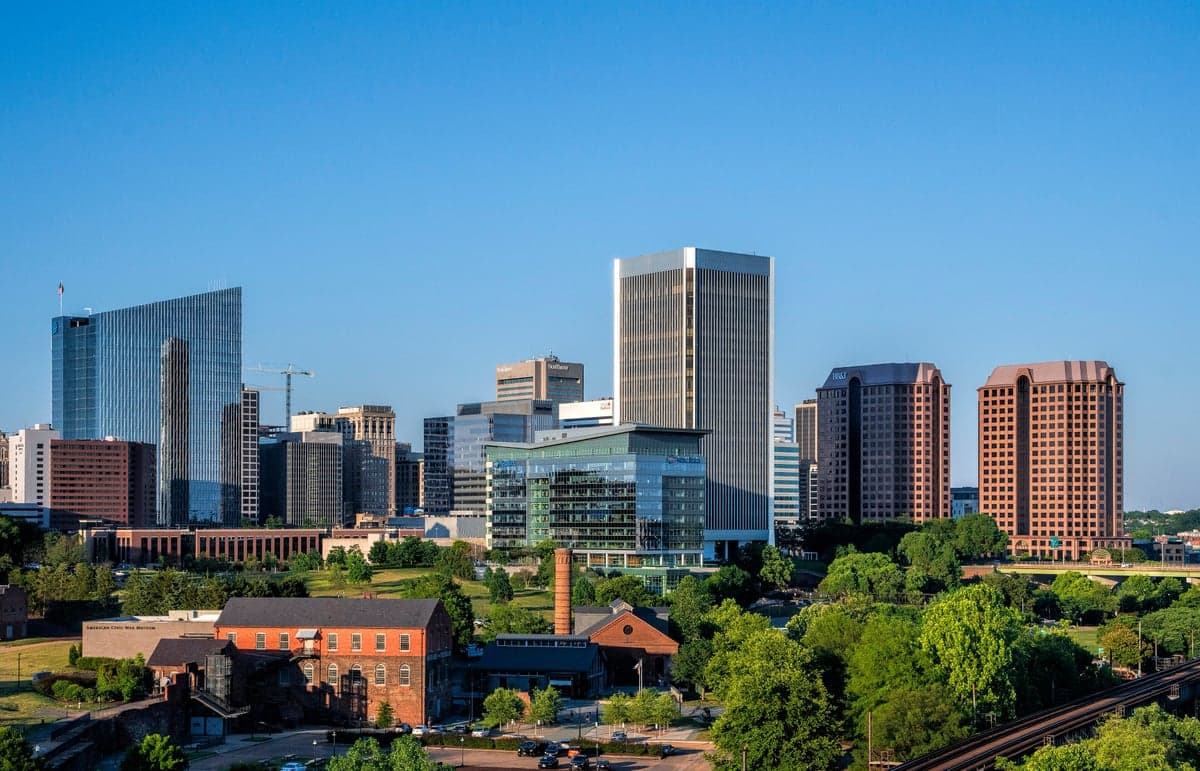
Photo: Wikipedia
Personal Sovereignty in Richmond, VA
Viable for self-reliance. Generally workable, though some barriers may limit total independence.
What does Personal Sovereignty tell us?
Personal Sovereignty measures your capacity for self-reliance and independence with minimal government friction. Higher scores mean fewer barriers between you and the way you want to live... but it assumes you have the space you need and good neighbors.
What does this tell us?
Personal Sovereignty measures your capacity for self-reliance and independence with minimal government friction. Higher scores mean fewer barriers between you and the way you want to live... but it assumes you have the space you need and good neighbors.
State Policy
Energy independence: Importer (20% of energy produced in-state)
Personal Liberty
Homesteading

Personal Liberty Analysis
Richmond, Virginia, presents a deeply mixed picture for the individualist seeking personal sovereignty. While the city itself is governed by a progressive urban machine that often prioritizes collective outcomes over individual autonomy, the broader Commonwealth of Virginia offers a legal framework that can, in places, push back against that tide. For the strategic relocator—particularly one with a survivalist or prepper mindset—Richmond’s viability hinges on understanding where state-level protections end and city-level overreach begins. The bottom line: you can carve out a pocket of autonomy here, but it requires constant vigilance against a local government that views your property, your children, and your medical choices as assets to be managed rather than rights to be respected.
Tax burden and regulatory posture: How much of your income and property stays yours
Virginia is not a low-tax haven, but it is not a confiscatory state either. The state income tax is a flat 5.75% on all income above $17,000, which is moderate compared to high-tax neighbors like Maryland or D.C. However, Richmond’s local tax burden is where the squeeze really happens. The city’s real property tax rate is $1.20 per $100 of assessed value, which is higher than surrounding counties like Henrico ($0.85) or Chesterfield ($0.96). This means your land and improvements are taxed at a premium simply for being inside city limits—a direct hit to anyone trying to build equity or hold property long-term. Sales tax in Richmond is 6.0% (5.3% state plus 0.7% local option), which is standard for Virginia but still a constant leakage from your pocket. For the prepper, the regulatory posture is more concerning: Richmond has a notoriously slow and expensive permitting process for home improvements, and the city’s zoning code is dense and often interpreted arbitrarily. If you want to add a workshop, a root cellar, or a rainwater catchment system, expect to navigate a bureaucratic maze that can take months. The city’s business license tax is also aggressive—anyone operating a home-based business, even a small-scale one, must pay a gross receipts tax starting at $0.36 per $100 of revenue. This is not a jurisdiction that encourages you to keep what you earn; it treats your labor as a revenue stream for the city.
Self-defense and gun law specifics: What you can carry, where, and how fast
Virginia is a shall-issue state for concealed carry, and Richmond does not have its own additional restrictions beyond state law—for now. The state preempts local gun ordinances, meaning the city council cannot ban firearms in parks or impose its own waiting periods. This is a critical protection. You can carry openly or concealed with a permit, and the permit process is straightforward: a background check, a fingerprint submission, and a fee of about $50, with issuance required within 45 days. However, there are two major caveats. First, Richmond is a “sensitive place” minefield: you cannot carry in any school, courthouse, government building, or airport terminal, and the city’s public transit system (GRTC) has posted “no firearms” signs on buses and trains. Second, the political climate in Richmond is hostile to gun rights. The city council has repeatedly passed symbolic resolutions urging the state to enact universal background checks and red flag laws, and the local police department has a reputation for aggressive enforcement of minor firearms violations. For the survivalist, the practical reality is that you can defend your home and person, but you will be treated with suspicion if you exercise that right visibly. Stand-your-ground laws apply statewide, but Richmond juries are not known for being sympathetic to self-defense claims involving firearms. If you use deadly force, expect a lengthy legal battle even if you are legally justified.
Self-reliance and homesteading viability: Lot sizes, zoning, and off-grid feasibility
This is where Richmond struggles most for the prepper. The city’s zoning code is designed for dense urban living, not self-sufficiency. Standard residential lots in the city proper are typically 0.1 to 0.25 acres, with many homes on lots of 5,000 square feet or less. Raising chickens is allowed in most residential zones, but with strict limits: no roosters, and the coop must be at least 25 feet from any dwelling. Beekeeping is permitted with a registration fee and annual inspection. But larger livestock—goats, rabbits for meat, or any animal for slaughter—is prohibited in all residential districts. Rainwater collection is legal in Virginia, but Richmond’s building code requires any system that collects more than 1,000 gallons to have a permit and an approved backflow prevention device. Solar panels are allowed, but the city’s historic overlay districts (which cover large swaths of the Fan, Church Hill, and Jackson Ward) can restrict their placement if they are visible from the street. Off-grid living is effectively impossible within city limits: the city requires connection to municipal water and sewer for any habitable structure, and composting toilets are not recognized as a legal alternative. For the serious homesteader, the only viable option is to buy in the surrounding counties—Henrico, Chesterfield, or Hanover—where lot sizes of 1 to 5 acres are common, zoning is more permissive, and the tax burden is lower. Inside Richmond, you are a renter of your own land, subject to the city’s rules on everything from grass height to the color of your front door.
Personal liberties: Parental rights, medical autonomy, speech, and property
Parental rights in Virginia are protected by state law, but Richmond’s school board has a history of pushing progressive curricula that can conflict with conservative values. The city’s public schools have implemented comprehensive sex education that includes LGBTQ+ content, and there is no formal opt-out process for specific lessons—only a blanket opt-out for the entire health curriculum. Medical autonomy is a bright spot: Virginia does not have a state-level vaccine mandate for adults, and the state’s right-to-try law allows terminally ill patients to access experimental treatments. However, Richmond’s health department has aggressively promoted public health mandates during emergencies, and the city council has shown willingness to impose mask and vaccine requirements on private businesses during declared health crises. Free speech is protected by the First Amendment, but Richmond has a “no camping” ordinance that has been used to disperse political protesters who set up encampments, and the city’s public forum rules require permits for any gathering of more than 50 people on public property. Property rights are the most concerning area: Richmond has a robust eminent domain authority and has used it for economic development projects, including the controversial Navy Hill redevelopment plan that was ultimately defeated but demonstrated the city’s appetite for taking private land for private gain. The city also has a rental inspection program that requires landlords to allow annual inspections of their properties, a clear intrusion on property rights that has been upheld by state courts.
Overall, Richmond offers a fragmented sovereignty. The state provides a baseline of protections—gun rights, parental rights, and a moderate tax structure—but the city government actively works to erode those protections at the local level. For the survivalist or prepper, the calculus is clear: Richmond is a place to work and engage with urban resources, but not a place to build a long-term autonomous homestead. The surrounding counties offer a far better balance of low taxes, permissive zoning, and political culture that respects individual choice. If you must be in the Richmond area for employment or family reasons, live in Henrico or Chesterfield and treat the city as a resource to be used, not a community to be trusted. Your sovereignty will be safer on the other side of the county line.

* Values derived from national, state, county, city and local statistics and may differ in a specific area. Last updated: 2026-05-01T21:27:23.000Z
Narrative content on this page is AI-generated and may contain mistakes. Verify any details that matter before acting on them.
ReloMaps may earn a commission from affiliate links at no extra cost to you.

