Photo: Wikipedia
Political ClimatePolitical Climate in Richmond, VA
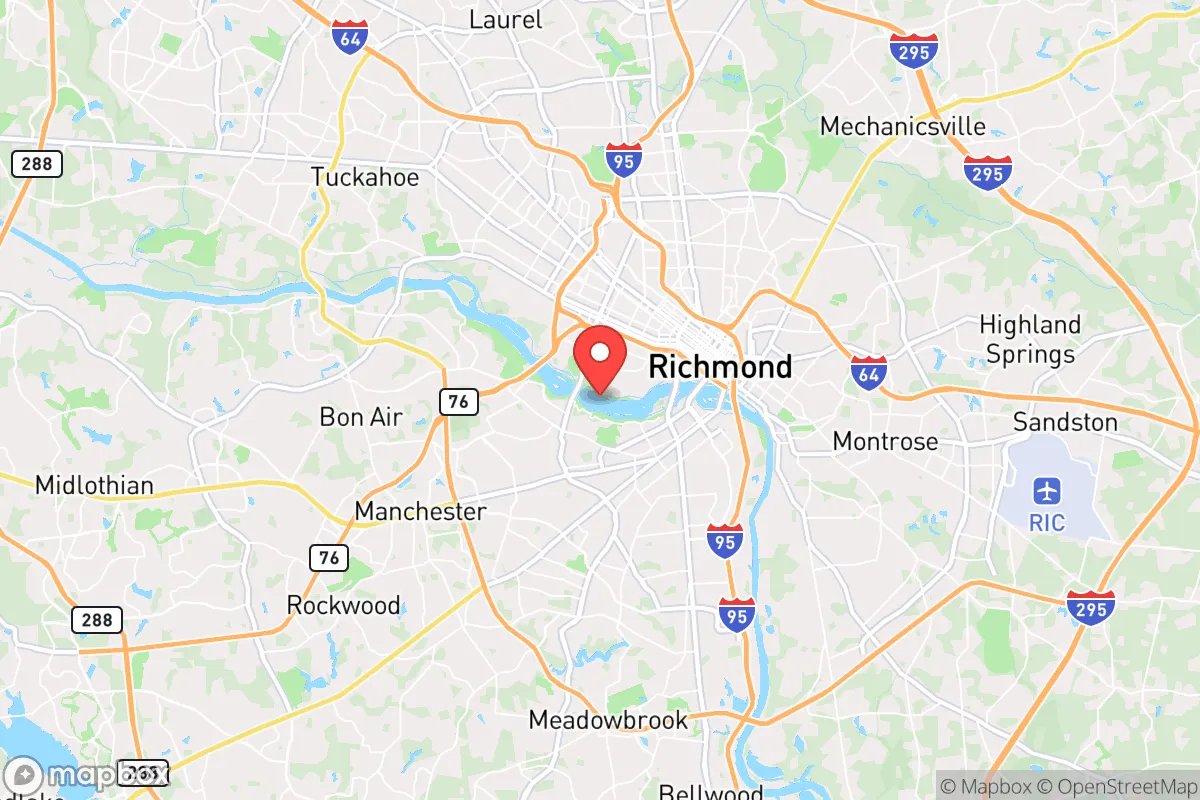
District shown is the primary district for this city’s centroid. Cities may span multiple districts.
Inherited from parent state — no local data available.
Local Political AnalysisPolitical Analysis of Richmond, VA
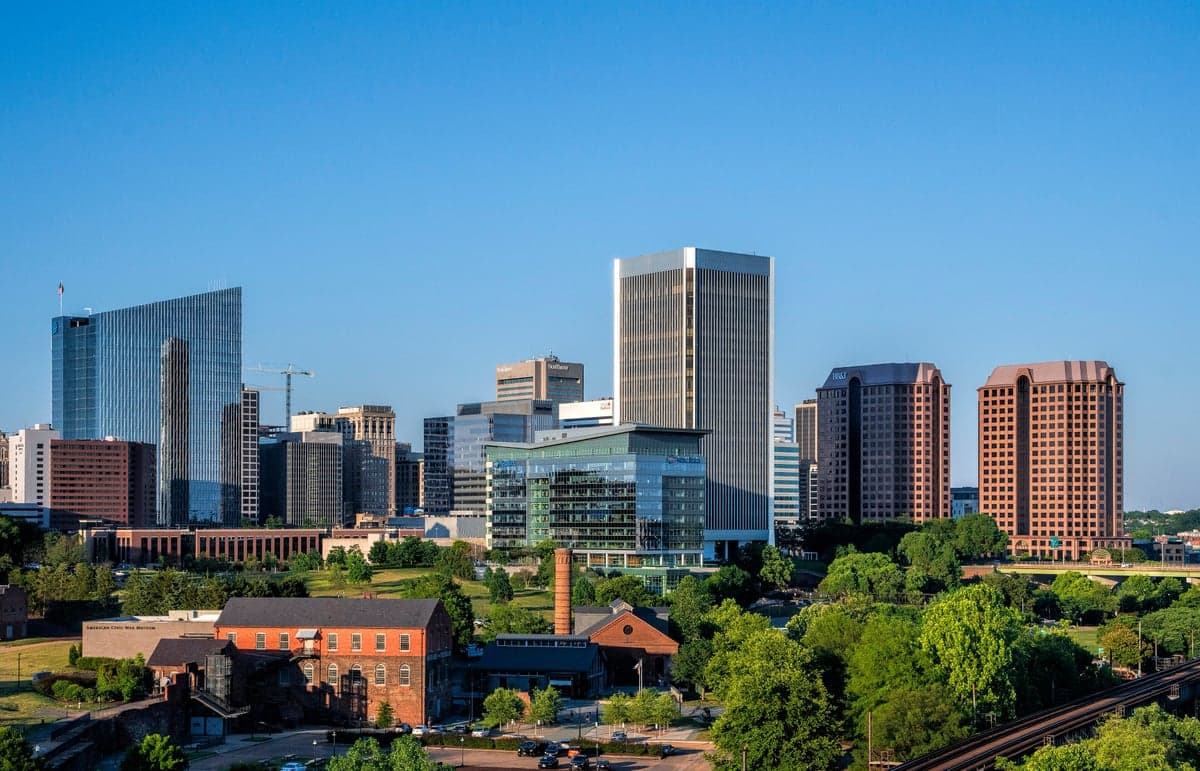
Richmond, Virginia, has a Cook PVI of D+17, meaning it votes about 17 points more Democratic than the national average. That wasn't always the case. I remember when this city was a lot more balanced—you could have a real conversation with your neighbor about local issues without it turning into a political lecture. Now, the city council and mayor's office are firmly in progressive hands, and the trajectory has been a steady march leftward over the past decade. If you're looking for a place where your vote might actually balance things out, Richmond isn't it—you're basically living in a one-party town.
How it compares
Drive 20 minutes west to Henrico County or Chesterfield County, and you'll find a completely different political reality. Henrico has shifted left in recent years, but Chesterfield still leans conservative, especially in the southern and western parts. Go another 30 minutes out to Goochland or Hanover, and you're in solidly red territory—places where people still believe in limited government and personal responsibility. Richmond itself is an island of deep-blue politics surrounded by a sea of purple and red. The contrast is stark: you can leave the city limits and feel like you've entered a different country, where property taxes are lower, school boards aren't pushing controversial curriculum, and the local government isn't constantly trying to regulate how you live your life.
What this means for residents
For those who value personal freedoms and limited government, living in Richmond means constantly fighting an uphill battle. The city has embraced progressive policies that many of us see as government overreach—things like expanding the city's authority over housing through zoning changes that make it harder to own a single-family home without jumping through hoops, or pushing for higher taxes to fund programs that don't always deliver results. The school board has become a battleground over curriculum and parental rights, and if you have kids in Richmond Public Schools, you've probably felt the pressure of a system more focused on social engineering than on reading, writing, and arithmetic. The city council has also flirted with defunding the police, which has led to slower response times in some neighborhoods. It's not the Richmond I grew up in—where you could trust that your local leaders would focus on keeping the streets safe and the taxes low, not on chasing the latest national trend from California or New York.
On the cultural side, Richmond has always had a unique identity—it's a historic city with a strong sense of place. But lately, that identity has been overshadowed by a push to remove statues, rename streets, and rewrite history in a way that feels more like erasure than education. The city's leadership seems more interested in making a political statement than in preserving what made Richmond special. If you're considering a move here, just know that your voice on local issues will be one of many, and it's likely to be drowned out by a well-funded progressive machine. The long-term outlook? Unless there's a major shift in who shows up to vote, Richmond will keep moving left, and those who value individual liberty and fiscal restraint will find themselves increasingly out of step with their own local government.

State Political ClimatePolitical Climate in Virginia
State Political AnalysisPolitical Environment in the State
Virginia has shifted from a reliably purple swing state to a solidly blue-leaning commonwealth over the past 15 years, driven primarily by explosive growth in the Washington D.C. suburbs. While the state still elects Republican governors in off-year cycles (Glenn Youngkin in 2021), the General Assembly has been under Democratic control since 2020, and the state’s electoral votes have gone blue in every presidential election since 2008. The real story, however, is the widening chasm between the urban crescent—Northern Virginia, Richmond, and Hampton Roads—and the rest of the state, where conservative values still hold strong in places like Lynchburg, Roanoke, and the Shenandoah Valley.
Urban vs. rural divide
The political map of Virginia is a tale of two commonwealths. The urban crescent—Fairfax County, Loudoun County, Prince William County, and the City of Alexandria—now accounts for over half the state’s population and votes overwhelmingly Democratic. In 2024, Fairfax County gave Kamala Harris a 40-point margin, while Loudoun, once a swing county, delivered a 25-point blue margin. Meanwhile, Southside Virginia (counties like Pittsylvania, Halifax, and Mecklenburg) and the Shenandoah Valley (Rockingham, Augusta, Frederick counties) vote Republican by 30-40 points. The Richmond suburbs are a microcosm: Chesterfield County, once reliably red, has trended purple, while Henrico County is now solidly blue. The Hampton Roads region is split—Virginia Beach leans purple, Norfolk is deep blue, and Chesapeake remains competitive. The rural-urban divide is not just about population density; it’s about culture, economics, and a growing sense that the state government in Richmond no longer represents the interests of rural Virginians.
Policy environment
Virginia’s tax burden is moderate compared to neighboring Maryland, but it’s creeping upward. The state income tax rate is a flat 5.75% (down from 5.75% under Youngkin’s push, but still higher than many southern states). Property taxes are set locally, with Loudoun County averaging around 1.2% of assessed value—a significant cost for families. The regulatory posture is increasingly progressive: the Virginia Clean Economy Act mandates a 100% carbon-free grid by 2050, which has driven up electricity costs. Education policy is a flashpoint: Governor Youngkin’s 2022 executive order on “inherently divisive concepts” in schools was largely symbolic, as local school boards in Fairfax and Arlington counties have doubled down on DEI initiatives and gender-inclusive policies. The state’s election laws are among the most liberal in the South—no voter ID requirement (photo ID is requested but not mandatory), same-day voter registration, and no-excuse absentee voting. For conservatives, the policy environment feels like a slow-motion takeover by Northern Virginia’s progressive agenda, with rural areas having little say.
Trajectory & freedom
Virginia’s trajectory over the past five years has been a steady erosion of personal freedoms from a conservative perspective. The 2020 General Assembly, under Democratic control, passed a sweeping gun control package: universal background checks, a “one handgun a month” limit, and a red flag law (the “Extreme Risk Protective Order” law) that allows police to seize firearms without a criminal conviction. In 2021, the state abolished the death penalty. On medical freedom, Virginia was one of the first states to mandate COVID-19 vaccines for state employees and healthcare workers—a policy that remains in place. Parental rights have taken a hit: the 2020 “Virginia Values Act” added sexual orientation and gender identity to the state’s nondiscrimination laws, which has been used to pressure schools into allowing biological males in girls’ sports and locker rooms. The 2022 “Right to Contraception Act” codified access to birth control and abortion, but also opened the door to taxpayer-funded abortion. On the positive side for conservatives, Youngkin’s 2023 executive order on “restoring excellence in education” did roll back some DEI mandates in K-12, but the legislature blocked his efforts to ban critical race theory. The bottom line: Virginia is becoming less free for those who value gun rights, parental authority, and medical autonomy.
Civil unrest & political movements
Virginia has been a national flashpoint for political violence and activism. The 2017 “Unite the Right” rally in Charlottesville left one counter-protester dead and exposed deep racial and ideological fault lines. Since then, left-wing activist groups like “Showing Up for Racial Justice” (SURJ) and “Virginia Defenders” have been highly organized, particularly in Richmond and Arlington. The 2020 George Floyd protests in Richmond saw the toppling of Confederate statues and a year-long occupation of the Capitol grounds. On the right, the “Virginia Citizens Defense League” (VCDL) has held massive annual Lobby Day rallies at the Capitol, drawing thousands of gun rights activists. Immigration politics are tense: Prince William County and Fairfax County have declared themselves “sanctuary cities,” refusing to cooperate with ICE detainers—a policy that has frustrated conservative residents. Election integrity remains a hot-button issue: the 2020 election saw widespread use of drop boxes and mail-in ballots, and a 2021 audit of Loudoun County found discrepancies in 1,200 ballots, though no fraud was proven. The 2023 school board meetings in Loudoun County became national news after a sexual assault case involving a transgender student, sparking massive parental protests. For a new resident, the political atmosphere is charged—you’ll see yard signs, bumper stickers, and heated Nextdoor debates in every suburb.
Projection
Over the next 5-10 years, Virginia will continue its blueward drift, driven by in-migration from D.C. and the Northeast. The 2030 census will likely add another seat in Northern Virginia, further diluting rural representation. The Republican Party’s only hope is to hold the governor’s mansion in 2025 and 2029, but even then, the General Assembly will remain Democratic. Expect more gun control, more DEI mandates in schools, and higher taxes to fund the state’s green energy mandates. The one wild card is the Hampton Roads region: if military families and defense contractors (who lean conservative) continue to move to Chesapeake and Suffolk, it could slow the blue trend. But the reality is that Virginia is becoming a version of Maryland—a state where conservatives can live comfortably in rural enclaves but have little influence over state policy. For a conservative family moving in now, expect to find a state where your vote in state elections is largely irrelevant unless you live in a swing district like Virginia Beach or Chesterfield.
For a new resident, the practical takeaway is this: Virginia offers beautiful landscapes, strong job markets (especially in defense and tech), and decent schools in the suburbs, but the political climate is increasingly hostile to conservative values. If you value low taxes, gun rights, and local control over schools, you’ll want to target specific counties—Loudoun’s rural west, Fauquier County, or the Shenandoah Valley—where the local culture still aligns with your values. But understand that state-level policies will continue to tighten. Virginia is a state where you can carve out a conservative life, but you’ll be swimming against the current in Richmond.
* Values derived from national, state, county, city and local statistics and may differ in a specific area. Last updated: 2026-05-01T21:27:23.000Z
Narrative content on this page is AI-generated and may contain mistakes. Verify any details that matter before acting on them.
ReloMaps may earn a commission from affiliate links at no extra cost to you.

