Photo: Wikipedia
Demographics of Ripley, WV
Affluence Level in Ripley, WV
A low-income area with significant economic hardship. Household wealth and educational attainment are well below national averages.
People of Ripley, WV
The people of Ripley, West Virginia today number 3,066, forming a predominantly white (93.7%) community with a small but notable East/Southeast Asian presence (2.9%) and a Hispanic share of 1.9%. The city has zero foreign-born residents and no Black or Indian-subcontinent population, making it one of the most ethnically homogeneous small towns in the Mid-Ohio Valley. Ripley’s identity is rooted in its role as the Jackson County seat, with a working-class character shaped by local manufacturing, healthcare, and county government employment, and a population density of roughly 1,100 people per square mile.
How the city was settled and grew
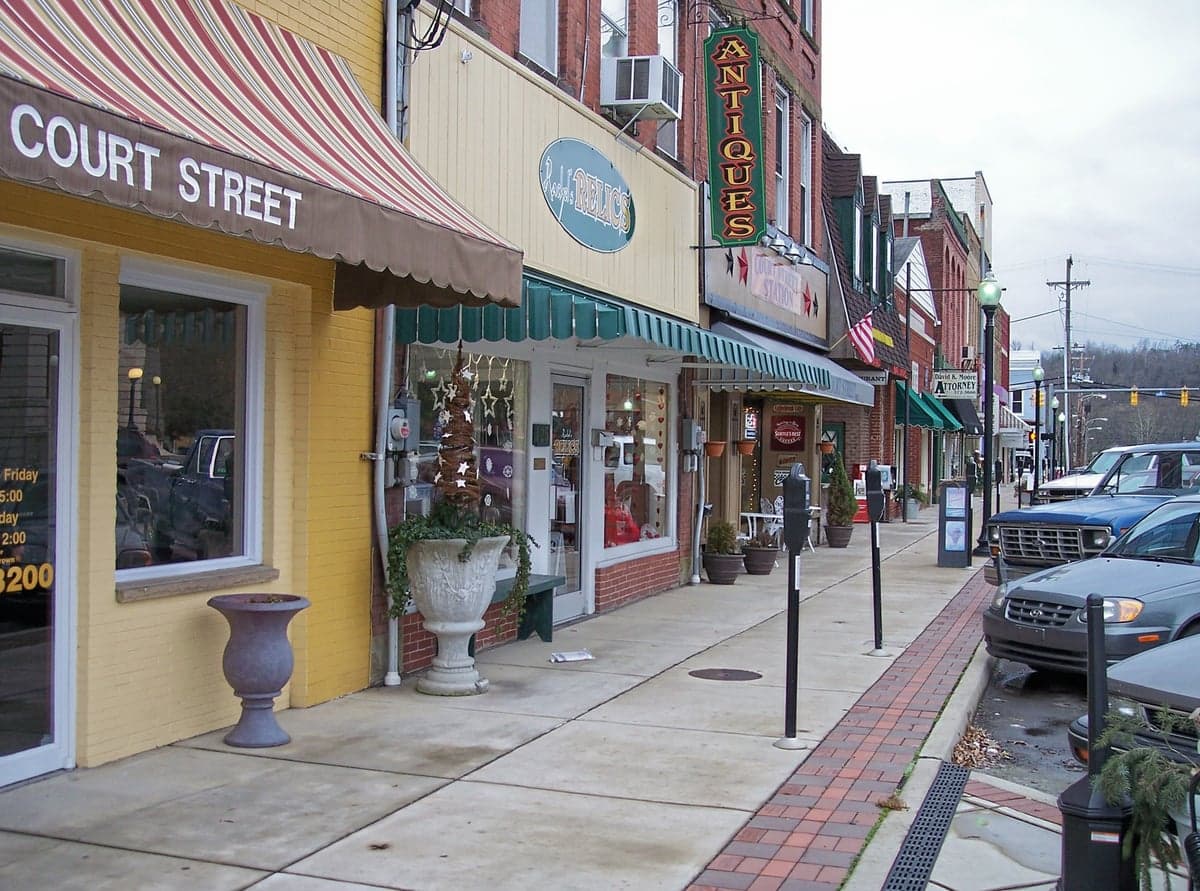
Ripley was founded in 1832 as the county seat of newly formed Jackson County, named after a local landowner and politician. The original settlers were primarily of English, Scots-Irish, and German ancestry, moving westward from Virginia’s Shenandoah Valley and eastern Pennsylvania. They were drawn by cheap land grants in the Ohio River watershed and the promise of subsistence farming along the Mill Creek and Sandy Creek valleys. The earliest homes clustered around the courthouse square, forming what is now Historic Downtown Ripley, where many 19th-century brick storefronts still stand. By the 1850s, a second wave of German Catholic families settled in the North Ripley area near the Baltimore & Ohio Railroad depot, establishing St. Michael’s Church and a small brewery district. The town grew slowly through the late 1800s as a market center for surrounding farms, with a population of just 800 by 1900. A third wave arrived during the 1910s–1930s, when the South Side neighborhood developed around the new Ravenswood Glass Plant and the Jackson County Hospital, attracting workers from rural Appalachia and a handful of Italian stonemasons who built the county’s stone bridges.
Modern era (post-1965)
After the 1965 Immigration Act, Ripley saw virtually no foreign-born influx—the foreign-born share remains 0.0% today. Instead, the city’s post-1965 demographic story is one of domestic out-migration and suburbanization. From the 1970s through the 1990s, many younger residents left for larger cities like Charleston and Columbus, while the Fairplains subdivision (developed in the 1980s) attracted commuters working at the nearby Kaiser Aluminum plant in Ravenswood and the federal prison in Glenville. The Ripley Heights area, a hillside district west of downtown, grew in the 1990s and 2000s as a bedroom community for Jackson County government employees and teachers. The East/Southeast Asian population (2.9%) is a recent phenomenon, concentrated almost entirely in the Ripley Business Park area, where a small number of Filipino and Vietnamese families settled after being recruited for engineering and technical roles at the local NGK Spark Plugs plant (opened 2005). The Hispanic share (1.9%) is scattered across the city, with no single enclave, and consists mainly of Mexican-origin families working in agriculture and construction. The Black population has been zero since at least 1990, and the Indian-subcontinent population remains zero.
The future
Ripley’s population is projected to remain stable or decline slightly over the next decade, mirroring West Virginia’s broader demographic trend of aging and out-migration. The city is not homogenizing further—it is already at the floor of ethnic diversity—but it is tribalizing into two distinct enclaves: the older, white, native-born population concentrated in the Historic Downtown and North Ripley neighborhoods, and a smaller, younger, more transient group in the Ripley Heights and Fairplains subdivisions who commute to regional employers. The East/Southeast Asian community is plateauing, with no new recruitment waves expected from NGK Spark Plugs, and the Hispanic population is slowly assimilating into the white majority through intermarriage. No new immigrant communities are likely to arrive, given the lack of refugee resettlement programs and the city’s distance from major interstate corridors. The college-educated share (20.3%) is below the national average and is unlikely to rise significantly, as most degree-holding residents are older professionals in government and education.
For someone moving in now, Ripley is becoming a stable, aging, and ethnically uniform small town where the population is shrinking slightly and the remaining residents are increasingly rooted in local government and manufacturing. The city offers low crime, low cost of living, and a tight-knit social fabric, but little demographic change or growth is expected in the next 10–20 years. New arrivals will find a community that values continuity over change, with most social life revolving around churches, the county fair, and high school sports.

* Values derived from national, state, county, city and local statistics and may differ in a specific area. Last updated: 2026-04-24T11:44:14.000Z
Narrative content on this page is AI-generated and may contain mistakes. Verify any details that matter before acting on them.
ReloMaps may earn a commission from affiliate links at no extra cost to you.

