Photo: Wikipedia
Demographics of Roanoke, TX
Affluence Level in Roanoke, TX
A middle-class area roughly in line with national averages across income, home values, education, and employment.
People of Roanoke, TX
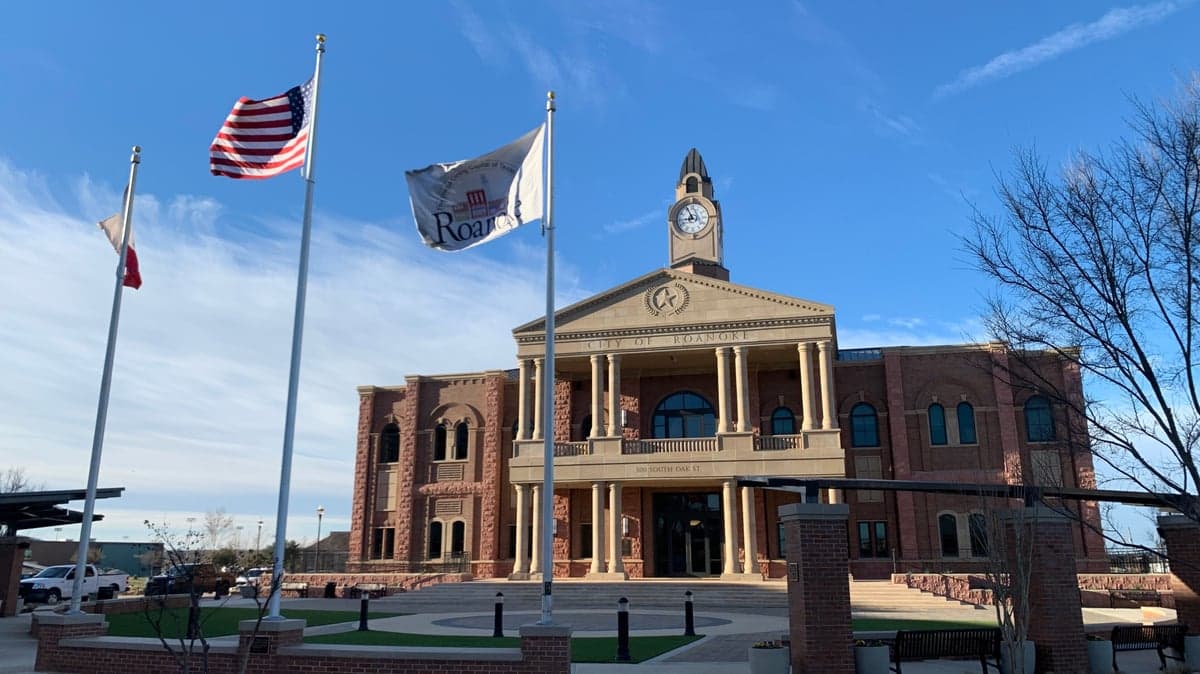
Today, Roanoke, Texas is a rapidly growing suburban city of nearly 10,000 residents, known for its small-town feel and strong family-oriented character. The population is predominantly White (59.0%) with a significant Hispanic minority (21.4%), alongside growing East/Southeast Asian (5.3%) and Indian subcontinent (1.9%) communities. Nearly half of adults hold a college degree (47.5%), reflecting an educated, professional workforce drawn by the city’s location in the booming Dallas-Fort Worth metroplex. Roanoke’s identity is shaped by its historic downtown, the “Unique Dining Capital of Texas” nickname, and a blend of longtime ranching families with newer suburbanites.
How the city was settled and grew
Roanoke’s human history begins in the 1880s, when the Texas and Pacific Railway laid tracks through the area, attracting settlers to what was then a farming and ranching outpost. The town was officially founded in 1881 and named after Roanoke, Virginia, by railroad officials. The original population consisted of Anglo-American homesteaders and farmers, many of whom were drawn by the promise of fertile blackland soil for cotton and grain. These early families built homes in what is now Old Town Roanoke, the historic core centered around Byron Street and the railroad depot. A small number of African American families also settled in the area during this period, working as sharecroppers and laborers, though their numbers remained modest. By the early 20th century, Roanoke remained a quiet agricultural community, with a population that hovered around 300 until the post-World War II era.
Modern era (post-1965)
The modern transformation of Roanoke began in earnest after the 1965 Hart-Cellar Immigration Act, though the city’s growth was initially driven more by domestic suburbanization than international migration. The completion of State Highway 114 and the expansion of the Dallas-Fort Worth International Airport in the 1970s made Roanoke accessible to commuters. Subdivisions like Oak Creek and Willow Creek were developed in the 1980s and 1990s, attracting middle-class White and Hispanic families from Dallas and Fort Worth seeking larger lots and lower taxes. The Hispanic population grew steadily during this period, with many families settling in the South Roanoke area near Highway 377, drawn by affordable housing and proximity to construction and service jobs. The 2000s saw an influx of East/Southeast Asian professionals, particularly in the Preserve at Roanoke and Lakes of Roanoke neighborhoods, as tech and finance workers from the DFW corridor sought newer, larger homes. The Indian subcontinent community, though smaller, has concentrated in the same master-planned subdivisions, reflecting a pattern of educated, high-income immigrants moving directly into suburban enclaves. The Black population (4.5%) remains relatively small and is dispersed across the city, with no single dominant neighborhood.
The future
Roanoke’s population is heading toward continued diversification, though the pace is moderate compared to larger DFW suburbs. The foreign-born share (7.9%) is below the national average, suggesting that future growth will come primarily from domestic migration rather than new immigration. The Hispanic population is expected to rise gradually, driven by natural increase and continued movement from nearby cities, while the East/Southeast Asian and Indian communities are likely to grow as the city’s reputation for good schools and new housing spreads. The city is not tribalizing into distinct ethnic enclaves; rather, neighborhoods like Preserve at Roanoke and Oak Creek are becoming more mixed, with White, Hispanic, and Asian families living side by side. The biggest demographic shift may be generational: as Baby Boomer ranchers sell land to developers, the city is filling with younger families, lowering the median age and increasing demand for parks, schools, and family amenities. Over the next 10-20 years, Roanoke will likely become more educated, more diverse, and more suburban, but it will retain its core identity as a safe, family-oriented community with a strong sense of local history.
For someone moving in now, Roanoke offers a stable, growing environment where traditional values meet modern suburban convenience. The population is becoming more diverse but remains predominantly White and Hispanic, with a strong emphasis on community and schools. Newcomers will find a city that is still small enough to know your neighbors but connected enough to access the full DFW economy, making it a practical choice for families and professionals seeking a balanced, low-crime lifestyle.

* Values derived from national, state, county, city and local statistics and may differ in a specific area. Last updated: 2026-05-11T19:32:13.000Z
Narrative content on this page is AI-generated and may contain mistakes. Verify any details that matter before acting on them.
ReloMaps may earn a commission from affiliate links at no extra cost to you.

