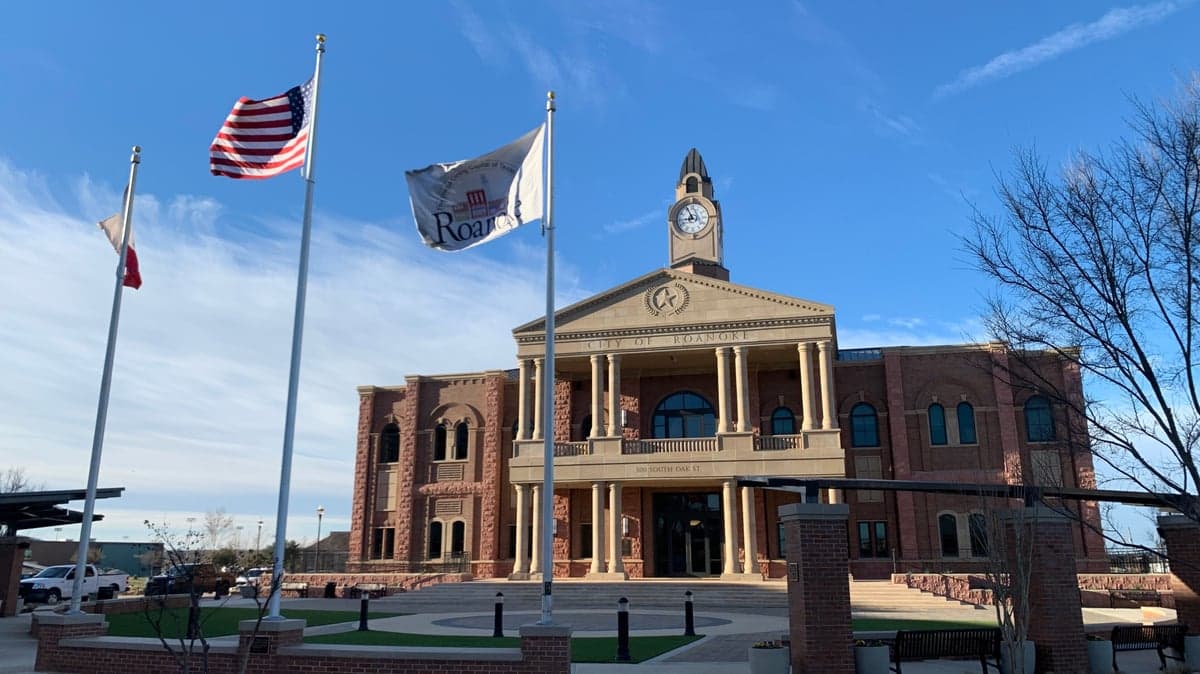
Photo: Wikipedia
Political ClimatePolitical Climate in Roanoke, TX
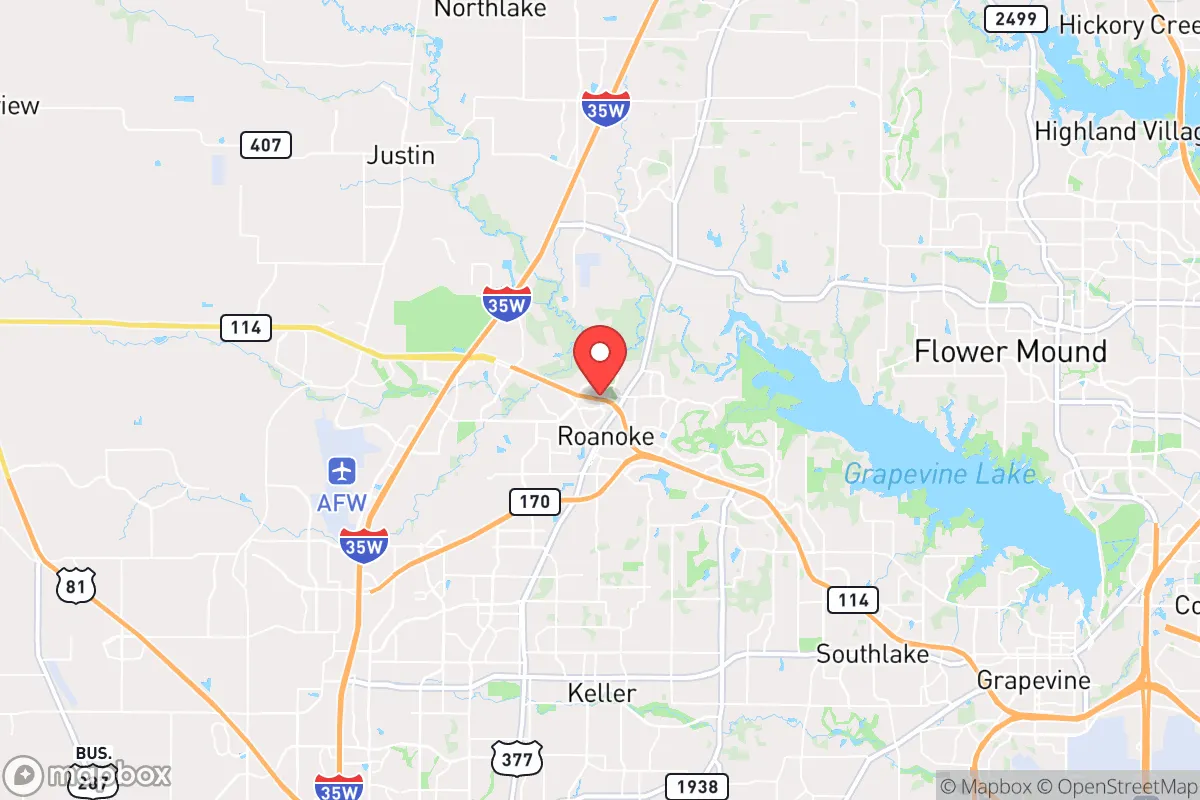
District shown is the primary district for this city’s centroid. Cities may span multiple districts.
Local Political AnalysisPolitical Analysis of Roanoke, TX
Roanoke, Texas, has long been a solidly conservative stronghold, and that hasn't changed much even as the Metroplex has grown around it. With a Cook PVI of R+11, this town leans significantly more Republican than the state of Texas as a whole, which sits at R+4. In practical terms, that means you’ll find a lot of folks here who value limited government, personal responsibility, and the Second Amendment—values that feel increasingly under threat in some of the bigger cities nearby.
How it compares
When you stack Roanoke up against the broader Texas political landscape, the difference is stark. The state’s R+4 rating already makes it a reliably red state, but Roanoke’s R+11 puts it in a whole other league. Drive 20 minutes east to Denton, and you’ll hit a college town that’s been trending blue for years—Denton County itself is still red, but the city council there has been flirting with progressive policies like sanctuary city ordinances and higher property taxes. Head south to Fort Worth, and while Tarrant County was once a GOP stronghold, it’s now a battleground where you see more and more government overreach creeping in, especially around zoning and business mandates. Roanoke, by contrast, has held the line. The local elections here rarely see serious progressive challengers, and the city council tends to focus on keeping taxes low and letting people live their lives without a bunch of red tape. It’s a place where you can still buy a gun without a two-week wait and where your small business won’t get buried in regulations from city hall.
What this means for residents
For someone living in Roanoke, the political climate translates into a daily life that feels more free and less micromanaged than in many parts of Texas. You won’t see mask mandates or vaccine passports being pushed here—local leaders generally trust residents to make their own health decisions. Property taxes are a concern everywhere in Texas, but Roanoke’s city government has been more restrained than neighboring towns like Flower Mound or Highland Village, which have seen bigger budget increases for pet projects. The downside? As the Metroplex expands, you’re seeing more transplants moving in from blue states, and some of them bring ideas about “community standards” that sound a lot like government control. There’s a real risk that if Roanoke doesn’t stay vigilant, it could start sliding toward the kind of progressive policies that have hurt places like Austin—where housing costs have skyrocketed and crime has gotten worse thanks to soft-on-crime district attorneys. For now, though, the conservative majority here keeps things grounded.
One thing that sets Roanoke apart culturally is its no-nonsense approach to local governance. You won’t find a bunch of feel-good resolutions about national issues taking up city council time—they stick to roads, water, and public safety. The police department is well-funded and respected, and there’s a strong sense that law and order comes before social experiments. If you’re looking for a place where your rights aren’t treated as negotiable, Roanoke is still that town. But keep an eye on the school board races—that’s where the progressive push often starts, and it’s already happening in nearby Keller and Southlake. Roanoke’s best defense is staying informed and showing up to vote in every local election, not just the big ones. The future here depends on whether the old-school conservative values hold strong against the tide of change coming from the cities.

State Political ClimatePolitical Climate in Texas
State Political AnalysisPolitical Environment in the State
Texas has been a reliably Republican state for decades, with a Cook PVI of R+4, but that headline number masks a deeply complex and shifting political landscape. The dominant coalition has long been a mix of socially conservative rural voters, business-friendly suburbanites, and a growing libertarian-leaning population drawn by low taxes and minimal regulation. Over the last 10-20 years, the state has seen a slow but steady erosion of its GOP dominance, driven by explosive growth in the blue-leaning metros of Austin, Dallas, Houston, and San Antonio, while the rural and exurban areas have only hardened their conservative stance.
Urban vs. rural divide
The political map of Texas is a tale of two worlds. The major urban centers—Austin (Travis County), Dallas (Dallas County), Houston (Harris County), San Antonio (Bexar County), and El Paso (El Paso County)—have become Democratic strongholds, often voting blue by margins of 15 to 30 points. These cities are the engines of the state's population growth, attracting a mix of young professionals, tech workers, and diverse immigrant communities. In contrast, the vast rural and small-town areas—places like Lubbock, Amarillo, Tyler, and Midland-Odessa—vote Republican by similarly lopsided margins. The real battleground is the suburbs and exurbs. Counties like Collin (north of Dallas), Denton, and Fort Bend (southwest of Houston) have been trending purple. In 2020, Fort Bend County flipped to Biden after years of GOP control, a clear warning sign for conservatives. Meanwhile, the Rio Grande Valley, once a Democratic stronghold, has shown surprising shifts toward the GOP in recent cycles, with counties like Zapata and Starr seeing double-digit swings to the right.
Policy environment
Texas remains a low-tax, low-regulation state, which is its primary selling point for conservatives. There is no state income tax, and property taxes, while high, are offset by a robust homestead exemption and a 10% cap on annual appraisal increases. The regulatory posture is business-friendly, with minimal red tape for everything from building permits to occupational licensing. On education, the state has leaned into school choice, with the 2023 passage of a universal Education Savings Account (ESA) program that lets parents use state funds for private school or homeschooling. Healthcare policy is a mixed bag: Texas did not expand Medicaid under the ACA, keeping government out of that system, but the state also has some of the highest uninsured rates in the country. Election laws have been a flashpoint. The 2021 Senate Bill 1 tightened voter ID requirements, banned drive-through and 24-hour voting, and gave partisan poll watchers more access—all moves that conservatives argue protect election integrity but that progressives decry as suppression. The state also has a constitutional carry law (permitless carry) for handguns, passed in 2021, and a near-total ban on abortion (trigger law) that went into effect after Dobbs.
Trajectory & freedom
On balance, Texas has been moving in a direction that expands personal liberty for conservatives, though not without some worrying countercurrents. The 2021 permitless carry law (HB 1927) was a major win for gun rights, allowing law-abiding adults to carry a handgun without a license. The 2023 ESA program (HB 3) expanded parental freedom in education. The state also passed a law in 2023 banning COVID-19 vaccine mandates by private employers (SB 7), a clear stand for medical autonomy. However, there are red flags. The 2021 election law (SB 1) was a double-edged sword: while it tightened security, it also gave the state government more power to override local election officials, which some see as a centralization of authority. On property rights, Texas has strong eminent domain protections, but the rapid growth in cities like Austin and Dallas has led to increased zoning and land-use restrictions that can feel like government overreach. The biggest concern for freedom-minded residents is the creeping influence of progressive policies in the blue cities—things like sanctuary city ordinances in Austin and Dallas, which conflict with state law and create a patchwork of enforcement that can feel chaotic.
Civil unrest & political movements
Texas has seen its share of political flashpoints. The 2020 Black Lives Matter protests in Austin and Houston were large and occasionally violent, leading to property damage and a lasting sense of unease in those downtown areas. The border crisis has been a constant source of tension, with Governor Abbott's Operation Lone Star deploying state troopers and National Guard to the border, often clashing with the Biden administration's policies. This has created a visible, ongoing political spectacle in border towns like El Paso and Eagle Pass. On the right, the "Texit" movement—advocating for secession—has gained some grassroots traction, though it remains a fringe idea. Election integrity remains a hot-button issue, with many conservatives still skeptical of the 2020 results in the state's large, Democrat-run counties. You'll see "Stop the Steal" rallies in smaller towns and persistent calls for a forensic audit of Harris County's 2020 election. The most visible daily flashpoint for a new resident might be the constant political billboards along highways—everything from anti-abortion messages to "Defund the Police" counter-protests—and the occasional protest at the state capitol in Austin.
Projection
Over the next 5-10 years, Texas is likely to become more competitive at the statewide level, but it will not flip blue overnight. The in-migration from California and other blue states is a double-edged sword: many of these newcomers are fleeing high taxes and regulation, making them natural conservatives, but they also bring cultural and political baggage that can shift suburban precincts leftward. The GOP's challenge is to hold the suburbs while the cities grow. The state's Republican leadership is aware of this and is likely to double down on conservative policies—further school choice expansion, tighter border security, and more election integrity measures—to keep the base energized. The biggest wildcard is the Hispanic vote. If the GOP continues to make inroads with working-class Hispanic voters in the Rio Grande Valley and around Houston, the state could remain red for another generation. If not, the suburbs will continue to drift. A new resident moving in now should expect to see a state that is still fundamentally conservative in its laws and culture, but with increasingly loud and visible progressive pockets in the major cities. The political fights will only get more intense, not less.
For someone relocating to Texas, the bottom line is this: you are moving to a state that, on paper, protects your freedom to keep your money, raise your kids, and defend your home. But you need to choose your county carefully. If you want a reliably conservative environment, look at the exurbs of Dallas (like Frisco or McKinney) or the Houston suburbs (like Katy or Cypress). If you move into Austin or Dallas proper, you will be living in a blue city with all the progressive policy experiments that entails—higher taxes, more regulation, and a very different cultural vibe. The state will protect your rights from the top down, but local governments have a lot of power to make your daily life more or less free. Do your homework on the county and city you choose, because in Texas, the real political action is at the local level.
* Values derived from national, state, county, city and local statistics and may differ in a specific area. Last updated: 2026-05-11T19:32:13.000Z
Narrative content on this page is AI-generated and may contain mistakes. Verify any details that matter before acting on them.
ReloMaps may earn a commission from affiliate links at no extra cost to you.

