Photo: Wikipedia
Demographics of Rochester, NH
Affluence Level in Rochester, NH
A middle-class area roughly in line with national averages across income, home values, education, and employment.
People of Rochester, NH
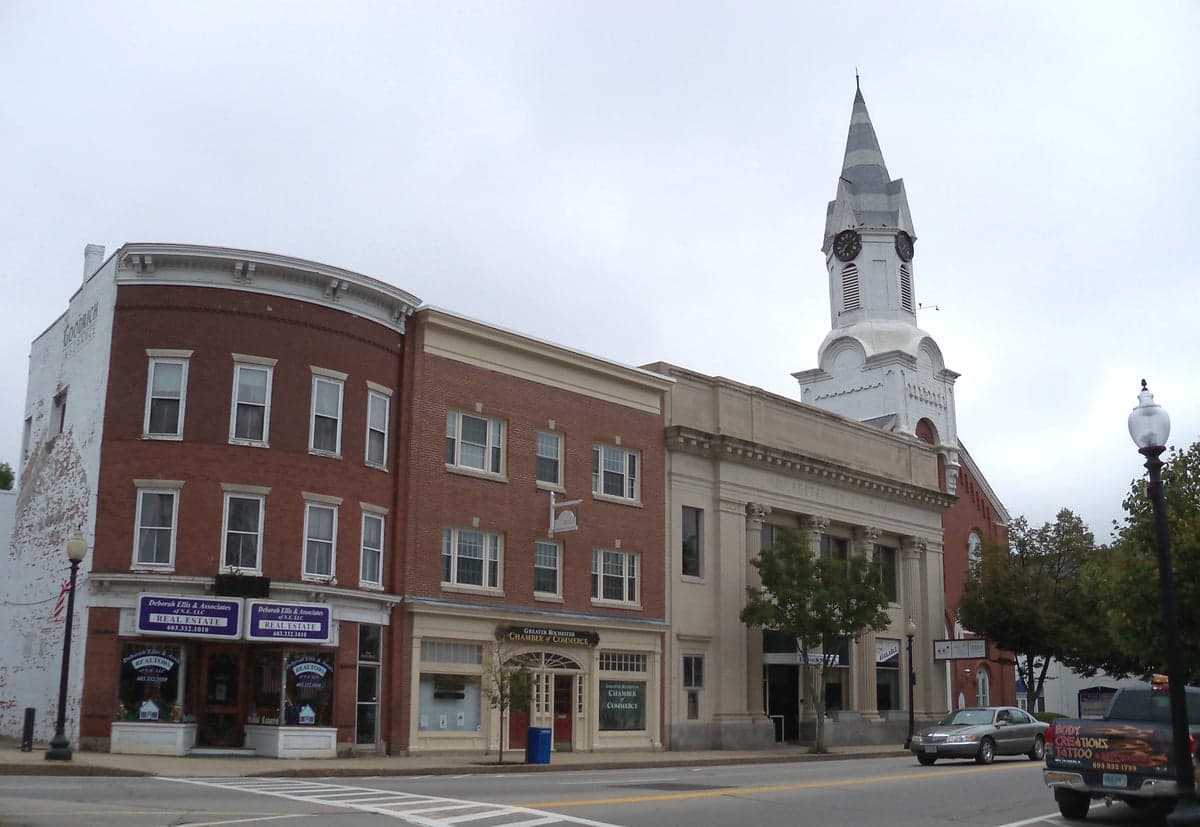
The people of Rochester, New Hampshire, today form a predominantly white, working- and middle-class community of 32,866 residents, with a character shaped by its industrial roots and recent suburban growth. The city is notably less diverse than the state average, with 92.3% of residents identifying as white, a foreign-born population of just 1.0%, and small Hispanic (1.7%), Black (0.8%), East/Southeast Asian (0.9%), and Indian-subcontinent (0.9%) communities. Rochester retains a distinct identity as a former mill town that has evolved into a regional commercial hub, where a sense of local pride and self-reliance remains strong among families who have lived here for generations.
How the city was settled and grew
Rochester was first settled in 1728 as part of a land grant from the Masonian proprietors, who offered parcels to attract English colonists from Massachusetts and coastal New Hampshire. The original settlers were primarily farmers of English and Scottish descent, who established homesteads along the Cocheco River and what is now the Rochester Neck area, the city’s oldest residential district. The arrival of the Boston & Maine Railroad in the 1840s transformed the town, drawing Irish immigrants to build the rail lines and later to work in the burgeoning shoe and textile mills. These Irish families settled in the Gonic village section, a distinct neighborhood along the river that still retains a dense, walkable mill-housing character. A second wave of French-Canadian laborers arrived from Quebec between 1880 and 1910, recruited for the mills and shoe factories; they concentrated in the East Rochester district, where St. Leo’s Church and French-language parochial schools anchored the community. By 1900, Rochester was a classic New England mill town, with a population that was overwhelmingly white, Catholic, and working-class, and these ethnic enclaves remained largely intact through the mid-20th century.
Modern era (post-1965)
The post-1965 period brought no major wave of foreign immigration to Rochester; the city’s foreign-born share has remained below 2% for decades, a stark contrast to the national trend. Instead, the most significant demographic shift has been domestic in-migration from southern New Hampshire and Massachusetts, driven by Rochester’s relatively affordable housing and its location along the Spaulding Turnpike. This suburbanization began in the 1970s and accelerated after 2000, as families priced out of Portsmouth and Dover moved north. Newer subdivisions such as Hanson Pines and Rochester Hill attracted these arrivals, who are predominantly white, college-educated at rates slightly above the city average (26.7% overall), and more likely to commute to jobs in the Seacoast region. The small Hispanic and East/Southeast Asian populations that exist today are largely concentrated in the Downtown area, near rental housing and service-sector jobs, while the Indian-subcontinent community is scattered across newer developments and is not clustered in a single neighborhood. The city’s Black population remains very small (0.8%) and is dispersed, with no historically Black neighborhood. Overall, Rochester has not experienced the ethnic enclave formation seen in larger cities; instead, the city has become more homogenously white as older French-Canadian and Irish identities have assimilated into a broader, undifferentiated American identity.
The future
Rochester’s population is projected to continue growing slowly, driven by continued domestic in-migration from the expensive Seacoast region rather than by international immigration. The city’s foreign-born share is likely to remain below 2% for the foreseeable future, as there is no major employer or refugee resettlement program attracting newcomers from abroad. The Hispanic and East/Southeast Asian communities may grow modestly through secondary migration from larger cities, but they will likely remain small and dispersed rather than forming distinct enclaves. The Indian-subcontinent population, currently 0.9%, is similarly unlikely to cluster. The dominant trend is homogenization: as older ethnic neighborhoods like Gonic and East Rochester lose their distinct character through generational turnover and new construction, the city is becoming a more uniform, predominantly white, middle-class suburb. For a conservative-leaning individual or family moving in now, this means joining a community where the population is stable in its racial and ethnic composition, where English is the near-universal language, and where the cultural touchpoints are those of small-city New England rather than a multicultural metropolis.
Rochester is becoming a quieter, more suburban version of its mill-town past — a place where the population is aging slightly, growing slowly, and remaining overwhelmingly white and native-born. For someone seeking a community with a strong sense of local identity, low demographic churn, and a population that shares a common cultural background, Rochester offers a stable and predictable environment. The city is not diversifying rapidly, and its future demographic trajectory is one of gradual, homogeneous growth rather than transformation.

* Values derived from national, state, county, city and local statistics and may differ in a specific area. Last updated: 2026-04-22T23:05:57.000Z
Narrative content on this page is AI-generated and may contain mistakes. Verify any details that matter before acting on them.
ReloMaps may earn a commission from affiliate links at no extra cost to you.

