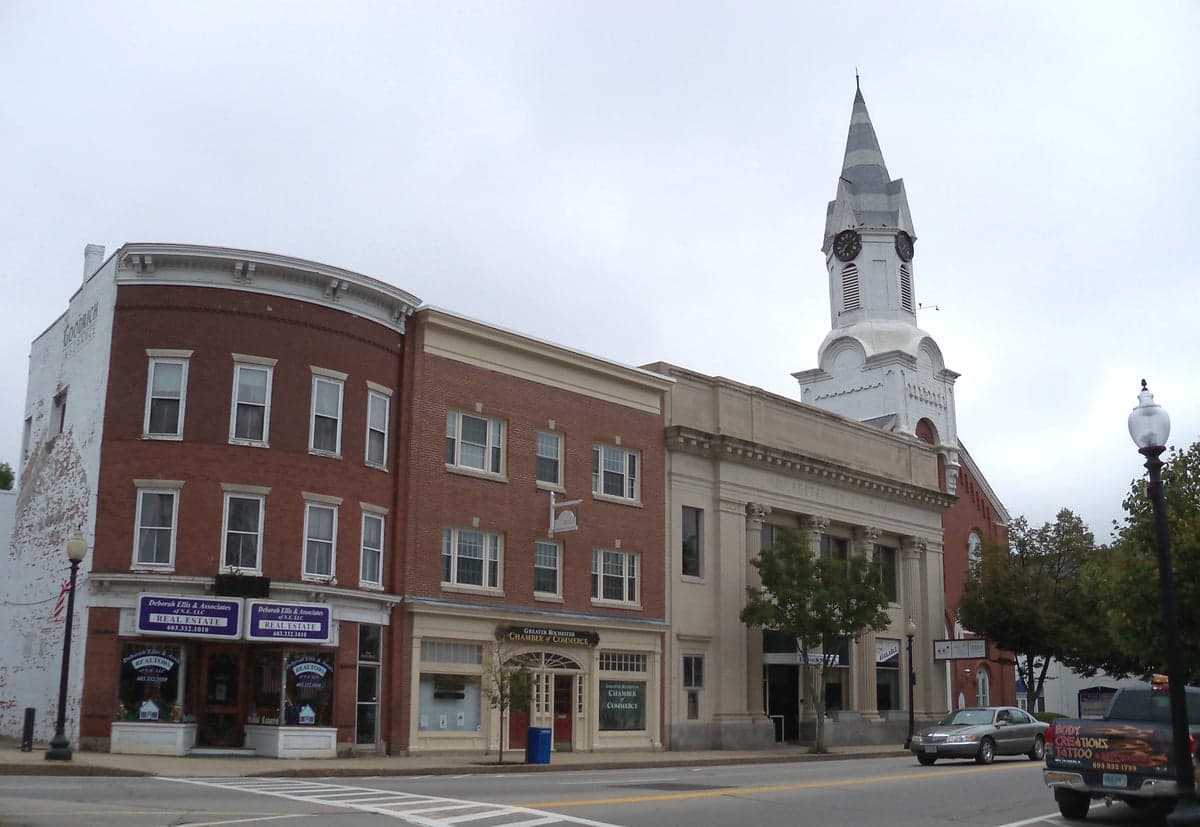
Photo: Wikipedia
Personal Sovereignty in Rochester, NH
Viable for self-reliance. Generally workable, though some barriers may limit total independence.
What does Personal Sovereignty tell us?
Personal Sovereignty measures your capacity for self-reliance and independence with minimal government friction. Higher scores mean fewer barriers between you and the way you want to live... but it assumes you have the space you need and good neighbors.
What does this tell us?
Personal Sovereignty measures your capacity for self-reliance and independence with minimal government friction. Higher scores mean fewer barriers between you and the way you want to live... but it assumes you have the space you need and good neighbors.
State Policy
Energy independence: Importer (10% of energy produced in-state)
Personal Liberty
Homesteading

Personal Liberty Analysis
Rochester, New Hampshire, offers a notably high degree of personal sovereignty compared to much of the Northeast, largely because the state’s Live Free or Die ethos is not just a slogan but a legal and cultural reality. For the individual or family operating from a survivalist or prepper mindset, this means fewer layers of government intrusion into daily life, from how you heat your home to how you educate your children. While no location is a perfect fortress against federal overreach, Rochester sits in a state that consistently ranks among the most resistant to broad mandates, making it a strategic base for those prioritizing autonomy and self-reliance.
Tax burden and regulatory posture: How New Hampshire’s structure protects your wallet and choices
New Hampshire’s tax structure is a major draw for anyone looking to minimize government extraction from their income and property. The state has no state income tax on wages or salaries and no state sales tax, which means every dollar you earn or spend stays in your control. For a prepper or conservative household, this eliminates two of the most common tools governments use to fund programs you may not support. Property taxes in Rochester are moderate for the region—around $25 to $30 per $1,000 of assessed value—but this is the primary local revenue source, so you get a direct say in municipal spending through local elections. The regulatory environment is similarly lean. New Hampshire does not have a state-level building code for single-family homes in most rural areas, and Rochester’s zoning is relatively permissive compared to Massachusetts or southern New England. There are no state-mandated energy codes forcing you into expensive green retrofits, and the state’s right-to-work laws mean you are not forced into union membership or dues to hold a job. This regulatory posture gives you breathing room to build, repair, and live without needing a dozen permits for basic improvements.
Self-defense and gun law specifics: What the Second Amendment looks like in practice
For anyone serious about self-defense and preparedness, New Hampshire is one of the strongest Second Amendment states in the country. Rochester residents benefit from constitutional carry—no permit is required to carry a concealed firearm, whether you are in town or on your own land. The state also has no firearm registration, no waiting periods, and no magazine capacity restrictions. You can legally own suppressors, short-barreled rifles, and other NFA items without state-level roadblocks, as long as you comply with federal law. Stand-your-ground laws are in effect, meaning you have no duty to retreat before using deadly force if you are lawfully present and believe you or another person faces imminent harm. Castle doctrine protections extend to your home, vehicle, and workplace. For the prepper, this means you can stockpile ammunition, train with standard-capacity magazines, and carry openly or concealed without worrying about a patchwork of local ordinances—Rochester cannot pass its own gun laws that are stricter than the state’s. The only notable restriction is that you cannot carry in federal buildings, courthouses, or secure areas of airports, which is standard nationwide. This legal environment gives you maximum latitude to prepare for worst-case scenarios without the government tracking your inventory or limiting your tools.
Self-reliance and homesteading viability: Lot sizes, zoning, and off-grid feasibility in Rochester
Rochester’s mix of suburban and rural zoning makes it a viable location for serious self-reliance projects, though you need to choose your parcel carefully. The city allows agricultural uses on lots of two acres or more in most residential zones, and many properties in the outskirts are on five to ten acres, giving you room for gardens, chicken coops, or even a small orchard. Zoning does not prohibit rainwater collection, and there are no state-level restrictions on drilling a private well—many homes in the area already rely on well water. For off-grid energy, New Hampshire has no net metering mandate that forces you to sell power back to the grid at unfavorable rates, and you can install solar panels without a state permit for systems under 10 kW. However, Rochester does have a building code for electrical work, so you will need a licensed electrician for grid-tied systems. The real advantage is that there are no state laws banning composting toilets, greywater systems, or alternative heating like wood stoves, which are common in the region. For the prepper, this means you can set up a property that runs independently of municipal water, sewer, and power without constant government oversight. The biggest hurdle is local zoning for things like keeping livestock—chickens are generally allowed, but pigs or goats may require a special exception on smaller lots. If you buy a parcel outside the city’s urban growth boundary, you have even more freedom to build a homestead that can sustain you through supply chain disruptions or grid failures.
Personal liberties: Parental rights, medical autonomy, speech, and property protections
New Hampshire has some of the strongest parental rights protections in the country, which is critical for families who want to control their children’s education and medical decisions. The state has no mandatory vaccination laws for school attendance—parents can claim a religious or philosophical exemption without hassle. Homeschooling is straightforward: you simply file a one-time notice with the local school district and provide a basic curriculum outline; there are no state-mandated testing requirements or home visits. Rochester’s school district is generally cooperative with homeschoolers, and many families participate in local co-ops or hybrid programs. On medical autonomy, New Hampshire does not have a state-level vaccine passport system, and during the COVID-19 era, it was one of the few states that never imposed a statewide mask mandate. The state also has a right-to-try law for terminally ill patients and no state-level restrictions on ivermectin or hydroxychloroquine prescriptions by licensed doctors. For free speech, there are no state laws that criminalize offensive speech or create hate speech categories beyond what the First Amendment already protects. Property rights are strong: New Hampshire has no state-level inheritance tax, and the estate tax only kicks in above $6.4 million, so your land and assets pass to your heirs without the government taking a cut. Eminent domain is rarely abused, and the state’s right-to-farm law protects agricultural operations from nuisance lawsuits, which matters if you plan to run a small homestead or sell eggs and produce.
Overall, Rochester offers a level of personal sovereignty that is rare in the Northeast and competitive with many parts of the Mountain West or Midwest. The combination of no income tax, constitutional carry, minimal zoning for rural properties, and strong parental rights creates an environment where you can live largely on your own terms. Compared to states like New York, Massachusetts, or California, where government overreach into healthcare, education, and self-defense is the norm, Rochester feels like a refuge. It is not a libertarian utopia—you still pay property taxes, follow federal laws, and deal with local building permits in the city center—but for the survivalist or prepper who wants to build a resilient, independent life without constant state interference, this is one of the best options in the region. The key is to buy land outside the densest parts of town, get involved in local politics to keep the regulatory climate favorable, and take full advantage of the freedoms New Hampshire’s legal framework provides.

* Values derived from national, state, county, city and local statistics and may differ in a specific area. Last updated: 2026-04-22T23:05:57.000Z
Narrative content on this page is AI-generated and may contain mistakes. Verify any details that matter before acting on them.
ReloMaps may earn a commission from affiliate links at no extra cost to you.

