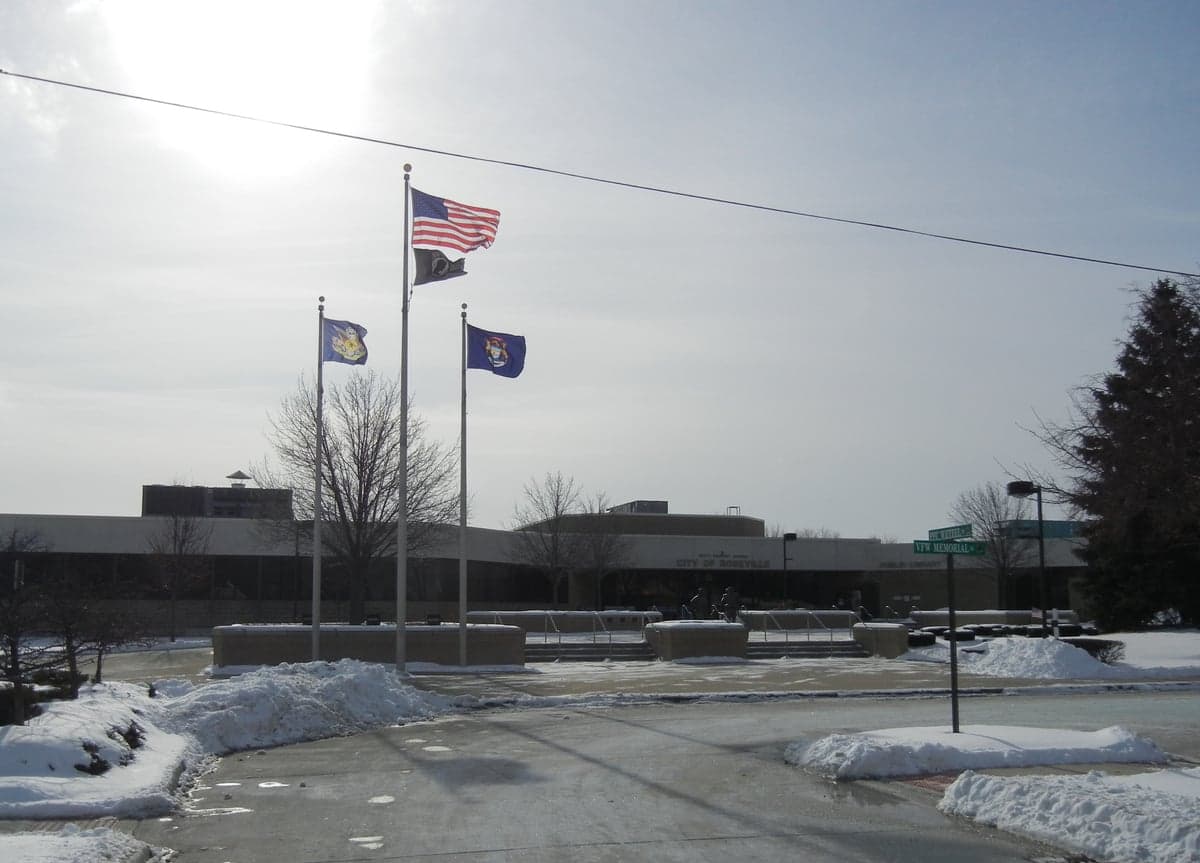
Photo: Wikipedia
Demographics of Roseville, MI
Affluence Level in Roseville, MI
A middle-class area roughly in line with national averages across income, home values, education, and employment.
People of Roseville, MI
The people of Roseville, Michigan, form a dense, working-class community of 47,240 residents, distinct for its strong blue-collar identity and rapid demographic transition. Once a nearly all-white suburb of Detroit, Roseville today is 65.5% white and 23.2% Black, with small but growing Hispanic (4.1%) and East/Southeast Asian (1.2%) populations. The city is notably less educated than the state average—only 15.2% of adults hold a bachelor’s degree—and its foreign-born share is a low 2.0%, reflecting a population rooted in multi-generational American families rather than recent immigration. This is a place where old neighborhoods of Polish and Italian immigrants now house a younger, more diverse generation of renters and first-time homebuyers.
How the city was settled and grew
Roseville’s original population was drawn by the promise of farmland and, later, factory work. Platted in the 1830s along the Clinton River, the area remained rural through the 19th century, settled by Yankee farmers from New England and upstate New York. The real transformation began after 1900, when Detroit’s auto boom pulled waves of European immigrants east along Gratiot Avenue. Polish and Italian families dominated the early 20th-century influx, building modest bungalows and two-story frame houses in what became the Gratiot-Frazho neighborhood—the historic core of Roseville’s working-class settlement. By the 1920s, the Kelly Road corridor saw a second wave of German and Irish families, many employed at the nearby Dodge Main plant in Hamtramck. The city incorporated in 1926, and post-World War II, the Utica Road district filled with returning GIs and their families, drawn by cheap land and the promise of Chrysler and Ford jobs. These neighborhoods remain the city’s demographic anchors, though their ethnic character has shifted.
Modern era (post-1965)
The 1967 Detroit riot and subsequent white flight reshaped Roseville’s population dramatically. Through the 1970s and 1980s, the city absorbed tens of thousands of white families fleeing the city’s racial integration, cementing its reputation as a “sundown suburb.” However, by the 1990s, that pattern reversed. Black families began moving east from Detroit along the Gratiot Avenue corridor, settling in the Little Mack and Common Road neighborhoods, where aging postwar ranches and Cape Cods offered affordable entry points. The 2000s brought a smaller but notable wave of Chaldean (Iraqi Christian) families from Detroit’s northeast side, clustering around Gratiot near 11 Mile Road, though the city’s Arab population remains modest. The Hispanic share, now 4.1%, grew steadily after 2010, driven by Mexican and Puerto Rican families seeking lower housing costs than Macomb County’s more affluent northern suburbs. East/Southeast Asian residents—primarily Vietnamese and Filipino—are concentrated in the Frazho Road area, near the city’s eastern edge, but remain a small presence at 1.2%. The Indian subcontinent population (0.4%) is negligible and scattered. Roseville’s Black population surged from roughly 5% in 1990 to 23.2% today, making it one of Macomb County’s most racially integrated communities, though the integration is largely sequential rather than simultaneous—older white residents remain in the western neighborhoods, while newer Black residents concentrate east of Gratiot.
The future
Roseville’s population is heading toward a more diverse but economically fragile future. The white share is declining steadily—down from 85% in 2000—as older residents age in place and younger white families choose exurbs like Chesterfield or Washington Township. The Black population is likely to plateau near 30% over the next decade, as Detroit’s out-migration slows and housing prices in Roseville rise. Hispanic growth will continue, potentially reaching 6-8% by 2035, driven by natural increase and continued in-migration from Southwest Detroit. The East/Southeast Asian and Indian populations are too small to drive neighborhood change and will likely remain below 3% combined. The city is not tribalizing into distinct ethnic enclaves; rather, it is homogenizing into a lower-middle-class, majority-minority suburb where race matters less than income. The low college attainment rate (15.2%) and high share of renters suggest Roseville will remain a working-class bedroom community, not a destination for professionals. The Gratiot-Frazho and Little Mack neighborhoods are already seeing the most rapid turnover, while the Utica Road district remains the most stable, with longer-term white homeowners.
For someone moving in now, Roseville offers a dense, affordable, and increasingly diverse community with deep roots in the auto industry and a clear trajectory toward a Black and Hispanic majority. The city is becoming a more typical inner-ring suburb—less white, less insular, and more economically mixed—but it retains a distinctively Midwestern, blue-collar character that sets it apart from the more affluent and homogeneous suburbs to the north. New residents should expect a place where neighborly familiarity still matters, but where the old ethnic boundaries are fading fast.

* Values derived from national, state, county, city and local statistics and may differ in a specific area. Last updated: 2026-04-30T03:37:46.000Z
Narrative content on this page is AI-generated and may contain mistakes. Verify any details that matter before acting on them.
ReloMaps may earn a commission from affiliate links at no extra cost to you.

