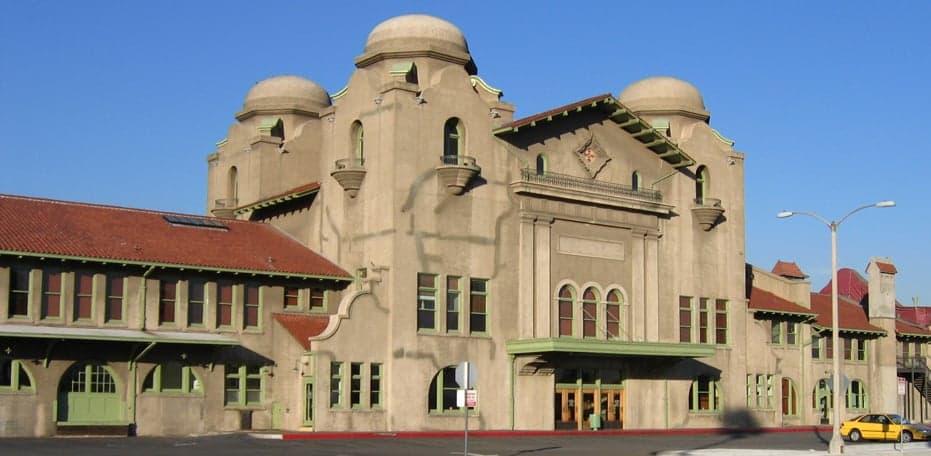
Photo: Wikipedia
Demographics of San Bernardino, CA
Affluence Level in San Bernardino, CA
A middle-class area roughly in line with national averages across income, home values, education, and employment.
People of San Bernardino, CA
The people of San Bernardino, California, today number 221,774, forming a predominantly Hispanic (69.6%) and young city with a median age of 30.2. The population is notably less college-educated than the state average (12.8% vs. 34.7%), and the city carries a working-class, family-oriented character shaped by waves of migration from Mexico, Central America, and the American South. San Bernardino is a majority-minority city where non-Hispanic whites make up just 11.8% of residents, and its identity is defined by a blend of historic railroad and military roots, suburban sprawl, and a recent struggle with economic disinvestment.
How the city was settled and grew
San Bernardino’s modern population history begins with the 1851 Mormon settlement led by Amasa Lyman and Charles C. Rich, who purchased the Rancho San Bernardino land grant and laid out a grid of streets that still defines downtown. The Mormon colonists were recalled to Utah in 1857, but their departure opened the area to Anglo-American farmers and merchants drawn by the fertile Santa Ana River valley. The arrival of the Southern Pacific Railroad in the 1880s transformed the city into a regional rail hub, attracting a wave of Mexican laborers who built and maintained the tracks. These early Mexican settlers concentrated in the Westside neighborhood, near the rail yards, establishing a barrio that remains a core of the city’s Hispanic community today. By 1900, the population had reached 6,150, with a small but growing Mexican working class alongside Anglo ranchers and merchants. The early 20th century brought a second major wave: African Americans from the South and Midwest, recruited by the Santa Fe Railroad and later by the Kaiser Steel mill (opened 1942 in nearby Fontana). Black families settled primarily in the Westside and Perth neighborhoods, creating a distinct African American cultural and civic corridor along Base Line Street. The post-World War II boom, fueled by the Kaiser mill and Norton Air Force Base (opened 1942), drew additional white and Hispanic migrants, and the city’s population surged from 43,646 in 1940 to 91,922 in 1960. The Del Rosa and Muscoy areas grew as white working-class suburbs during this period, while the Arrowhead Springs neighborhood attracted wealthier residents seeking cooler foothill temperatures.
Modern era (post-1965)
The 1965 Hart-Cellar Immigration Act reshaped San Bernardino’s demographics by opening legal channels for Mexican and Central American migration. The Hispanic share of the population rose from roughly 20% in 1970 to 69.6% today, driven by both immigration and higher birth rates. New arrivals from Mexico and El Salvador settled heavily in the Westside and Mount Vernon corridor, where Spanish-language businesses and Catholic parishes anchored the community. At the same time, the closure of Norton Air Force Base in 1994 and the decline of Kaiser Steel (closed 1983) triggered a white flight to adjacent suburbs like Redlands and Highland, accelerating the city’s racial turnover. The African American population peaked at around 20% in the 1980s and has since declined to 11.2%, as many Black families moved to more affordable inland suburbs or left California entirely. The East/Southeast Asian population (3.5%) is small but concentrated in the University District near California State University, San Bernardino, with Filipino and Vietnamese families forming the largest subgroups. The Indian subcontinent population (0.4%) is negligible, with most South Asian families residing in nearby Loma Linda or Rancho Cucamonga. The foreign-born share stands at 13.5%, well below the California average of 26.5%, indicating that the city’s Hispanic growth is now primarily native-born second and third generation.
The future
San Bernardino’s population is likely to continue its trajectory toward an even higher Hispanic majority, as the white and Black shares slowly decline through out-migration and aging. The city’s low college attainment rate (12.8%) and high poverty rate (29.3% as of 2023) suggest limited upward mobility, which may discourage new in-migration from outside the region. However, the Downtown and University District are seeing modest reinvestment, including new housing and retail aimed at attracting younger, more educated residents. The East/Southeast Asian population may grow slightly as students and faculty at Cal State San Bernardino settle nearby, but the city is unlikely to see the large-scale Asian immigration that has reshaped neighboring cities like Irvine or Chino Hills. The African American community is stabilizing after decades of decline, anchored by historic churches and civic organizations in the Westside. Overall, San Bernardino is becoming more ethnically homogeneous (Hispanic) rather than more diverse, and its future depends on whether economic revitalization can retain young families who might otherwise move to higher-opportunity suburbs.
For a conservative-leaning individual or family considering relocation, San Bernardino offers a low cost of living relative to coastal California and a strong sense of community in its historic neighborhoods, but the trade-offs include high crime rates, underperforming schools, and limited job growth outside the public sector and logistics. The city is becoming a predominantly Hispanic working-class enclave, with distinct enclaves for Black and white residents shrinking over time. It is not a place of rapid demographic change or gentrification, but rather a city where the population is slowly consolidating around its majority group while struggling to reverse decades of economic decline.

* Values derived from national, state, county, city and local statistics and may differ in a specific area. Last updated: 2026-04-24T09:08:44.000Z
Narrative content on this page is AI-generated and may contain mistakes. Verify any details that matter before acting on them.
ReloMaps may earn a commission from affiliate links at no extra cost to you.

