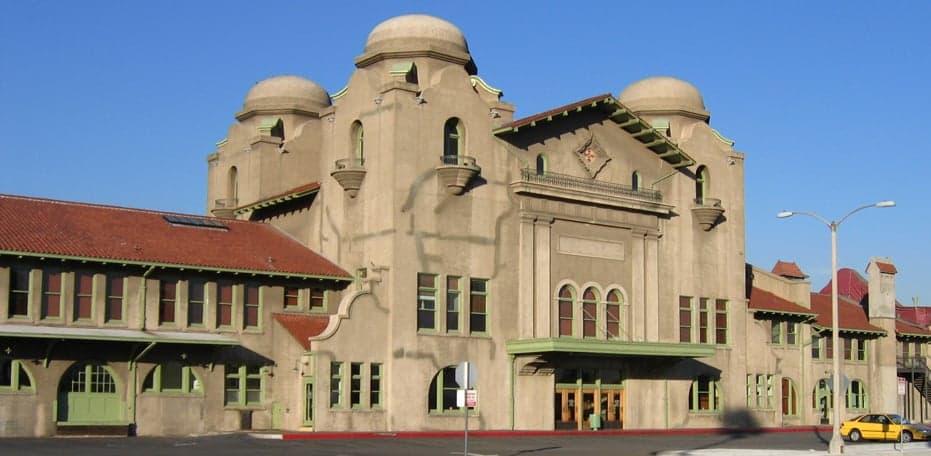
Photo: Wikipedia
Political ClimatePolitical Climate in San Bernardino, CA
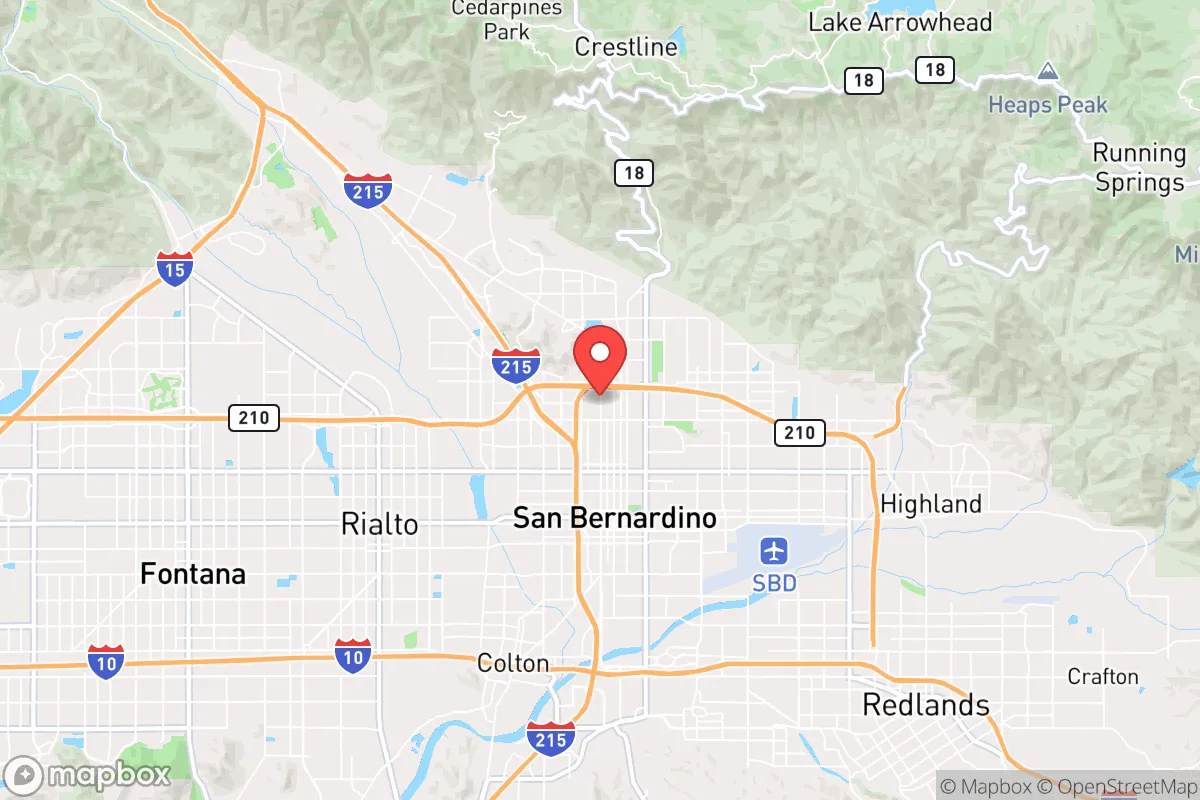
District shown is the primary district for this city’s centroid. Cities may span multiple districts.
Local Political AnalysisPolitical Analysis of San Bernardino, CA
San Bernardino has been a reliably Democratic stronghold for decades, and honestly, it’s only gotten more lopsided in recent years. The Cook PVI sits at D+7, which means the city leans about seven points more Democratic than the national average, and that gap has been widening with each election cycle. If you’ve lived here as long as I have, you remember when the city council and local politics had a real mix of voices—fiscal conservatives, union Democrats, even a few libertarian-leaning independents. Now, the political machine is almost entirely progressive, and the shift has been noticeable in everything from housing policy to how the police department is funded.
How it compares
Drive 15 minutes west to Redlands, and you’ll feel like you’re in a different country politically. Redlands still has a strong conservative base, with a city council that’s pushed back on state mandates and kept property taxes relatively low. Head east to Highland or Loma Linda, and you’ll find more of the same—communities where people still believe in local control and personal responsibility. But San Bernardino itself? It’s surrounded by these more balanced towns, yet it’s become an island of one-party rule. The contrast is stark: while Redlands voters rejected a rent control measure in 2020, San Bernardino’s council passed one without a public vote, citing a “housing emergency.” That kind of top-down decision-making is exactly what worries me about where we’re headed.
What this means for residents
For the average person living here, the political climate translates into a few concrete realities. First, taxes and fees have crept up steadily—sales tax is now over 8.75%, and the city has floated new business license surcharges that hit small shops hardest. Second, public safety has become a political football. The council voted to cut the police budget by 8% in 2021, and while they restored some funding after a crime spike, the message was clear: your safety is negotiable. Third, and this is the big one for families, school board meetings have turned into battlegrounds over curriculum and parental rights. The current board leans heavily progressive, and parents who question critical race theory or gender ideology in classrooms are often dismissed as “bigots.” It’s not the San Bernardino I grew up in, where the biggest political fights were about potholes and water rates.
On the cultural side, the city has embraced some policies that feel like government overreach. The “sanctuary city” ordinance, passed in 2017, limits local cooperation with federal immigration enforcement—which sounds noble until you realize it also means city resources can’t be used to verify legal status for things like business licenses or rental permits. There’s also a push for “equity” in zoning that would override single-family neighborhoods to allow high-density apartments without parking requirements. That’s not planning; that’s social engineering. If you value personal freedom—the freedom to run a business without endless red tape, to send your kid to school without political indoctrination, to feel safe in your own home—San Bernardino’s trajectory is a warning sign. The old-timers like me are either digging in or looking at places like Redlands or Yucaipa, where the government still remembers it works for you, not the other way around.

State Political ClimatePolitical Climate in California
State Political AnalysisPolitical Environment in the State
California is a one-party Democratic state where Republicans have been reduced to a permanent minority, holding no statewide offices and just 11 of 52 U.S. House seats after the 2024 elections. The state’s political trajectory over the past 20 years has been a steady march leftward: in 2004, George W. Bush lost California by 10 points; by 2024, Kamala Harris carried it by 28 points, a shift driven by massive growth in the Bay Area and Los Angeles metros. For a conservative considering relocation, the reality is that the state’s governance is dominated by a progressive coalition that views personal freedom—especially in business, education, and self-defense—as secondary to collective outcomes.
Urban vs. rural divide
The political map of California is a tale of two worlds. The coastal metros—San Francisco, Los Angeles, San Diego, and Oakland—are deep blue strongholds that produce roughly 70% of the state’s Democratic vote. In Los Angeles County alone, Biden won 71% in 2020, and the city’s Board of Supervisors has functionally governed as a single-party body for decades. Meanwhile, the Central Valley and inland regions—Bakersfield, Fresno, Redding, and the Inland Empire—vote reliably Republican, with counties like Kern and Tulare routinely delivering 60%+ for GOP candidates. The divide is stark: in 2024, Orange County, once a conservative bastion, flipped to Harris by 8 points, while San Bernardino County swung right by 5 points, reflecting a suburban realignment. The rural north, including Shasta County (Redding), is now the last redoubt of conservative California, but its population is too small to counterbalance the coastal cities.
Policy environment
California’s policy environment is a case study in progressive governance. The state has the highest personal income tax rate in the nation (13.3% for top earners), a 7.25% sales tax floor that local governments can push to 10%+, and a corporate tax rate of 8.84%. Property taxes are capped at 1% of assessed value under Prop 13, but annual increases and transfer taxes in cities like San Francisco (a 0.7% transfer tax on properties over $10 million) add layers of cost. Education policy is dominated by the California Teachers Association, which has blocked school choice and charter expansion; the state’s 2023 “Parental Rights” bill (AB 1078) actually restricted local school boards from banning certain books, effectively overriding parental input. Healthcare is heavily regulated, with the state running its own insurance exchange (Covered California) and mandating employer coverage. Election laws are among the most liberal: universal mail-in voting, same-day registration, and no voter ID requirement—a system that conservatives argue erodes ballot integrity. The state’s regulatory posture is hostile to housing development, energy production, and small business, with the California Environmental Quality Act (CEQA) weaponized to block everything from new homes to solar farms.
Trajectory & freedom
California is becoming less free by nearly every measure. The state’s “freedom index” from the Cato Institute ranks it 49th nationally, dragged down by economic and personal liberty scores. Recent legislation has expanded government control: SB 2 (2023) banned concealed carry in most public places, effectively nullifying the Bruen Supreme Court decision; AB 2098 (2022) allowed medical boards to discipline doctors for “misinformation,” chilling free speech in healthcare; and SB 9 (2021) preempted local zoning to force higher density, overriding property rights. On parental rights, AB 1955 (2024) prohibits school districts from requiring notification when a child changes gender identity, stripping parents of basic knowledge. The state has also moved to criminalize “hate speech” broadly, with AB 302 (2023) requiring social media platforms to report hateful content—a de facto speech code. Medical autonomy is constrained by vaccine mandates for schoolchildren and healthcare workers, with no religious exemption. Property rights are further eroded by rent control (AB 1482) and a 2024 ballot measure that allows local governments to impose vacancy taxes. The trajectory is clear: each legislative session adds new restrictions on guns, speech, and family decisions.
Civil unrest & political movements
California has been a flashpoint for civil unrest and political activism. The 2020 George Floyd protests in Los Angeles and Oakland resulted in over $1 billion in property damage, with the city of Oakland seeing 100+ businesses looted and burned. The state’s sanctuary law (SB 54) prohibits local law enforcement from cooperating with federal immigration authorities, creating a de facto safe harbor for illegal immigration—a policy that has fueled tensions in border-adjacent San Diego and inland agricultural areas like Coachella Valley. The “CalExit” secession movement gained 600,000 signatures in 2016 but fizzled after Trump’s loss. More recently, the “Recall Newsom” effort in 2021 collected 1.7 million signatures but failed to remove the governor, revealing the GOP’s organizational weakness. Election integrity remains a hot-button issue: the state’s universal mail-in system, implemented permanently in 2021, has led to widespread concerns about ballot harvesting and signature verification, with no serious reform on the horizon. Visible flashpoints include the homeless encampments in San Francisco’s Tenderloin and Los Angeles’ Skid Row, where progressive policies have decriminalized public drug use and camping, creating a daily reminder of governance failures.
Projection
Over the next 5-10 years, California will likely become more progressive, not less. Demographic trends favor the left: the state’s white population is shrinking (now 35%), while Latino and Asian populations—who vote Democratic by 2-to-1 margins—are growing. In-migration from other states is negative (net loss of 700,000 residents since 2020), but those leaving are disproportionately conservative-leaning middle-class families heading to Texas, Arizona, and Idaho. The remaining population is younger, more urban, and more dependent on government services. The state’s supermajority Democratic legislature will continue to pass bills on gun control, rent control, and speech regulation, with no serious opposition. The only wildcard is a potential economic crisis: if the state’s budget deficit (projected at $73 billion for 2025-26) forces severe cuts to social programs, it could trigger a backlash. But for now, the political machine is self-reinforcing—public sector unions, trial lawyers, and Silicon Valley donors fund the campaigns, and the media ecosystem in San Francisco and Los Angeles ensures no alternative narrative gains traction.
For a conservative moving to California, the bottom line is that you will be a political minority in a state that actively works against your values. Your taxes will be high, your gun rights severely limited, your parental authority undermined, and your vote effectively meaningless in statewide elections. If you must move here for work or family, target the inland counties—Placer County (Roseville) or San Diego County’s North County (Escondido)—where local governance is more conservative and you can find like-minded communities. But understand that the state legislature in Sacramento will continue to impose progressive policies regardless of local sentiment. California is not a place for someone who values personal freedom, fiscal sanity, or traditional family structures—it is a one-party state where the government’s reach extends into every corner of daily life.
* Values derived from national, state, county, city and local statistics and may differ in a specific area. Last updated: 2026-04-24T09:08:44.000Z
Narrative content on this page is AI-generated and may contain mistakes. Verify any details that matter before acting on them.
ReloMaps may earn a commission from affiliate links at no extra cost to you.

