Photo: Wikipedia
Demographics of San Francisco, CA
Affluence Level in San Francisco, CA
A wealthy area with high-earning, well-educated households. Incomes, home values, and educational attainment meaningfully outpace national averages.
People of San Francisco, CA
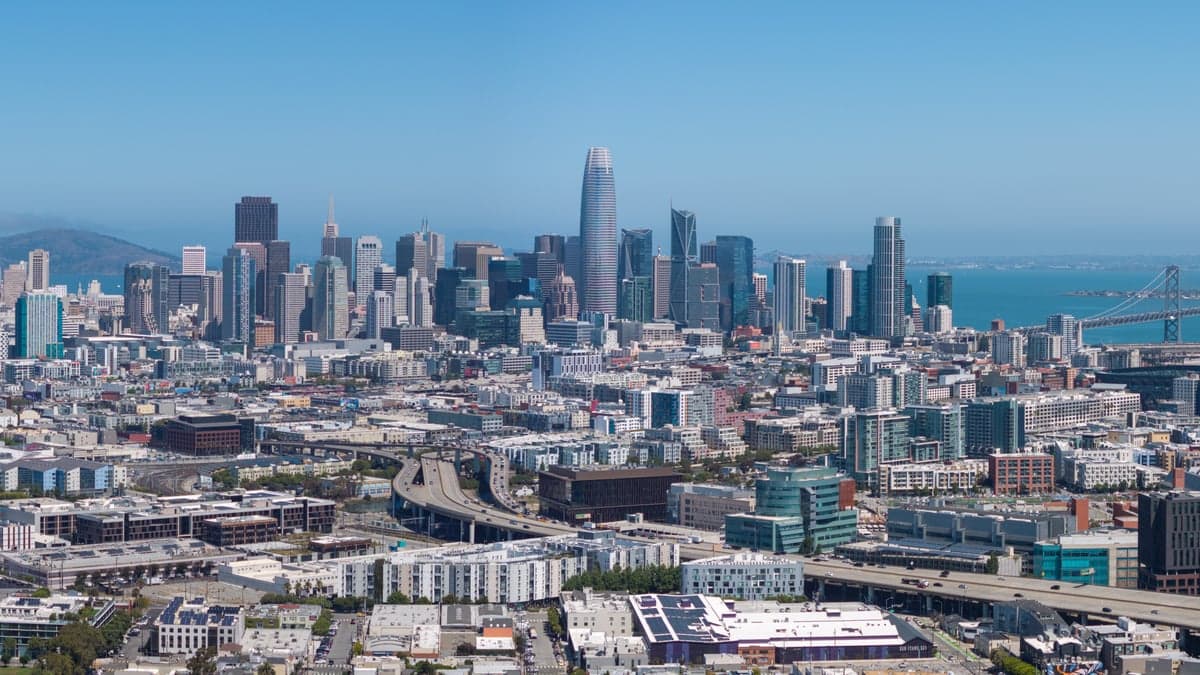
San Francisco today is a dense, globally connected city of 836,321 residents, marked by a starkly bifurcated demographic profile: a highly educated, predominantly white and East/Southeast Asian professional class coexists with a shrinking, older Black and Hispanic population. The city’s foreign-born share stands at 12.7%, a figure that belies the outsized cultural and economic influence of its immigrant communities, particularly those from China and the Philippines. Its identity is defined by extreme wealth inequality, a tech-driven economy, and a political culture that is overwhelmingly liberal, yet its neighborhoods remain among the most ethnically segregated in California.
How the city was settled and grew
San Francisco’s population exploded during the 1848-1855 Gold Rush, transforming a sleepy Mexican pueblo of a few hundred into a chaotic boomtown of over 50,000. The initial wave was overwhelmingly male, drawn from the eastern United States, Europe (especially Ireland, Germany, and Italy), and China. Chinese laborers, who arrived by the tens of thousands, built the transcontinental railroad and settled in what became Chinatown, the oldest and largest Chinese enclave outside Asia. Irish immigrants clustered in the working-class Mission District and South of Market, while Italian fishermen and vintners established North Beach as a Mediterranean stronghold. The 1906 earthquake and fire destroyed much of the city but accelerated rebuilding and densification, drawing new waves of European immigrants through the 1920s. By 1940, San Francisco was a majority-white, working-class port city with a substantial Japanese community in Japantown (Nihonmachi) and a growing Black population arriving for wartime shipyard jobs.
Modern era (post-1965)
The 1965 Hart-Cellar Immigration Act fundamentally reshaped San Francisco. It ended national-origin quotas, triggering a massive influx from East and Southeast Asia. Chinese immigrants from Hong Kong, Taiwan, and later mainland China expanded Chinatown outward into the Sunset District and Richmond District, creating a second, larger Chinatown west of Twin Peaks. Filipino immigrants, who arrived in large numbers after 1965, concentrated in the South of Market area and the Excelsior District, establishing the city’s largest Asian subgroup after the Chinese. Meanwhile, domestic migration shifted: the Black population, which peaked at 13.4% in 1970, declined sharply as redlining, urban renewal, and rising housing costs pushed families to Oakland and Antioch. The white population also fell, from 71% in 1960 to 42% by 1990, as middle-class families fled to suburbs. The 1990s dot-com boom and 2010s tech surge reversed that trend: young, affluent whites and Asians moved into formerly working-class neighborhoods like the Mission District and SoMa, displacing long-standing Latino and Black residents. By 2020, the city’s Hispanic share had dropped to 15.9%, and the Black share to 4.8%, while the white share rebounded to 37.5% and the East/Southeast Asian share held at 31.5%.
The future
San Francisco’s population is heading toward greater homogenization by income and education, even as its ethnic enclaves persist. The city’s 60.1% college-educated rate is among the highest in the nation, and the tech sector continues to attract highly skilled immigrants from China and India (the latter now at 3.2% and growing, though still a small share). However, the foreign-born proportion has plateaued at 12.7%, down from a peak of 22% in 1990, as immigration restrictions and high housing costs deter new arrivals. The East/Southeast Asian communities are aging and suburbanizing: many second- and third-generation Chinese and Filipino families are moving to Daly City, San Mateo, and the South Bay. The Hispanic population is stable but not growing, concentrated in the Mission District and Bernal Heights, while the Black population continues a slow decline. The city is not tribalizing into distinct enclaves so much as consolidating into two broad zones: the wealthy, white-and-Asian northern and eastern neighborhoods (Pacific Heights, Marina, SoMa) and the more diverse, lower-income southern and western areas (Excelsior, Visitacion Valley).
For a conservative-leaning individual or family considering relocation, San Francisco is a city where traditional family structures and middle-class stability are increasingly rare. The population is bifurcated between a highly educated, transient professional class and a shrinking, older working-class base. The city’s future is one of continued demographic sorting by income, with ethnic enclaves persisting but thinning as younger generations leave for more affordable suburbs. Moving in now means joining a city that is simultaneously the most dynamic and the most economically stratified in California — a place where your neighbors are likely to be either a tech executive or a long-term renter, with little in between.

* Values derived from national, state, county, city and local statistics and may differ in a specific area. Last updated: 2026-04-15T23:41:27.000Z
Narrative content on this page is AI-generated and may contain mistakes. Verify any details that matter before acting on them.
ReloMaps may earn a commission from affiliate links at no extra cost to you.

