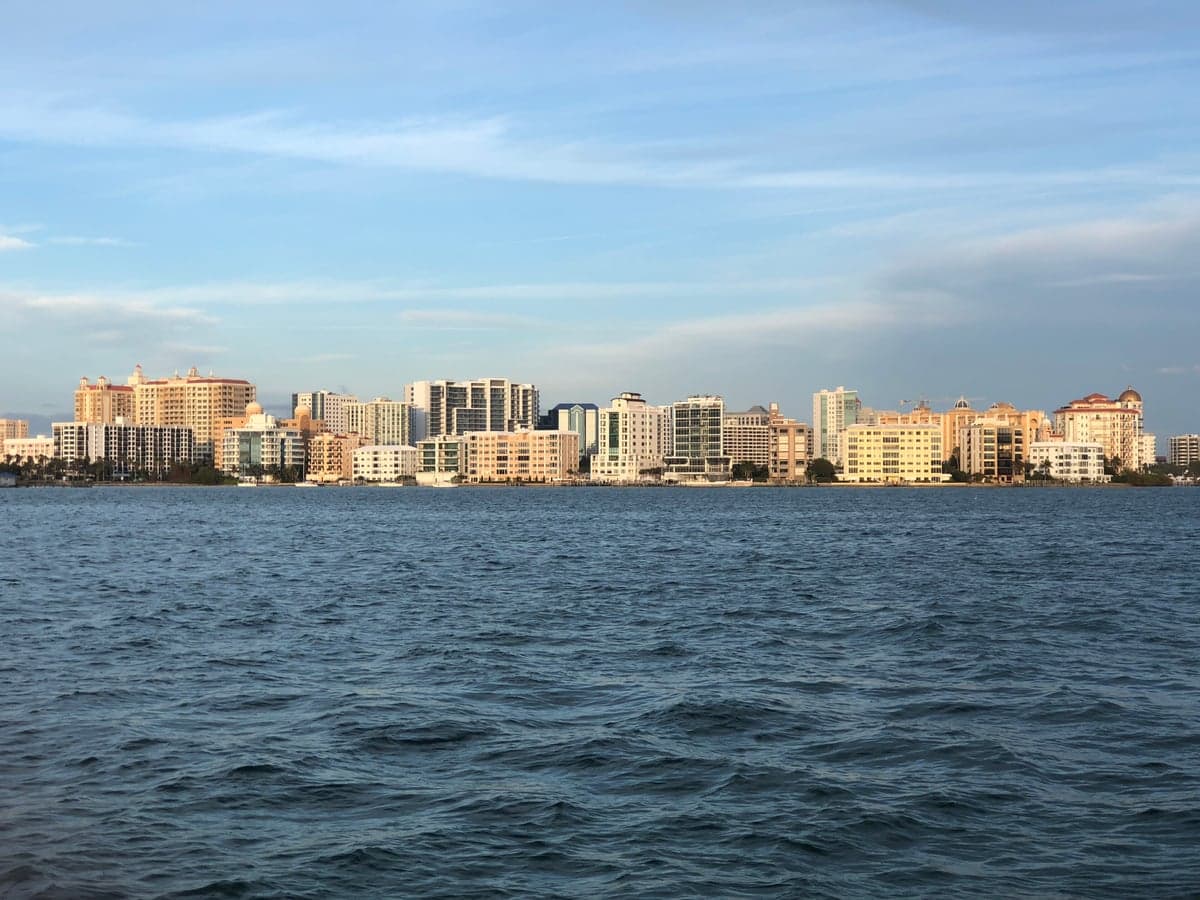
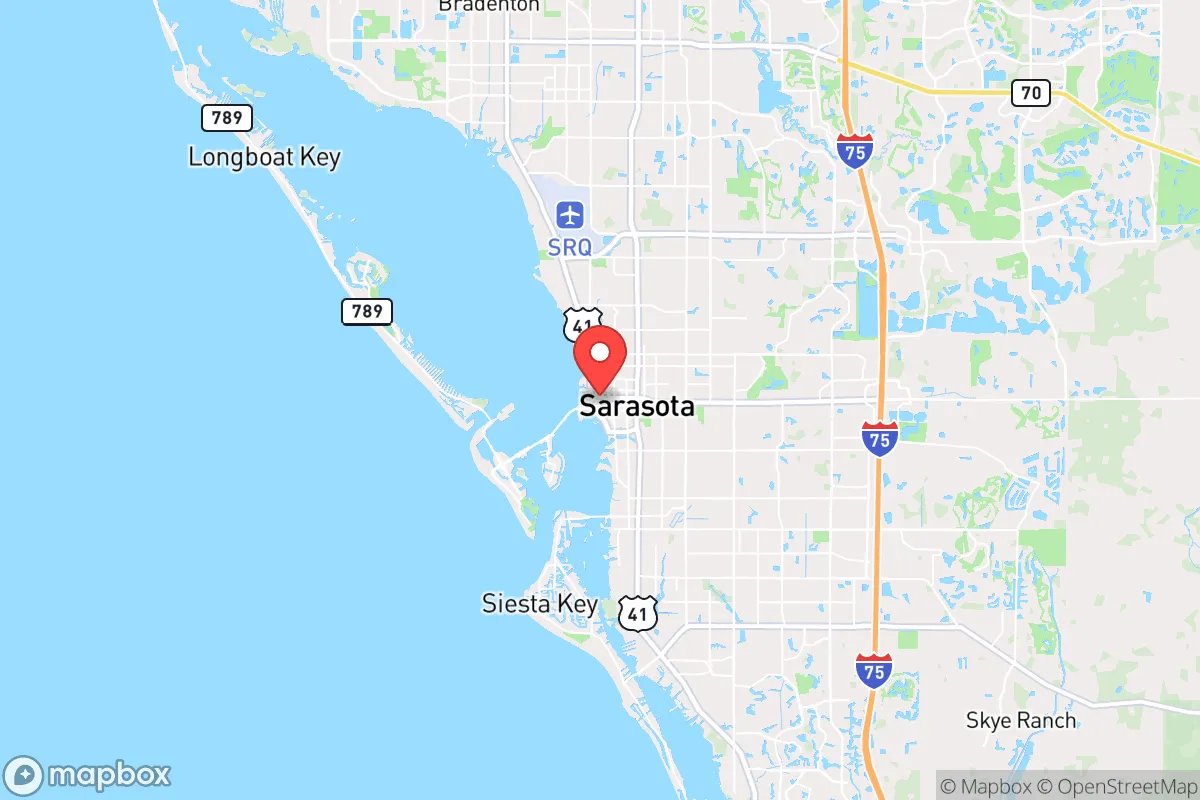
Photo: Wikipedia
Demographics of Sarasota, FL
Affluence Level in Sarasota, FL
A middle-class area roughly in line with national averages across income, home values, education, and employment.
People of Sarasota, FL
The people of Sarasota, Florida today form a city of 56,218 residents that is older, wealthier, and more politically conservative than the national average, with a distinctive cultural identity shaped by decades of Midwestern and Northeastern retirement migration. The city is 63.8% White, 16.3% Hispanic, 15.0% Black, and 1.5% East/Southeast Asian, with a separate 0.6% Indian-subcontinent population. A high 41.7% of adults hold a college degree, and the foreign-born share sits at just 7.2% — well below the national average of roughly 14%. The population skews heavily toward retirees and empty-nesters, giving Sarasota a slower pace and a strong civic focus on arts, beaches, and golf rather than family-oriented suburban sprawl.
How the city was settled and grew
Sarasota was not a colonial-era settlement; its modern history begins in the 1880s when the Florida Mortgage and Investment Company, backed by Scottish investors, purchased large tracts of land and began promoting the area as a winter resort for wealthy Northerners. The first significant wave of permanent residents arrived between 1885 and 1910, drawn by the promise of citrus farming, fishing, and tourism. These early settlers were overwhelmingly White Protestants from the Midwest and Northeast, and they clustered in what is now the Downtown Sarasota core and along the bayfront in Bayfront Park and Gillespie Park. The Black population arrived during the same period, largely as laborers in the citrus and fishing industries, and established a distinct community in the Newtown neighborhood (historically called "Black Bottom"), which remains the city's primary African American enclave today. By 1920, Sarasota had fewer than 2,000 residents, but the 1920s land boom brought a second wave of speculators and retirees, building the Mediterranean Revival architecture that still defines the Laurel Park and Burns Court districts. The Great Depression stalled growth, but World War II brought a temporary military presence at the Sarasota Army Air Field, which later became the Sarasota-Bradenton International Airport.
Modern era (post-1965)
The post-1965 period transformed Sarasota from a sleepy resort town into a full-fledged retirement destination. The Immigration and Nationality Act of 1965 had a modest direct effect here — the foreign-born share remains low — but the indirect effect was a surge in domestic in-migration as Northern retirees, many of them Jewish and Catholic, sought warm winters and low taxes. These newcomers settled heavily in the Southside Village area and the newer subdivisions west of Tamiami Trail, such as Indian Beach and Arlington Park. The Hispanic population began growing in the 1980s and 1990s, driven by Puerto Rican and Mexican migrants who found work in construction, landscaping, and the service industry. They concentrated in the Newtown and Gillespie Park neighborhoods, which became increasingly mixed Black and Hispanic. The East/Southeast Asian population, primarily Vietnamese and Filipino, arrived in smaller numbers during the 1990s and 2000s, often as medical professionals or small-business owners, and settled in the South Gate area. The Indian-subcontinent population remains tiny (0.6%) and is mostly concentrated among tech and medical professionals in the Lakewood Ranch area, which is technically in unincorporated Manatee County but functions as a Sarasota exurb. The Black population, which was roughly 25% of the city in 1970, has declined to 15% as many middle-class Black families moved to suburban areas like North Port and Venice, while Newtown has seen significant Hispanic in-migration.
The future
Sarasota's population is heading toward continued slow growth, with the city projected to reach roughly 62,000 by 2035. The dominant trend is aging in place: the 65+ cohort already makes up over 30% of residents, and that share is rising as younger retirees replace older ones. The Hispanic population is growing steadily, likely reaching 20-22% by 2035, driven by natural increase and continued service-sector migration. The Black population is stabilizing after decades of decline, but is unlikely to regain its 1970 share. The East/Southeast Asian and Indian-subcontinent populations are growing from a very small base, but remain niche — Sarasota lacks the tech or university anchors that drive larger Asian-American communities in Tampa or Orlando. The city is not tribalizing into distinct enclaves; instead, it is slowly homogenizing as older White residents die or move to assisted living and are replaced by slightly more diverse, but still predominantly White, newcomers. The biggest demographic wildcard is climate migration: if sea-level rise accelerates, Sarasota's barrier islands (Siesta Key, Lido Key) could see property values drop, pushing wealthier residents inland and potentially accelerating the retirement-to-family demographic shift.
For someone moving to Sarasota now, the bottom line is that this remains a predominantly White, older, and affluent city with a small but growing Hispanic minority and a very small Black and Asian presence. The city is not becoming a diverse melting pot; it is becoming a slightly less White, slightly younger version of itself. Newcomers should expect a community where civic life revolves around the arts, the beach, and golf, and where the political and cultural tone is set by conservative-leaning retirees rather than young families or immigrants. If you are a single professional or parent seeking a more diverse or family-oriented environment, the suburbs of Lakewood Ranch or North Port may offer a better fit than the city proper.

* Values derived from national, state, county, city and local statistics and may differ in a specific area. Last updated: 2026-05-14T01:43:34.000Z
Narrative content on this page is AI-generated and may contain mistakes. Verify any details that matter before acting on them.
ReloMaps may earn a commission from affiliate links at no extra cost to you.

