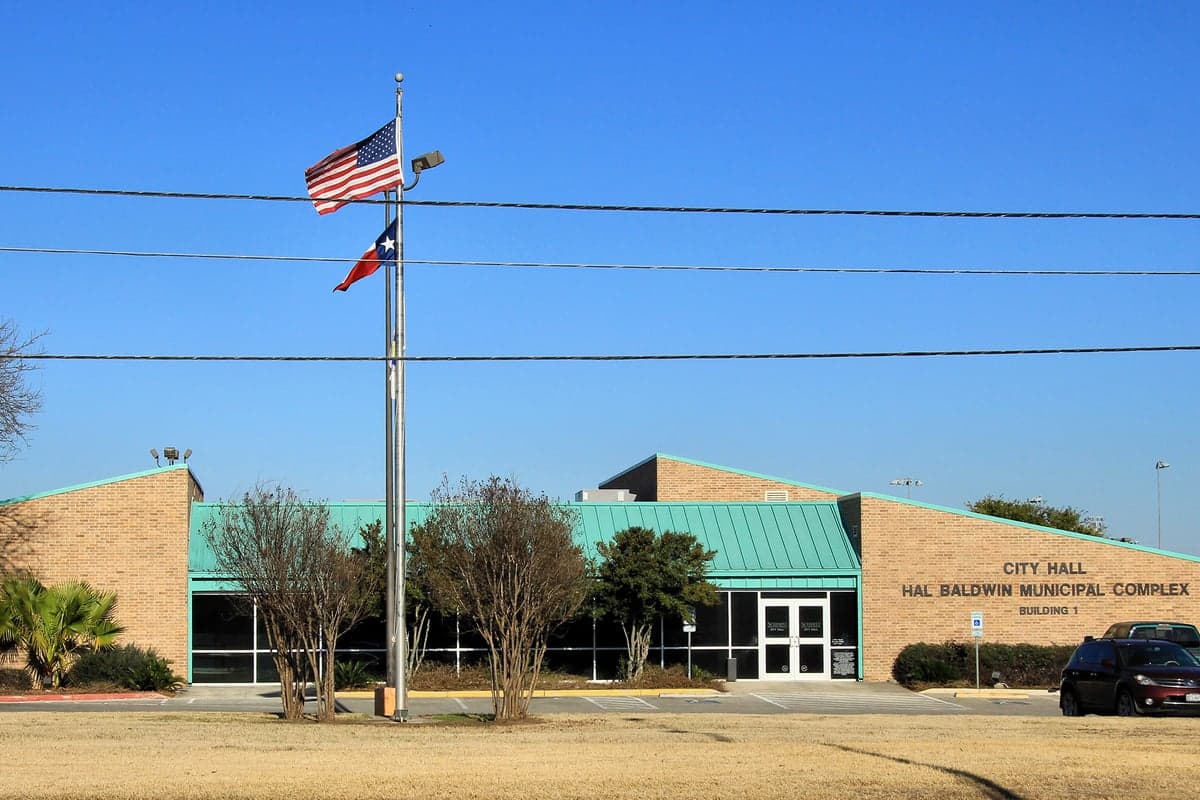
Photo: Wikipedia
Demographics of Schertz, TX
Affluence Level in Schertz, TX
A middle-class area roughly in line with national averages across income, home values, education, and employment.
People of Schertz, TX
The people of Schertz, Texas, is a city of 43,128 residents characterized by a diverse, family-oriented, suburban identity with a notably high college attainment rate of 40.2%. The population is predominantly White (47.8%) and Hispanic (32.4%), with a significant Black community (11.3%) and a small East/Southeast Asian (East/Southeast Asian) population (2.4%). The city’s foreign-born share is very low at 2.4%, reflecting a population shaped primarily by domestic migration from within Texas and the broader United States.
How the city was settled and grew
Schertz’s human history is a 20th-century story, not a colonial one. The area was originally part of the vast land grants of Spanish and Mexican Texas, but the city itself was formally founded in the 1880s as a railroad stop along the Galveston, Harrisburg and San Antonio Railway. The original settlers were German and Czech farmers drawn to the fertile blackland prairie soil, establishing small homesteads. The historic Old Schertz neighborhood, centered around Main Street and the original rail depot, was built by these families and remains the city’s oldest residential core. For decades, Schertz remained a tiny farming community, with a population that barely reached a few hundred by the mid-20th century. The construction of Randolph Air Force Base in the 1930s brought the first significant wave of non-agricultural residents, mostly military personnel and civilian support staff, who settled in the Schertz Estates area near the base’s northern boundary.
Modern era (post-1965)
The modern demographic transformation of Schertz began in earnest after the 1965 Immigration and Nationality Act, but the city’s growth, however, was driven overwhelmingly by domestic suburbanization rather than international migration. The completion of Interstate 35 and the expansion of San Antonio’s employment base in the 1970s and 1990s and 2000s turned Schertz into a prime bedroom community. This period saw the development of large master-planned subdivisions like Foster Estates and Green Valley, which attracted a wave of White and Hispanic families from San Antonio and the surrounding region seeking newer, larger homes and highly-rated schools in the Schertz-Cibolo-Universal City Independent School District. The city’s Black population, which now stands at 11.3%, grew significantly during this era, drawn by the result of domestic migration from other parts of Texas cities like Houston and Dallas, as well as from other Southern states. These families concentrated in newer master-planned communities such as Woodlake and Travis Ranch, which offered affordable housing and a suburban lifestyle. The Hispanic population, now 32.4%, is a mix of long-established Tejano families and more recent domestic arrivals from South Texas, with a notable presence in the Schertz Crossing area. The Asian (East/Southeast Asian) population, at 2.4%, is small and dispersed, with no single ethnic enclave, reflecting professional families drawn to the city’s schools and proximity to military and tech jobs in San Antonio. The Indian subcontinent population is recorded at 0.0%, indicating no measurable community.
The foreign-born share of 2.4% is among the lowest in the San Antonio metro area, underscoring that Schertz’s identity is rooted in domestic, not international, migration.
The future
Schertz is likely to continue its trajectory as a homogenizing, family-oriented suburb. The city is not tribalizing into distinct ethnic enclaves; instead, the trend is toward assimilation into a broader suburban culture. The Hispanic population is projected to grow slowly, driven by natural increase and continued domestic migration from South Texas, but the city is not experiencing the rapid Hispanicization seen in many other Texas suburbs. The Black population is stable and well-integrated, with no signs of concentrated resegregation. The Asian community, while small, may see modest growth as the San Antonio tech sector expands, but Schertz is unlikely to become a major destination for new destination for East/Southeast Asian destination. The very low foreign-born share suggests that international migration will remain a minor factor. The city’s high college attainment rate and strong school district will continue to attract college-educated families, reinforcing its demographic profile relatively stable compared to the rapid changes seen in nearby San Antonio or New Braunfels.
For a bottom-line, Schertz is becoming a stable, middle-to-upper-middle-class suburb with a diverse but assimilated population. For a conservative-leaning family or individual moving in now, the city offers a demographic environment where demographic environment where demographic change is unlikely to undergo dramatic demographic shifts in the next decade. The primary change will be continued gradual growth, with the population becoming slightly more Hispanic and remaining highly educated, while maintaining its core identity as a safe, family-focused community anchored by Randolph Air Force Base and the Schertz-Cibolo-Universal City school system.

* Values derived from national, state, county, city and local statistics and may differ in a specific area. Last updated: 2026-05-14T18:38:12.000Z
Narrative content on this page is AI-generated and may contain mistakes. Verify any details that matter before acting on them.
ReloMaps may earn a commission from affiliate links at no extra cost to you.

