 Popular
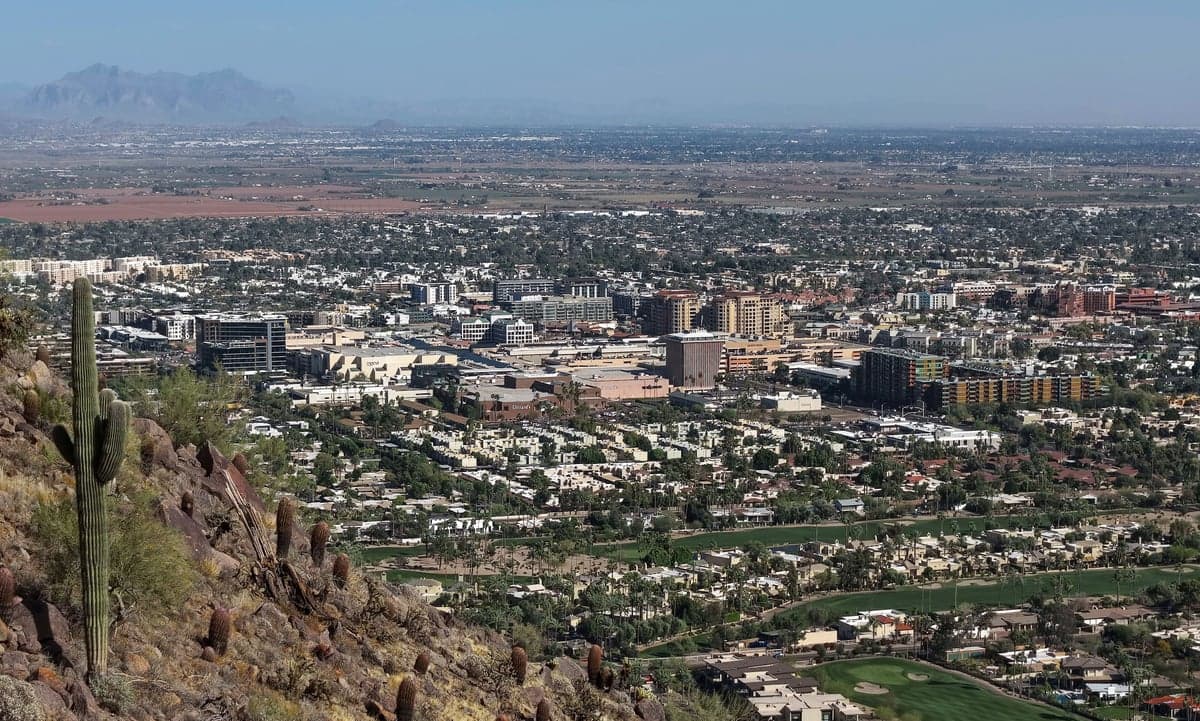
Photo: Wikipedia
Personal Sovereignty in Scottsdale, AZ
Viable for self-reliance. Generally workable, though some barriers may limit total independence.
What does Personal Sovereignty tell us?
Personal Sovereignty measures your capacity for self-reliance and independence with minimal government friction. Higher scores mean fewer barriers between you and the way you want to live... but it assumes you have the space you need and good neighbors.
What does this tell us?
Personal Sovereignty measures your capacity for self-reliance and independence with minimal government friction. Higher scores mean fewer barriers between you and the way you want to live... but it assumes you have the space you need and good neighbors.
State Policy
Energy independence: Importer (20% of energy produced in-state)
Personal Liberty
Homesteading

Personal Liberty Analysis
For the individualist or prepper evaluating Scottsdale, Arizona, the personal sovereignty environment is a mixed bag—strong state-level protections for gun rights and property are undercut by a municipal regulatory apparatus that can feel intrusive, especially on land use and building codes. While Arizona as a whole ranks among the most liberty-oriented states in the union, Scottsdale’s wealthy enclave status means local governance leans toward strict enforcement of HOA covenants, noise ordinances, and water restrictions. The net result: you get the Second Amendment and tax advantages, but don’t expect to disappear into the desert with a homestead—this is a city that manages its image and resources tightly.
Tax burden and regulatory posture for individuals and families
Arizona’s tax climate is a clear win for sovereignty-minded residents. The state’s flat income tax rate sits at 2.5% as of 2025, down from higher brackets in prior years, and there is no estate or inheritance tax. Scottsdale adds a city sales tax of roughly 1.75% on top of the state’s 5.6%, but property taxes remain low—Maricopa County’s effective rate hovers around 0.55% of assessed value, well below the national average. For a prepper or conservative family, this means less of your income is funneled to government programs you may not trust. However, the regulatory posture is less friendly: Scottsdale enforces strict zoning codes, limits short-term rentals (a 2022 ordinance capped them in residential areas), and requires permits for even minor construction. If you value minimal government interference in your home or business, the city’s bureaucracy can feel like a leash—especially compared to unincorporated areas of Pinal County just east.
Self-defense and gun law specifics in Scottsdale
This is where Scottsdale shines for the armed citizen. Arizona is a constitutional carry state—no permit needed to carry a concealed firearm for anyone 21 or older who can legally possess a gun. There is no state-level magazine capacity ban, no assault weapon registry, and no red flag law as of 2026. Scottsdale itself does not impose additional gun restrictions beyond state law; you can open carry in most public spaces, though private businesses (and many HOAs) may post signage prohibiting firearms. The city’s police department is generally pro-Second Amendment, but be aware that Scottsdale’s upscale shopping districts like Kierland Commons and Old Town have private security that may ask you to leave if visibly armed. For the prepper, the key takeaway: you can build a defensive arsenal without bureaucratic hurdles, and the state’s castle doctrine and stand-your-ground laws provide strong legal backing for self-defense in your home or vehicle. Just keep a low profile in the tourist-heavy zones.
Self-reliance and homesteading viability: lot sizes, zoning, and off-grid feasibility
If your vision of personal sovereignty includes growing your own food, harvesting rainwater, or living off-grid, Scottsdale presents significant obstacles. The typical residential lot in Scottsdale’s core is 0.25 to 0.5 acres, with many newer subdivisions on even smaller parcels. Zoning codes require homes to be connected to municipal water and sewer—no septic systems or private wells are allowed in most areas. Rainwater harvesting is permitted but regulated: you can collect up to 10,000 gallons without a permit, but larger systems require city approval and must not interfere with drainage. Raising livestock? Chickens are allowed on lots of at least 20,000 square feet (about half an acre), but goats, pigs, and larger animals are prohibited in residential zones. For serious homesteading, you’ll need to look north to Cave Creek or east to the Tonto National Forest fringe. Scottsdale’s water supply is managed by the Central Arizona Project and Salt River Project, meaning you’re dependent on regional infrastructure—a vulnerability for the off-grid prepper. Solar panels are widely accepted, but HOAs often dictate placement and visibility.
Personal liberties: parental rights, medical autonomy, speech, and property
Arizona has been a battleground for parental rights, and the state leans conservative on this front. A 2024 law (HB 2492) strengthened parents’ access to school curricula and medical records, and Scottsdale’s school districts—particularly Scottsdale Unified—have generally complied with opt-out provisions for sex education and controversial materials. Medical autonomy is more nuanced: the state banned mask and vaccine mandates for public schools in 2023, but private employers in Scottsdale (especially in healthcare and tech) may still require vaccinations. Ivermectin and hydroxychloroquine are legal to prescribe, and telemedicine access is broad. Free speech is robust—Arizona has no hate speech laws that chill expression, and Scottsdale’s public forums (city council meetings, parks) are open for protest and assembly. Property rights are strong on paper: Arizona’s eminent domain laws require “public use” and just compensation, and the state has no rent control. However, Scottsdale’s HOAs can impose fines and liens for violations like unkempt yards or non-approved paint colors—a real constraint on personal expression for those in planned communities. For the survivalist, the biggest liberty concern is the city’s active code enforcement, which can feel like a petty tyranny over your own land.
Overall, Scottsdale offers a moderate-to-strong sovereignty score compared to coastal blue states, but it falls short of the libertarian ideal found in rural Arizona counties like Mohave or La Paz. The tax burden is low, gun laws are excellent, and parental rights are protected. But the trade-off is a municipal government that micromanages land use, water, and aesthetics—fine for a suburban professional, frustrating for a prepper who wants true self-reliance. If you’re willing to trade some autonomy for access to high-end infrastructure and a politically like-minded community, Scottsdale works. If your priority is maximum freedom from government oversight, look farther out into the Sonoran Desert.

* Values derived from national, state, county, city and local statistics and may differ in a specific area. Last updated: 2026-04-15T23:28:41.000Z
Narrative content on this page is AI-generated and may contain mistakes. Verify any details that matter before acting on them.
ReloMaps may earn a commission from affiliate links at no extra cost to you.

