 Popular
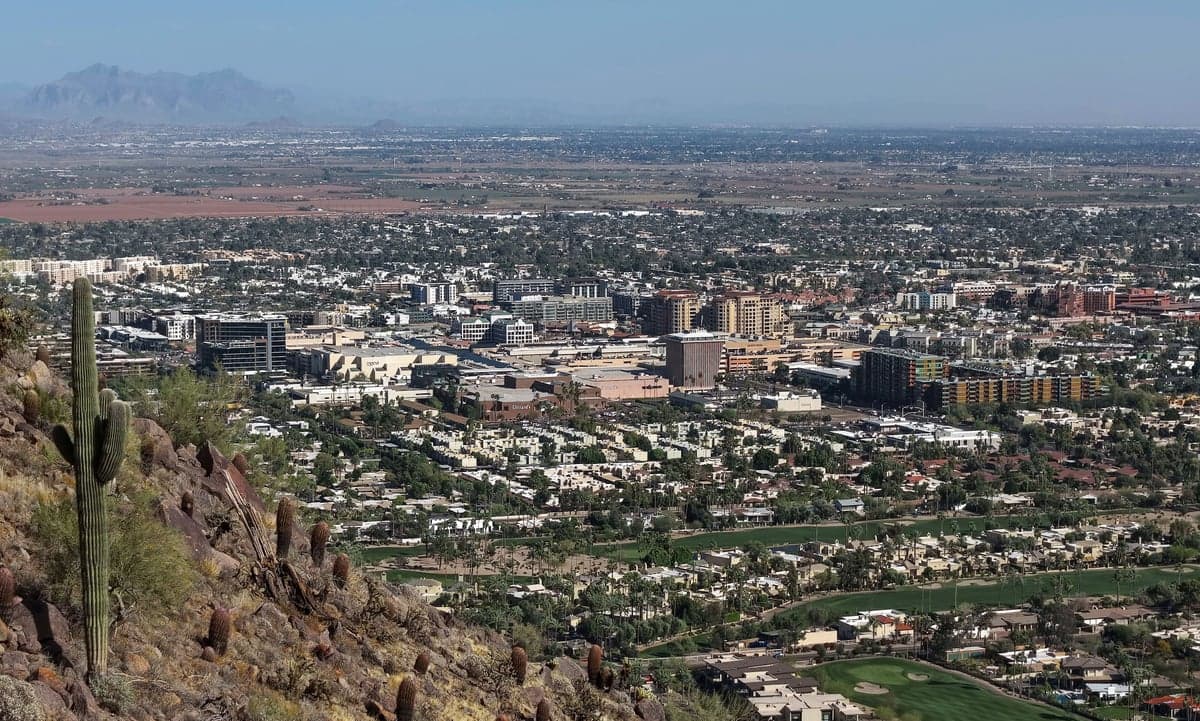
Photo: Wikipedia
Strategic Assessment of Scottsdale, AZ
Multiple tactical vulnerabilities. Population density, target proximity, or disaster risk are likely compounding. A retreat property and exit planning is required.
What does the Strategic Assessment tell us?
Our Strategic Assessment grades tactical survivability of an area. Major population centers, military targets, fallout zones, natural disasters, and border exposure all drive risk — lower exposure means a more defensible position in a crisis.
This is heavily inspired by Joel Skousen's Strategic Relocation book. Highly recommended you checkout the book ($)What does this tell us?
Our Strategic Assessment grades tactical survivability of an area. Major population centers, military targets, fallout zones, natural disasters, and border exposure all drive risk — lower exposure means a more defensible position in a crisis.
This is heavily inspired by Joel Skousen's Strategic Relocation book. Highly recommended you checkout the book ($)Strategic Pillars

Key Distances
Regional Safe Places
Below is our recommended "safe zones" in Arizona and the surrounding area based on our strategic heuristics. For most people, it's unrealistic to live in a “safe zone” full-time due to work, family or other personal reasons. They tend to be more rural. However, many of these areas are perfect for second homes and retreat properties that double as a vacation home or even a short-term rental.
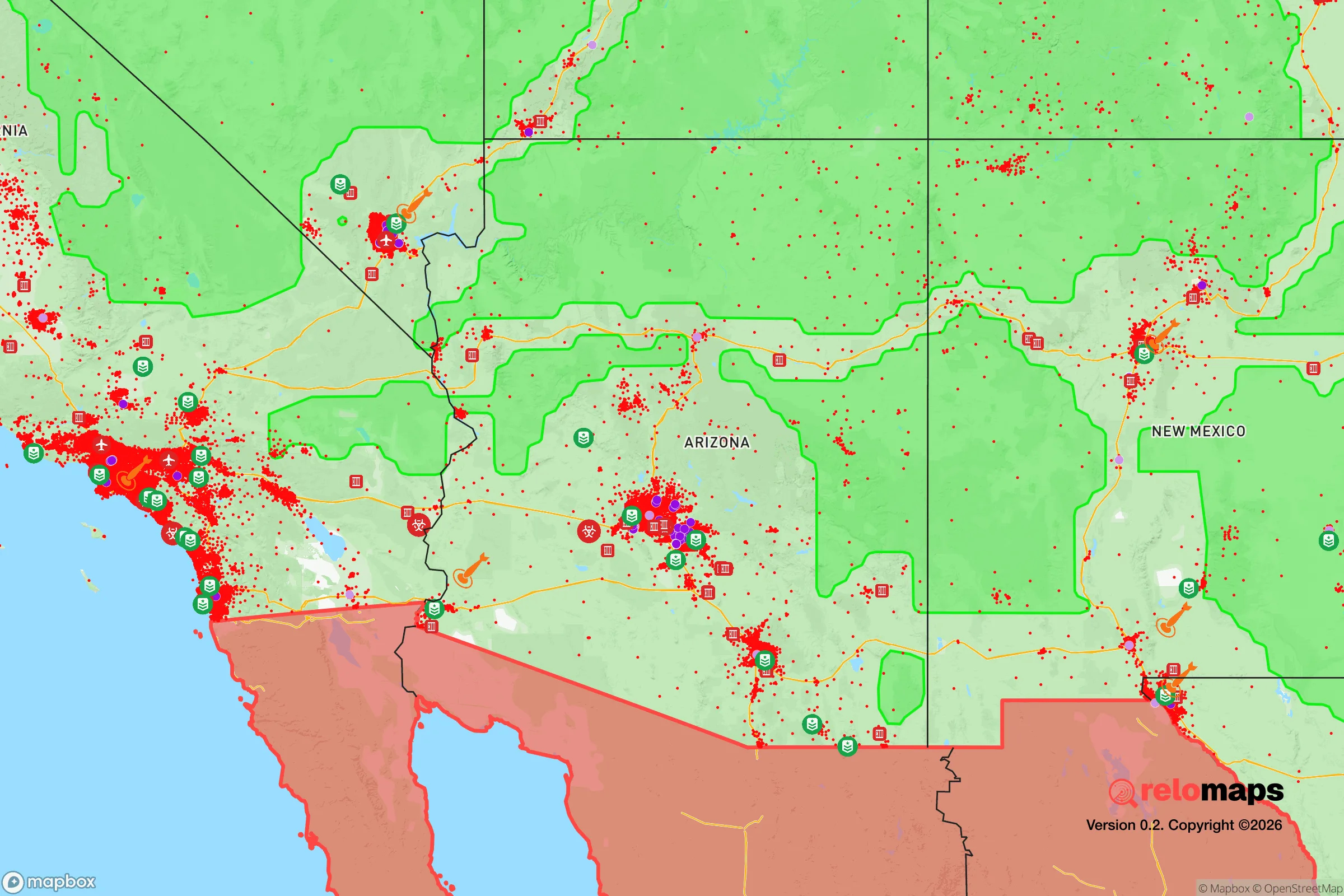
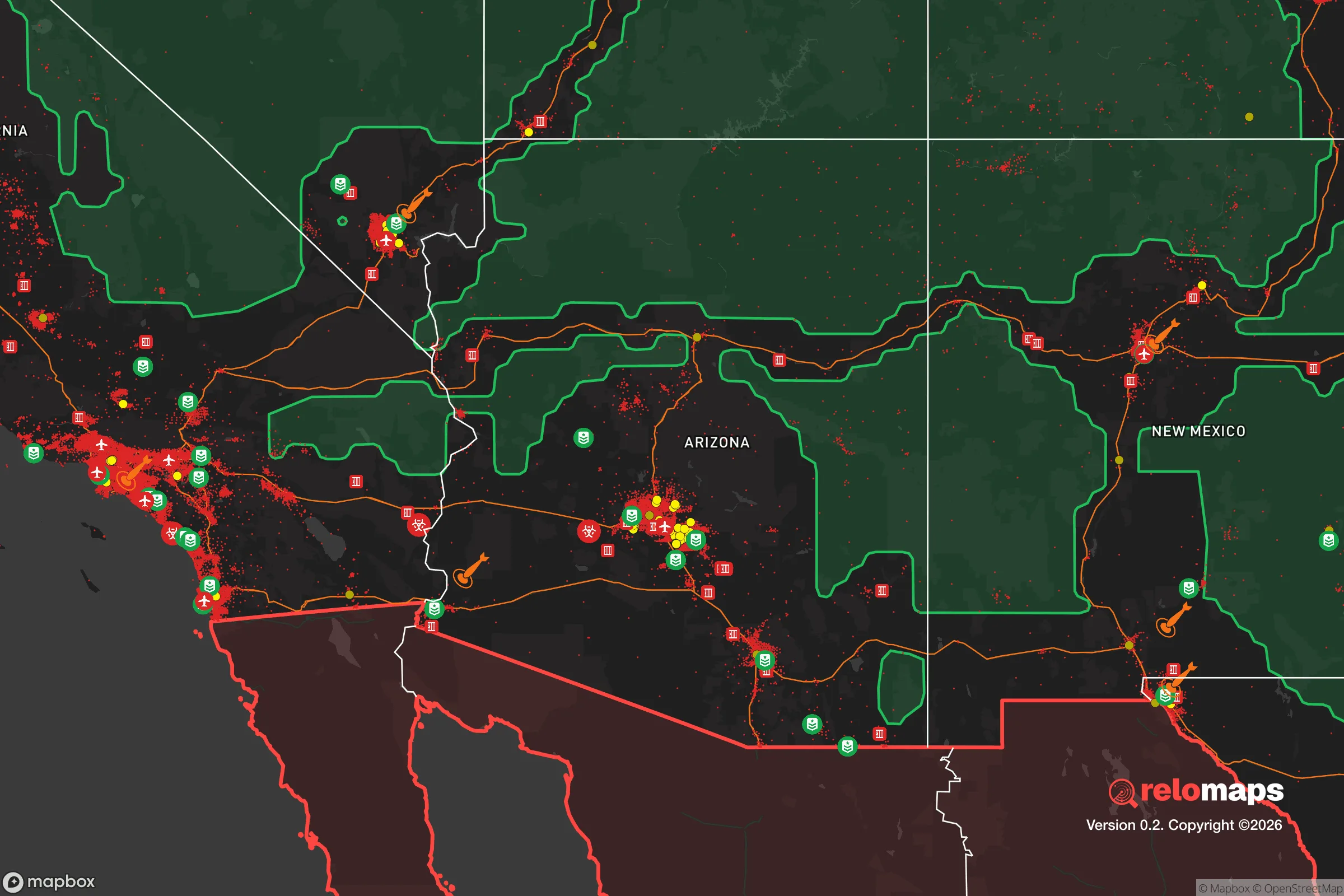


Important Note: For informational purposes only. This does not mean nothing bad ever happens in the green zones. Please use common sense. This is based on public data and modeled with AI. We tried to take a conservative approach but mistakes happen. We update this regularly as new information becomes available.
Solar Generator Recommendations
Backup power matters more here than in safer locations. We've picked three solar generators across budgets and capacity tiers — start with the budget unit if you only need a few essentials, or step up if you want to run a fridge and HVAC for days at a time.

Jackery Portable Power Station Explorer 300
Budget OptionPower on the Go: Weighing only 11 lbs, it's convenient to set up and store with book-sized foldable solar panels

BLUETTI Portable Power Station AC180
Designed for both indoor and outdoor scenarios, AC180 is highly capable as it has a robost capacity and continuous output power.

EF ECOFLOW DELTA Pro Ultra Power Station
Upgraded PickEcoFlow DELTA Pro Ultra is a whole-home energy system designed to grow with your family. Integrated with the Smart Home Panel 2, it scales to meet your evolving energy needs — keeping your home powered, intelligent, and secure through every stage of life.
We earn a commission, at no additional cost to you.
Strategic Assessment Analysis
Scottsdale sits in a precarious but potentially advantageous position for those serious about strategic relocation. Its location on the northeastern edge of the Phoenix metro area offers a buffer from the densest urban core while still providing access to critical infrastructure, but that same proximity to a major population center and its associated vulnerabilities—water scarcity, heat-island effects, and civil unrest potential—cannot be ignored. For a prepper or survivalist with a conservative mindset, Scottsdale’s real value lies in its blend of affluent, low-crime enclaves and its gateway role to the rugged, sparsely populated Sonoran Desert and the Tonto National Forest, which offer escape routes and remote resupply options. However, the city’s reliance on the Colorado River and its position downwind of potential fallout zones demand a clear-eyed assessment of risks versus rewards.
Geographic position and natural advantages for long-term survival
Scottsdale’s geography is a double-edged sword. The city sits at the base of the McDowell Mountains, with the McDowell Sonoran Preserve—over 30,000 acres of protected desert—providing immediate access to rugged terrain, natural water sources (ephemeral washes and a few perennial springs), and cover for those needing to bug out on foot or by off-road vehicle. The elevation ranges from roughly 1,200 to 2,500 feet, offering slightly cooler temperatures than Phoenix proper, which matters during extreme heat events that could accompany grid-down scenarios. The area’s arid climate means less risk of flooding or mold-related infrastructure collapse, but it also means annual rainfall averages only 8-10 inches, making independent water storage and purification non-negotiable. For a relocator, the key advantage is the ability to move east into the Tonto National Forest—nearly 3 million acres of federal land—where population density drops to near zero and natural cover increases. This is not a bug-out location in itself, but a staging ground for deeper desert or mountain retreats.
Risks, exposures, and proximity to fallout-relevant landmarks
The most glaring vulnerability is Scottsdale’s location within the Phoenix metro area, home to over 1.6 million people. In a mass casualty event—whether from a pandemic, coordinated attack, or economic collapse—the city’s affluent neighborhoods would become targets for looting and civil unrest, as seen in other cities during 2020. Scottsdale is less than 15 miles from Phoenix Sky Harbor International Airport, a potential target for a dirty bomb or conventional strike, and within 30 miles of Luke Air Force Base, which could draw retaliatory strikes in a conflict. Additionally, the city lies roughly 100 miles from the Palo Verde Nuclear Generating Station, the largest nuclear plant in the U.S. by output. While prevailing winds typically blow from the west, a worst-case release could deposit fallout across the eastern suburbs. The city’s water supply—90% from the Colorado River via the Central Arizona Project—is a single-point-of-failure risk; a drought or sabotage could leave Scottsdale dry within weeks. For the strategic relocator, these factors mean that Scottsdale is not a stand-alone survival location but a base that requires a hardened, self-sufficient property and a pre-planned evacuation route east or north.
Practical resilience for a relocator: food, water, energy, and defensibility
For those willing to invest, Scottsdale offers some practical resilience advantages. The city’s building codes are among the strictest in Arizona, with modern homes built to withstand 100-mph winds and seismic activity—a plus for structural integrity during disasters. Water storage is feasible: many homes have large lots (especially north of Shea Boulevard) where 10,000-gallon cisterns can be buried without violating HOA rules, though HOAs in areas like McCormick Ranch or DC Ranch may restrict visible modifications. Solar energy is a strong option, with over 300 sunny days per year and net metering policies that allow grid-tied systems to offset costs; off-grid setups require battery banks, which are legal but must be concealed from street view. Food production is limited by the arid climate—raised beds with shade cloth and drip irrigation can yield tomatoes, peppers, and squash, but year-round self-sufficiency would require a greenhouse and significant water storage. Defensibility varies by neighborhood: gated communities like Silverleaf or Estancia offer natural chokepoints and private security, but they also create a “fishbowl” effect if mobs target wealthy areas. A better bet is a property on the eastern edge, near the preserve, where a single access road and open desert provide early warning and escape routes. Firearms laws in Arizona are favorable—constitutional carry, no state-level magazine bans, and stand-your-ground statutes—but Scottsdale itself has a police force that is well-funded and responsive, which reduces the need for self-defense in normal times but could become overwhelmed in a crisis.
The overall strategic picture for Scottsdale is one of calculated trade-offs. It offers a high baseline of safety and infrastructure in stable times, with a strong economy (tourism, healthcare, and tech) that supports a self-reliant lifestyle. But its proximity to a major city, a nuclear plant, and a vulnerable water source means it is not a true retreat—it is a forward operating base. For the conservative prepper who can afford a property with hardened water, solar, and food systems, and who has a bug-out plan for the Tonto National Forest or the Mogollon Rim, Scottsdale can work as a long-term home. For those seeking isolation and minimal risk, the trade-offs are too high. The smart move is to treat Scottsdale as a hub for resources and community, not a final destination, and to have a secondary location ready in the high country or the desert beyond.

* Values derived from national, state, county, city and local statistics and may differ in a specific area. Last updated: 2026-04-15T23:28:41.000Z
Narrative content on this page is AI-generated and may contain mistakes. Verify any details that matter before acting on them.
ReloMaps may earn a commission from affiliate links at no extra cost to you.

