 Popular

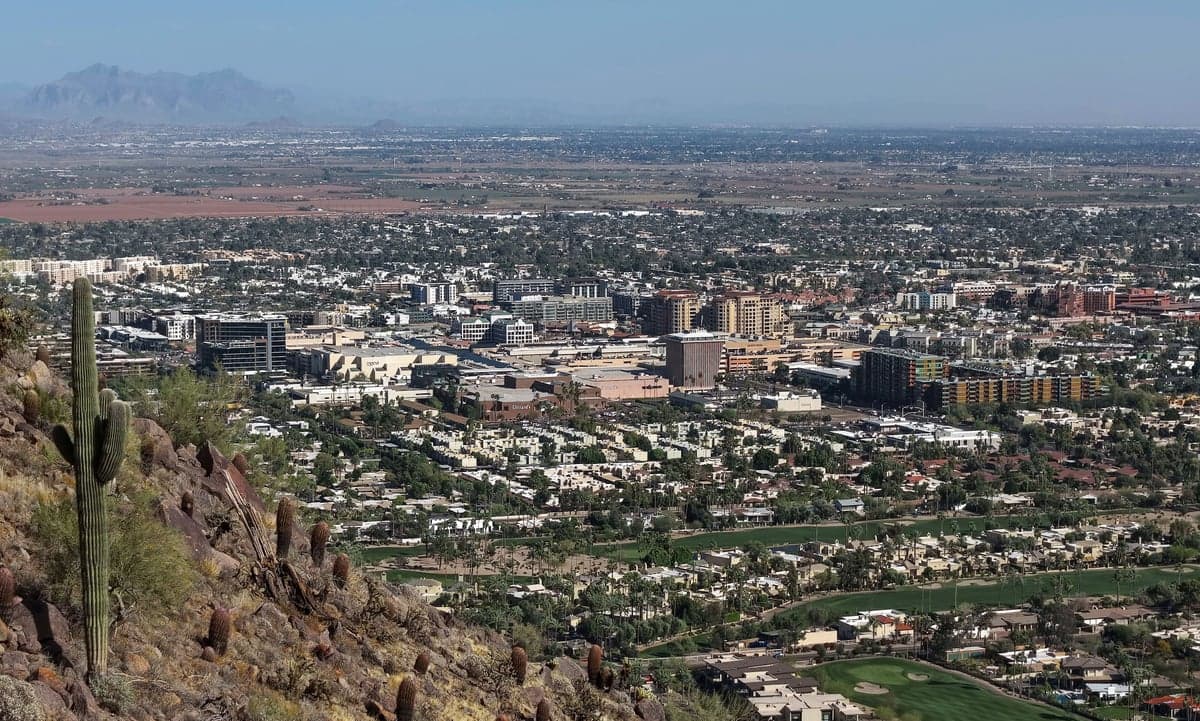
Photo: Wikipedia
Demographics of Scottsdale, AZ
Affluence Level in Scottsdale, AZ
An upper-middle-class area. Household wealth, education levels, and homeownership run ahead of national benchmarks.
People of Scottsdale, AZ
The people of Scottsdale, Arizona today number 242,169, forming a predominantly white, highly educated, and affluent population with a distinctive Western luxury identity. With 78.7% of residents identifying as white and 61.5% holding a college degree, Scottsdale ranks among the most educated and least diverse major suburbs in the Phoenix metro area. The city’s character is defined by its blend of high-end tourism, second-home ownership, and a growing professional class drawn by finance, healthcare, and tech sectors. Foreign-born residents make up just 4.2% of the population, a figure well below the national average, reinforcing Scottsdale’s reputation as a destination for domestic in-migration rather than international immigration.
How the city was settled and grew
Scottsdale was founded in 1888 by U.S. Army Chaplain Winfield Scott, who purchased 640 acres of desert land and promoted it as a farming and citrus-growing community. The original population was almost entirely Anglo-American homesteaders from the Midwest and East Coast, drawn by the promise of irrigated agriculture along the Arizona Canal. The city remained a small agricultural town through the early 20th century, with a 1950 population of just 2,000. The first major growth wave came after World War II, when returning veterans and retirees from colder states began settling in the Old Town Scottsdale area, which remains the historic core. The 1950s and 1960s saw the construction of the McCormick Ranch master-planned community, which attracted wealthy snowbirds and corporate transplants with its golf courses and ranch-style homes. The city’s population exploded from 10,000 in 1960 to nearly 68,000 by 1970, driven by air conditioning, interstate highways, and the rise of Phoenix as a Sun Belt hub.
Modern era (post-1965)
After the 1965 Hart-Cellar Act, Scottsdale’s demographic trajectory diverged sharply from other Sun Belt cities. Unlike Phoenix or Mesa, Scottsdale did not absorb large waves of Hispanic or Asian immigrants. Instead, the city became a magnet for domestic migrants—primarily white professionals, retirees, and second-home buyers from California, the Midwest, and the Northeast. The 1970s and 1980s saw the development of the Gainey Ranch and DC Ranch neighborhoods, both master-planned communities designed for upper-income families and empty-nesters. These areas remain overwhelmingly white and affluent today. The South Scottsdale corridor, closer to Old Town, became the most diverse part of the city, with a modest Hispanic population (9.4% citywide) concentrated in older apartment complexes and smaller homes. East/Southeast Asian residents (2.9%) and Indian-subcontinent residents (2.2%) are dispersed across the city, with small clusters near the Scottsdale Airpark employment zone, where tech and financial firms have located. The Black population remains very small at 1.9%, with no distinct neighborhood concentration. The city’s foreign-born share of 4.2% is the lowest among major Phoenix suburbs, reflecting its role as a domestic rather than international destination.
The future
Scottsdale’s population is projected to grow slowly, reaching roughly 260,000 by 2035, as available land for new development diminishes. The city is not homogenizing into a single demographic bloc but rather tribalizing into distinct lifestyle enclaves: North Scottsdale (including DC Ranch and Troon North) continues to attract wealthy families and retirees, while South Scottsdale is seeing gradual infill development and a slight uptick in Hispanic and younger professional residents. The Indian-subcontinent population, while small, is growing faster than any other minority group, driven by tech and healthcare jobs at the Scottsdale Airpark and nearby Mayo Clinic. East/Southeast Asian communities are plateauing, with many second-generation residents moving to Chandler or Tempe for more affordable housing. The Hispanic share is expected to rise slowly to around 12% by 2040, primarily through natural increase rather than new immigration. The white share will likely decline to the low 70s as the city ages and younger, more diverse cohorts enter the housing market. Scottsdale is becoming a more stratified city—wealthy and white in the north, slightly more diverse and middle-class in the south—but it will remain one of the least foreign-born and most highly educated cities in Arizona for the foreseeable future.
For a conservative-leaning individual or family considering relocation, Scottsdale offers a stable, low-crime, high-amenity environment with a population that is overwhelmingly native-born, English-dominant, and college-educated. The city is not becoming a melting pot but rather a series of affluent, lifestyle-oriented enclaves where demographic change is slow and incremental. New arrivals should expect a community that values privacy, outdoor recreation, and high property values, with limited exposure to the rapid ethnic diversification seen in other parts of the Phoenix metro area.

* Values derived from national, state, county, city and local statistics and may differ in a specific area. Last updated: 2026-04-15T23:28:41.000Z
Narrative content on this page is AI-generated and may contain mistakes. Verify any details that matter before acting on them.
ReloMaps may earn a commission from affiliate links at no extra cost to you.

