Photo: Wikipedia
Demographics of Shreveport, LA
Affluence Level in Shreveport, LA
A below-average socioeconomic profile. Incomes, home values, and educational attainment trail the U.S., with higher poverty and unemployment.
People of Shreveport, LA
Shreveport, Louisiana, is a majority-Black city of 183,483 residents, shaped by deep Southern roots and a history of boom-and-bust cycles tied to oil, gas, and river commerce. With a foreign-born population of just 1.4%, it remains one of the least ethnically diverse cities of its size in the South, and its population has been declining for decades. The city’s identity is defined by a stark Black-white demographic split, a small but growing Hispanic presence, and a sense of place rooted in historic neighborhoods that tell the story of who came, when, and why.
How the city was settled and grew
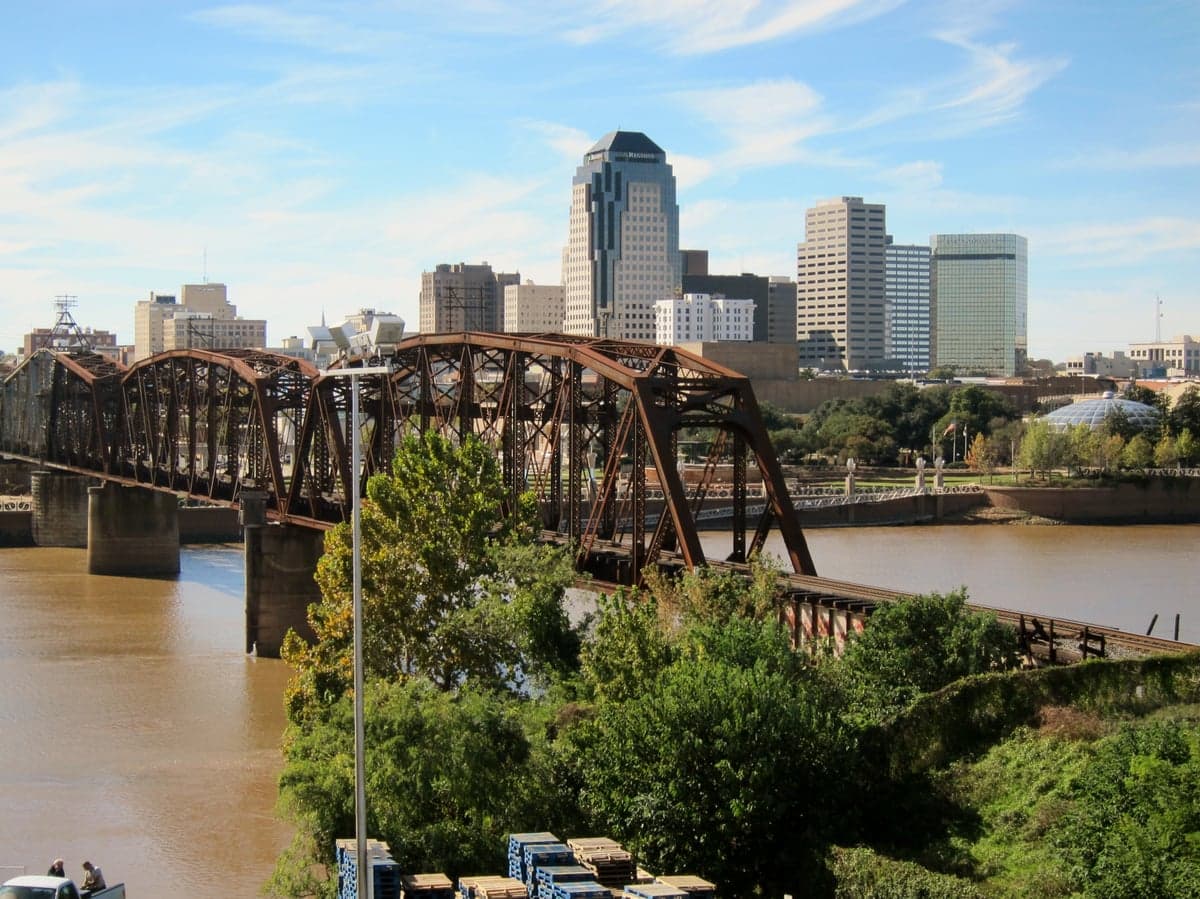
Shreveport was founded in 1836 as a speculative river town on the Red River, named after Captain Henry Miller Shreve, who cleared the river’s logjam to open navigation. The original settlers were Anglo-American planters and merchants from the Deep South, drawn by cotton and the river trade. By the 1870s, the city became a railroad hub, and the first major Black population arrived during Reconstruction, many as freedmen seeking work in the riverfront and rail yards. These early Black residents settled in Allendale and Lakeside, neighborhoods that remain historically Black today. The discovery of the Caddo-Pine Island oil field in 1906 triggered a boom that brought white and Black workers from across Texas, Arkansas, and Louisiana. White oil workers and managers built homes in South Highlands and Broadmoor, while Black laborers concentrated in Cooper Road and Stoner Hill. By 1950, Shreveport’s population had swelled to over 127,000, with a Black share of roughly 35%.
Modern era (post-1965)
The post-1965 era brought dramatic demographic change. The 1960s and 1970s saw white flight to suburban Bossier City and outlying areas, accelerated by school desegregation orders and the decline of downtown retail. Between 1970 and 2020, the white population fell from roughly 65% to 35.4%, while the Black population rose from 35% to 56.0%. Most white families who remained moved to the southern and southwestern edges of the city, particularly Southern Hills and the Ellerbe Road corridor. Black families expanded into formerly white neighborhoods like Broadmoor and South Highlands, though these areas remain more integrated than the city’s northern and western sections. The Hispanic population, now 3.9%, grew slowly, concentrated in the West Shreveport area near the industrial corridor. East and Southeast Asian communities (1.1%) are small and dispersed, with no single ethnic enclave. The Indian-subcontinent population (0.3%) is negligible. The foreign-born share of 1.4% is among the lowest for any U.S. city of this size, reflecting limited immigration and a population that is overwhelmingly native-born.
The future
Shreveport’s population is heading downward and aging. The city lost roughly 16,000 residents between 2010 and 2020, and the trend continues. Outmigration is driven by a weak job market, high poverty rates, and the pull of faster-growing metros in Texas and the Southeast. The Black share is likely to continue rising slowly as the white population ages and younger white families leave. The Hispanic share is growing from a very low base but remains far below the national average. The city is not tribalizing into distinct new enclaves; rather, it is becoming more uniformly Black, with the remaining white population concentrated in a few southern neighborhoods. No significant immigrant gateway is emerging. For a newcomer, Shreveport offers a deeply Southern, majority-Black city with a low cost of living and a strong sense of community in its historic neighborhoods, but the demographic trajectory suggests continued population loss and limited ethnic diversification over the next decade.
Shreveport is becoming a smaller, older, and more uniformly Black city, with a shrinking white population and only modest Hispanic growth. For a conservative-leaning individual or family moving in, this means a place where community ties are strong but economic opportunity is limited, and where the demographic future is one of slow contraction rather than growth or diversification.

* Values derived from national, state, county, city and local statistics and may differ in a specific area. Last updated: 2026-05-01T18:08:32.000Z
Narrative content on this page is AI-generated and may contain mistakes. Verify any details that matter before acting on them.
ReloMaps may earn a commission from affiliate links at no extra cost to you.

