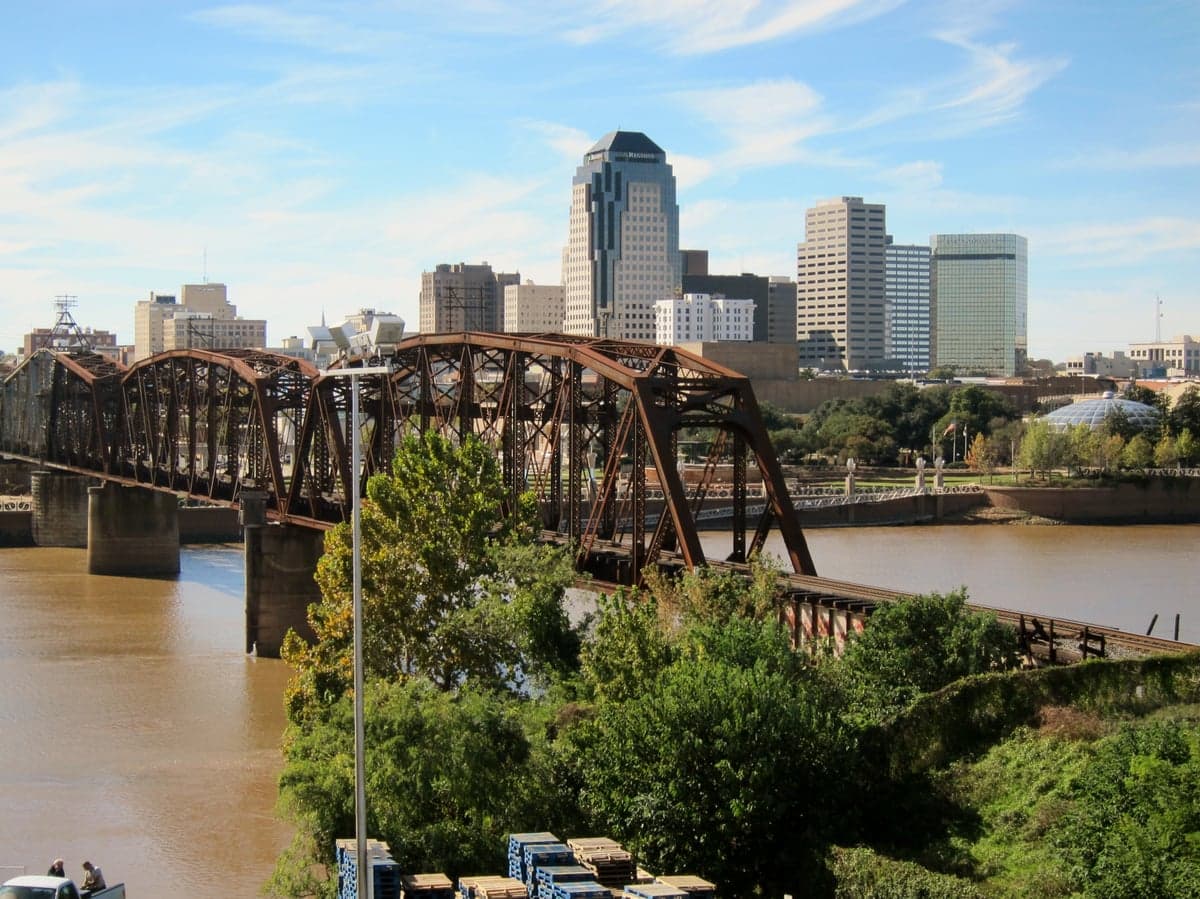
Photo: Wikipedia
Personal Sovereignty in Shreveport, LA
Strong independent fundamentals that actively favor personal liberty and low regulation.
What does Personal Sovereignty tell us?
Personal Sovereignty measures your capacity for self-reliance and independence with minimal government friction. Higher scores mean fewer barriers between you and the way you want to live... but it assumes you have the space you need and good neighbors.
What does this tell us?
Personal Sovereignty measures your capacity for self-reliance and independence with minimal government friction. Higher scores mean fewer barriers between you and the way you want to live... but it assumes you have the space you need and good neighbors.
State Policy
Energy independence: Net exporter (280% of energy produced in-state)
Personal Liberty
Homesteading

Personal Liberty Analysis
Shreveport offers a mixed bag for those prioritizing personal sovereignty, but the overall environment leans more toward individual autonomy than what you’ll find in many coastal or deep-blue states. While Louisiana’s state-level policies generally favor self-reliance—with low taxes, permissive gun laws, and minimal zoning in rural pockets—Shreveport itself sits in Caddo Parish, where local governance can sometimes introduce friction. For a survivalist or prepper mindset, the key is understanding where the state’s constitutional protections end and where city ordinances begin, particularly around property use, medical freedom, and self-defense.
Tax burden and regulatory posture in Louisiana and Shreveport
Louisiana’s tax structure is a net positive for sovereignty-minded individuals. There is no state property tax, though local parishes levy their own—Caddo Parish’s effective rate hovers around 0.52% of assessed value, which is below the national average. State income tax is a flat 3% for most earners, and sales tax in Shreveport totals about 9.55% (state + local). For a prepper, the absence of a state property tax means you can own land without the government taking a recurring cut based on assessed improvements—a subtle but real advantage for those building off-grid or homesteading. Regulatory posture at the state level is light: no state-level OSHA for private employers, minimal business licensing requirements, and no state-mandated energy codes for residential construction. However, Shreveport’s city government has a reputation for being more interventionist on issues like short-term rentals and building permits. The city’s zoning code, while not as restrictive as in the Northeast, still requires permits for accessory structures over 200 square feet—something a prepper building a bunker or workshop should plan around. Overall, the tax burden is low enough to keep more money in your pocket for supplies and land, but you’ll want to stay outside city limits if you want to avoid permit hassles.
Self-defense and gun law specifics in Louisiana and Shreveport
Louisiana is a constitutional carry state—no permit needed to carry a concealed firearm for anyone 18 or older who can legally possess one. This is a major win for personal sovereignty. Shreveport itself does not impose additional gun restrictions beyond state law, though the city has a higher-than-average violent crime rate (about 1,100 violent crimes per 100,000 residents in 2024), which makes carrying a practical necessity for many residents. Stand-your-ground laws are fully in effect: no duty to retreat if you are in a place you have a right to be. Castle doctrine applies to your home, vehicle, and workplace. For preppers, the state also allows the use of suppressors (with a federal tax stamp) and short-barreled rifles (with NFA paperwork). There are no state-level magazine capacity limits or assault weapon bans. One nuance: Louisiana does not have a “red flag” law, so there is no mechanism for temporary firearm seizure without a criminal conviction—a significant protection against government overreach. However, Shreveport’s local police have been known to respond aggressively to “brandishing” complaints, so discretion in public is wise. For a survivalist, the legal framework here is among the most permissive in the South, second only to states like Texas or Arkansas.
Self-reliance and homesteading viability: lot sizes, zoning, and off-grid feasibility
Shreveport’s urban core is not ideal for serious homesteading—most residential lots are 6,000 to 10,000 square feet, and city zoning restricts livestock (no chickens in many neighborhoods, no goats or pigs within city limits). But the surrounding areas—Bossier Parish to the east, rural Caddo Parish to the north and west—offer a different story. Outside city limits, minimum lot sizes drop to 1 acre in unincorporated areas, and many parcels are 5 to 20 acres, available for $3,000–$6,000 per acre as of 2025. Zoning in unincorporated Caddo Parish is minimal: no building permits for agricultural structures under 1,000 square feet, and no restrictions on rainwater collection, composting toilets, or solar panels. Off-grid feasibility is high: Louisiana has no state-level ban on off-grid living, though you will need a septic system permit (about $500) and a well permit (about $200). The climate is humid subtropical, so solar panels work year-round but require battery storage for cloudy stretches. Wood heating is common, and the state offers a tax credit for 50% of the cost of a wood-burning stove (up to $500). For a prepper, the real sweet spot is the rural fringe—places like Keithville, Mooringsport, or Belcher—where you can buy 10 acres, drill a well, and live with minimal government interference. Just be aware that Caddo Parish does enforce property maintenance codes if you let things get visibly run-down, so keep your land tidy.
Personal liberties: parental rights, medical autonomy, speech, and property
Louisiana has strong statutory protections for parental rights. The state’s “Parental Bill of Rights” (Act 436 of 2024) explicitly affirms that parents have the fundamental right to direct their children’s education, healthcare, and religious upbringing. This means no mandatory vaccine requirements for school attendance (medical and religious exemptions are honored), and parents can opt their children out of any sex education or “social-emotional learning” curriculum without penalty. Medical autonomy is also robust: Louisiana does not have a state-level vaccine mandate for adults, and there are no restrictions on purchasing raw milk, herbal supplements, or off-label medications. The state’s medical freedom law (Act 472 of 2022) prohibits discrimination based on vaccination status for employment or services. On speech, Louisiana is a First Amendment-friendly state—no hate speech laws beyond federal standards, and no state-level “disinformation” boards. Property rights are protected by a strong homestead exemption (up to $35,000 of assessed value exempt from seizure in bankruptcy) and a “right to farm” law that shields agricultural operations from nuisance lawsuits. For a survivalist, the biggest concern is that Shreveport’s city council has occasionally floated ordinances on noise, light pollution, and “public nuisance” that could theoretically be used to harass off-grid setups—but these have not passed as of early 2026. Overall, the legal climate here respects individual choice far more than in states like California or New York.
When stacked against other regions, Shreveport and its surrounding rural areas offer a solid foundation for personal sovereignty—especially for those willing to live outside city limits. The tax burden is low, gun laws are among the most permissive in the nation, and state-level protections for parental rights and medical autonomy are strong. The trade-offs are real: Shreveport’s urban crime rate is high, the local government can be meddlesome on permits, and the humid climate requires robust infrastructure for off-grid living. But for a prepper or survivalist looking for a low-cost, low-regulation base in the South, the Shreveport-Bossier area ranks well—comparable to rural Texas or Arkansas, but with cheaper land and a more relaxed regulatory environment. If you can tolerate the humidity and stay out of the city’s permit bureaucracy, this is a place where you can build the life you want without the government looking over your shoulder.

* Values derived from national, state, county, city and local statistics and may differ in a specific area. Last updated: 2026-05-01T18:08:32.000Z
Narrative content on this page is AI-generated and may contain mistakes. Verify any details that matter before acting on them.
ReloMaps may earn a commission from affiliate links at no extra cost to you.

