Photo: Wikipedia
Demographics of Sioux Falls, SD
Affluence Level in Sioux Falls, SD
A middle-class area roughly in line with national averages across income, home values, education, and employment.
People of Sioux Falls, SD
The people of Sioux Falls today number 197,642, forming a population that is predominantly white (78.1%) but increasingly diverse, with a foreign-born share of 4.7% that has grown steadily since the 1990s. The city’s character is shaped by a blend of Midwestern stability and new arrivals drawn by a strong job market in healthcare, finance, and manufacturing. Distinctive markers include a relatively young median age, a college-educated rate of 37.4%, and a noticeable concentration of East/Southeast Asian and Indian communities in specific neighborhoods, reflecting targeted economic migration rather than broad ethnic clustering.
How the city was settled and grew
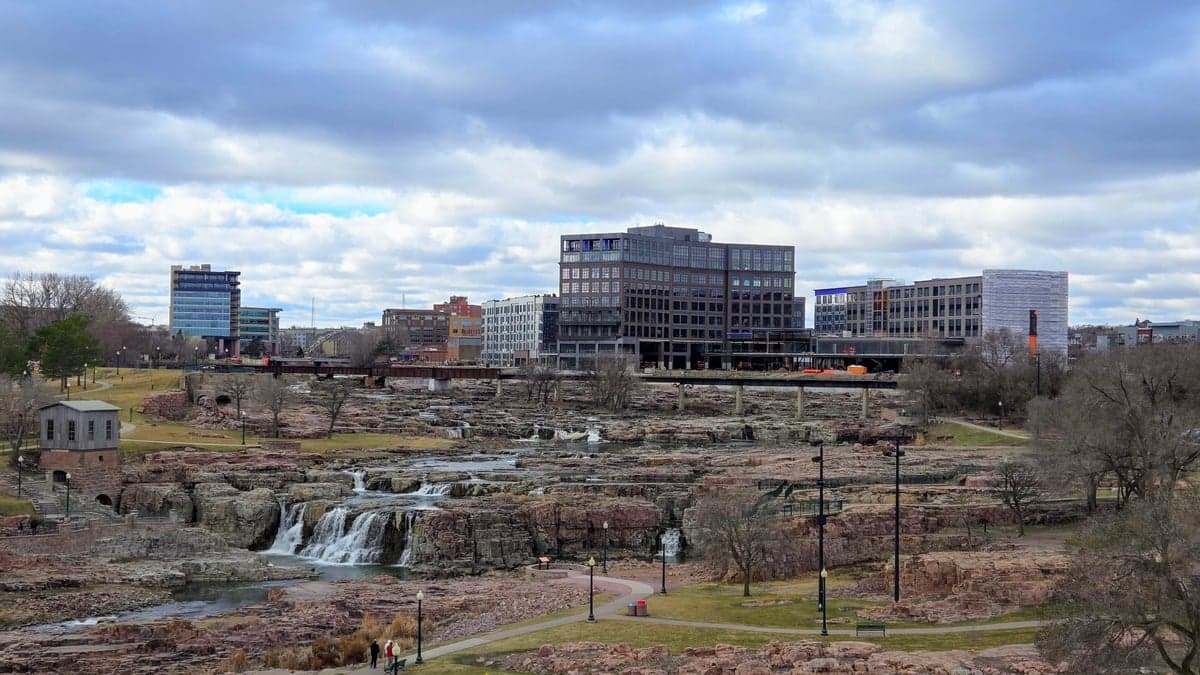
Sioux Falls was founded in 1856 around the falls of the Big Sioux River, with the original population consisting of Euro-American settlers—primarily of German, Norwegian, and Irish stock—who arrived via the Dakota Land Company’s land claims. The city’s early growth was driven by the quartzite quarrying industry and the arrival of the railroad in the 1870s, which turned it into a regional trade hub. The original settlers built the Cathedral Historic District, where many of the city’s oldest homes and churches still stand, reflecting the German and Scandinavian roots of the founding families. A second wave of European immigrants, including Czechs and Poles, arrived in the early 1900s to work in the stockyards and meatpacking plants, settling in the Dell Rapids area and the near south side around what is now McKennan Park. By 1950, the population was nearly entirely white and native-born, with a small African American community tied to railroad work.
Modern era (post-1965)
After the Hart-Cellar Act of 1965, Sioux Falls saw limited immigration until the 1990s, when refugee resettlement programs began bringing East/Southeast Asian groups—primarily Vietnamese and Hmong families—who settled in the central city neighborhoods near the intersection of Minnesota Avenue and 10th Street, where affordable housing and social services were concentrated. The city’s modern demographic shift accelerated after 2000, driven by domestic in-migration from the Midwest and West Coast, attracted by low unemployment and a cost of living below the national average. The Black population grew to 6.9%, largely through secondary migration from Chicago and Minneapolis, with families gravitating toward the southwest side near the Sanford Health campus and the eastern edge around the new high school. The Hispanic population (6.4%) expanded through both direct immigration from Mexico and Central America and internal moves from Texas and California, concentrating in the northwest quadrant near the meatpacking plants. The Indian subcontinent community (1.0%) is a newer, professional cohort, heavily tied to the healthcare and IT sectors, and clusters in the south-central neighborhoods around 41st Street and Louise Avenue, near the Sanford and Avera medical hubs. The East/Southeast Asian community (1.3%) remains smaller and more dispersed, with a visible presence in the downtown core and near the university.
The future
The population is heading toward continued moderate growth, projected to reach roughly 220,000 by 2035, driven by domestic in-migration rather than international arrivals. The city is not homogenizing; instead, it is tribalizing into distinct enclaves by income and ethnicity. The white population share is declining slowly (down from 85% in 2000), while the Hispanic and Black shares are rising steadily. The Indian and East/Southeast Asian communities are growing but from a small base, and they are likely to plateau as professional migration stabilizes. The foreign-born share (4.7%) is below the national average and is not expected to surge, as Sioux Falls lacks the large-scale refugee resettlement programs of the past. The next decade will likely see the southwest side become more affluent and white, the northwest side more Hispanic, and the central city more mixed, with the Black population spreading into the eastern suburbs. For a new resident, this means moving into a city where neighborhoods have distinct identities but remain safe and well-served by infrastructure.
Sioux Falls is becoming a more diverse but still predominantly white Midwestern city, where economic opportunity drives growth and ethnic enclaves are forming along income lines. For someone moving in now, the city offers a stable, family-oriented environment with a growing mix of cultures, though the pace of change is moderate and the overall character remains rooted in its Scandinavian and German heritage.

* Values derived from national, state, county, city and local statistics and may differ in a specific area. Last updated: 2026-04-30T00:42:09.000Z
Narrative content on this page is AI-generated and may contain mistakes. Verify any details that matter before acting on them.
ReloMaps may earn a commission from affiliate links at no extra cost to you.

