
Political ClimatePolitical Climate in Skidaway Island, GA
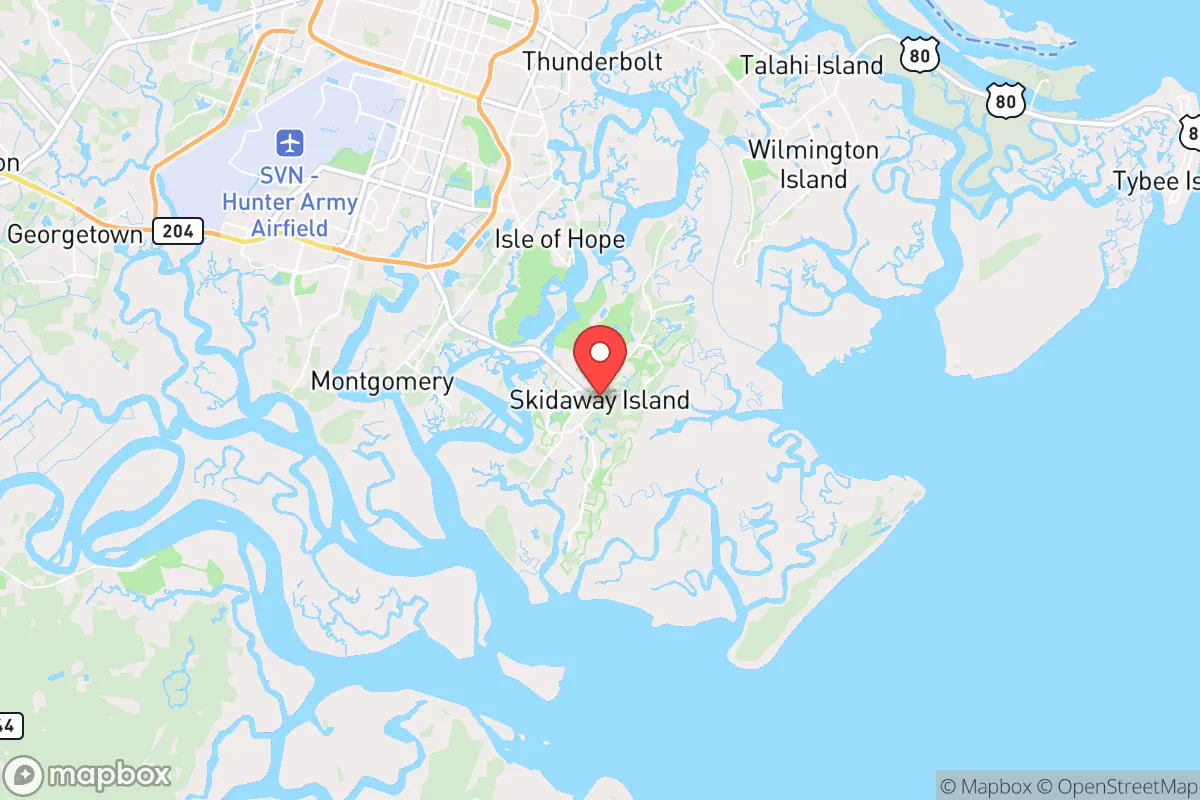
District shown is the primary district for this city’s centroid. Cities may span multiple districts.
Local Political AnalysisPolitical Analysis of Skidaway Island, GA
Skidaway Island leans solidly conservative, with a Cook PVI of R+8 that places it firmly in Republican territory, though the vibe here is more of a quiet, steady red than the loud, firebrand kind you might see in other parts of Georgia. The island itself has long been a haven for folks who value personal freedom, low taxes, and a government that stays out of your business—think less regulation, more common sense. Over the past decade, the political lean has held steady, but there’s a growing undercurrent of concern among long-time residents as nearby Savannah and Chatham County have started shifting leftward, bringing with them policies that feel like a slow creep of government overreach into daily life.
How it compares
Compared to the surrounding area, Skidaway Island is a distinct conservative bubble. Just a few miles west, Savannah’s core has trended increasingly progressive, with city council pushing initiatives like expanded public housing mandates and stricter environmental regulations that some here see as unnecessary red tape. Across the county, the contrast is stark: Chatham County as a whole leans more moderate, but Skidaway’s R+8 rating puts it in a different league from places like the Historic District or midtown, where younger transplants and university influence have nudged politics left. Head north to Pooler or Richmond Hill, and you’ll find similar conservative values, but Skidaway’s older, more established population—many retired military, business owners, and professionals—gives it a particularly grounded, don’t-tread-on-me character. The island’s gated communities and private neighborhoods also mean less exposure to the county’s broader political noise, which is both a blessing and a potential blind spot if things keep shifting.
What this means for residents
For residents, this political climate translates into a daily life where personal freedoms are largely respected—property rights are strong, zoning is minimal, and there’s little appetite for the kind of progressive social engineering you see in blue cities. You won’t find heavy-handed mask mandates or business shutdowns here; the local mindset is that people can make their own choices without a bureaucrat breathing down their neck. That said, the long-term trend is concerning. As Savannah’s influence grows, there’s been a push for more county-level oversight on everything from short-term rentals to coastal development, which could chip away at the island’s autonomy. Property taxes have inched up, and some worry that if the county flips further left, we’ll see more of that “we know what’s best for you” attitude creeping in. For now, though, Skidaway remains a place where you can live your life without a lot of government interference, and that’s exactly how most folks here want it.
Culturally, Skidaway Island has a distinct policy distinction: it’s one of the few places in coastal Georgia where you can still build or renovate a home without jumping through a dozen environmental hoops, thanks to the island’s private governance and a local board that leans heavily toward property rights over preservationist agendas. There’s a strong sense of community self-reliance—neighbors help neighbors, and the HOA handles the basics without turning into a mini-government. The shift toward progressive ideology elsewhere in the state is a real red flag for many here, especially as younger families move in and bring different ideas about taxes, land use, and social programs. But the old guard isn’t going quietly; they’re active in local elections and county meetings, fighting to keep Skidaway the kind of place where freedom isn’t just a slogan—it’s how you live. If you’re looking for a place that values individual liberty over collective control, this island still delivers, but keep an eye on the horizon.

State Political ClimatePolitical Climate in Georgia
State Political AnalysisPolitical Environment in the State
Georgia has shifted from a reliably red state to a genuine battleground over the past two decades, but its political soul remains deeply conservative outside of a few metro corridors. The state voted Republican in every presidential election from 1996 through 2016, then flipped blue for Biden in 2020 by a razor-thin 0.2% margin, only to see Trump carry it again in 2024 by roughly 2 points. This volatility masks a stable reality: Georgia’s conservative coalition is anchored in the sprawling exurbs, small towns, and rural counties, while Democrats have consolidated power in Atlanta’s urban core and its close-in suburbs. For a conservative considering relocation, the key question is whether you’ll land in a county that still reflects traditional values or one that’s been transformed by rapid in-migration and progressive activism.
Urban vs. rural divide
The political map of Georgia is a tale of two Georgias. The Atlanta metro area—Fulton, DeKalb, Cobb, Gwinnett, and Clayton counties—now accounts for roughly 60% of the state’s population and votes overwhelmingly Democratic. Fulton County alone delivered 73% of its vote to Biden in 2020, while DeKalb hit 84%. These numbers are driven by a combination of transplants from blue states, a growing Black professional class, and younger voters who have flooded into intown neighborhoods like Midtown, Buckhead, and the Old Fourth Ward. Meanwhile, the rest of the state remains deeply red. Rural counties like Murray, Gilmer, and Union in the north routinely vote 80%+ Republican, as do the agricultural counties of southwest Georgia like Colquitt and Thomas. The real action is in the exurban “collar counties” that ring Atlanta: Cherokee, Forsyth, Paulding, and Coweta. These counties have exploded in population over the last decade and remain solidly conservative—Forsyth County gave Trump 65% in 2024—but they’re also seeing an influx of moderates priced out of Cobb and Gwinnett. If you’re looking for a conservative-friendly environment with good schools and lower taxes, towns like Canton, Cumming, Dallas, and Newnan are where you’ll find like-minded neighbors. The coastal city of Savannah leans blue but is surrounded by conservative Chatham County, while Augusta and Columbus are purple-to-red metros with strong military and manufacturing bases.
Policy environment
Georgia’s state-level policy environment is broadly conservative, though not as aggressively so as Texas or Florida. The state has a flat income tax rate of 5.49% (down from 5.75% in 2024, with a path to 4.99% by 2029), and no state-level property tax—counties handle that. Georgia is a right-to-work state, meaning no forced union membership, and its regulatory climate is business-friendly, with no state-level minimum wage above the federal $7.25. On education, Georgia has a robust school choice program: the Georgia Promise Scholarship Act (2024) provides $6,500 per student for private school tuition or homeschooling expenses, and the state has over 100 charter schools. However, the state’s public school system is a mixed bag—rural districts often struggle, while suburban districts like Forsyth County Schools and Cherokee County Schools are top-tier. On healthcare, Georgia did not expand Medicaid under the ACA, and the state’s private insurance market is relatively competitive. Election integrity is a hot topic: the 2021 Election Integrity Act (SB 202) added voter ID requirements for absentee ballots, limited drop boxes, and banned mobile voting vans. It’s been attacked by the left as “Jim Crow 2.0,” but it’s held up in court and remains in effect. For conservatives, this is a net positive—it’s harder to cheat, and the state’s election machinery is now more transparent than in 2020.
Trajectory & freedom
Georgia’s trajectory on personal freedom is a mixed bag, trending in the right direction on some fronts but with worrying signs on others. On the positive side, Georgia became a constitutional carry state in 2022 (HB 218), allowing law-abiding citizens to carry a concealed firearm without a permit. This was a major win for Second Amendment advocates. The state also passed a parental rights bill in 2022 (HB 1178) that requires schools to notify parents of any changes to a student’s mental, emotional, or physical health—effectively blocking “don’t say gay” style policies from the left. On the negative side, Governor Brian Kemp signed a medical marijuana expansion in 2023 (HB 458), allowing low-THC oil for a broad list of conditions—a step toward normalization that worries some conservatives. More concerning is the 2024 “Safe at Home” law (SB 441), which created a state-run address confidentiality program for victims of domestic violence, stalking, and human trafficking. While well-intentioned, it sets a precedent for government-managed identity masking that could be expanded. Property rights remain strong—Georgia has no statewide rent control, and zoning is largely local—but the influx of out-of-state buyers is driving up home prices in conservative exurbs, making it harder for locals to afford homes. The biggest freedom concern is the Atlanta city government’s progressive overreach: the city has passed sanctuary policies limiting cooperation with ICE, and in 2024 it enacted a “safe streets” ordinance that restricts police traffic stops for minor violations. If you live in Atlanta proper, you’re subject to these policies; if you live in the exurbs, you’re largely insulated.
Civil unrest & political movements
Georgia has seen its share of political flashpoints, particularly in Atlanta. The 2020 protests following George Floyd’s death turned into riots in parts of Atlanta, with the Wendy’s on University Avenue burned to the ground and the city’s police precinct in the “Cop City” area becoming a flashpoint. The “Stop Cop City” movement—a left-wing activist campaign against a planned police training facility in DeKalb County—has led to violent clashes, including the 2023 shooting death of activist Manuel “Tortuguita” Terán by state troopers. This remains a live issue, with ongoing protests and legal battles. On the right, the Georgia Republican Party has been riven by internal fights between establishment conservatives (Kemp, Lt. Gov. Burt Jones) and Trump-aligned populists, but the party remains unified on core issues like election integrity and gun rights. Immigration politics are tense: Georgia is not a sanctuary state, but Atlanta’s city policies create friction. In 2024, the state legislature passed SB 110, which requires local law enforcement to cooperate with ICE detainers—a direct rebuke to Atlanta’s sanctuary stance. Election integrity remains a live wire: the 2020 election saw widespread allegations of irregularities in Fulton County, including ballot harvesting and chain-of-custody issues, which led to the 2021 law. The 2024 election was cleaner, but distrust lingers among conservatives. For a new resident, the most visible sign of political tension is the ubiquitous “Stop Cop City” graffiti in intown Atlanta versus the “Back the Blue” signs in exurban subdivisions.
Projection
Over the next 5-10 years, Georgia will likely remain a purple state, but the balance could tip further left if current demographic trends continue. The Atlanta metro is absorbing roughly 100,000 new residents per year, many from blue states like California, New York, and Illinois. These transplants tend to vote Democratic and bring progressive cultural values. However, the exurban counties are also growing fast, and they’re voting red. The key battleground will be the “collar counties”—Cherokee, Forsyth, Paulding, Coweta, and Henry. If these counties stay red, Georgia remains competitive for Republicans. If they flip purple, the state will become solidly blue. The state legislature is likely to remain Republican-controlled through 2030 due to gerrymandering, but the governor’s mansion could flip if a charismatic Democrat emerges. On policy, expect continued fights over election laws, school choice expansion, and property taxes. The biggest wildcard is the Atlanta city government’s push for more progressive policies—if the state legislature preempts Atlanta on issues like rent control, sanctuary policies, or police reform, it could create a legal and political firestorm. For a conservative moving in now, the safest bet is to choose a county like Forsyth or Cherokee, where the political culture is stable and the schools are strong. Avoid intown Atlanta and close-in suburbs like Decatur or Smyrna, which are trending hard left.
Bottom line: Georgia is still a good bet for conservatives who pick their location carefully. The state-level policy environment is solidly center-right, with low taxes, strong gun rights, and school choice. But the cultural and demographic tide is moving against traditional values in the metro core. If you’re a single professional or a parent looking for a community that shares your values, stick to the exurbs north of Atlanta or the smaller cities like Augusta, Columbus, or Macon. Avoid the intown Atlanta bubble, and you’ll find a state that still respects your freedoms—for now.
* Values derived from national, state, county, city and local statistics and may differ in a specific area. Last updated: 2026-04-23T05:15:54.000Z
Narrative content on this page is AI-generated and may contain mistakes. Verify any details that matter before acting on them.
ReloMaps may earn a commission from affiliate links at no extra cost to you.

