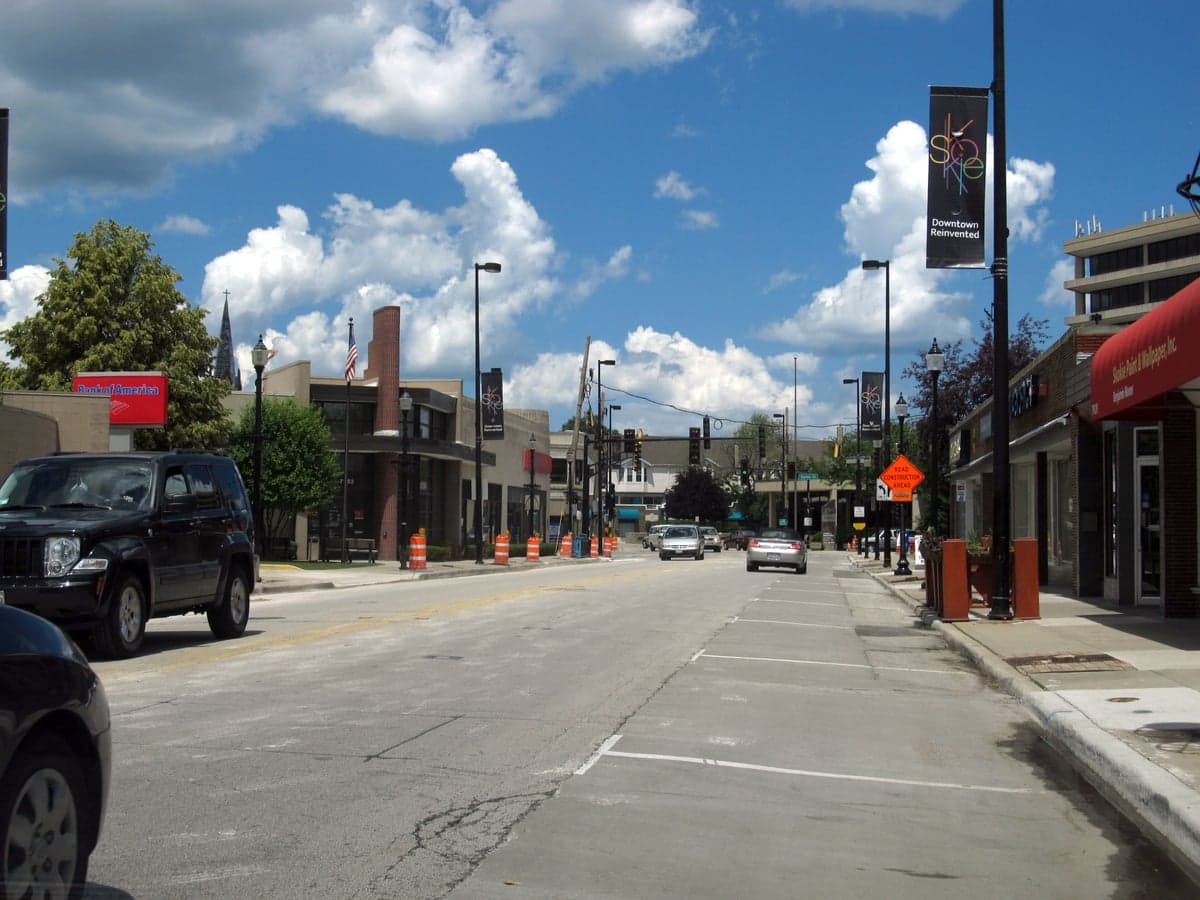
Photo: Wikipedia
Demographics of Skokie, IL
Affluence Level in Skokie, IL
A middle-class area roughly in line with national averages across income, home values, education, and employment.
People of Skokie, IL
The people of Skokie, Illinois today form a dense, ethnically intricate suburb of 66,427 residents, where no single group holds a majority. White residents make up 48.7% of the population, followed by East and Southeast Asian communities at 15.4%, Indian subcontinent residents at 11.5%, Hispanic residents at 11.0%, and Black residents at 9.9%, with over half of adults holding a college degree. This demographic mosaic is the product of distinct, layered migration waves that landed in specific neighborhoods, creating a city known for its religious diversity, strong public schools, and a palpable sense of middle-class stability. For a conservative-leaning mover, Skokie offers a dense, walkable suburb with low crime, high property values, and a population that has historically valued community institutions over rapid change.
How the city was settled and grew
Skokie was originally settled in the 1830s by Yankee and German farmers drawn to the fertile prairie along the Chicago River's North Branch. The village incorporated in 1888 as Niles Center, a name that reflected its early German and Luxembourgish Catholic population, who built St. Peter's Church and established the Niles Center Historic District around Lincoln Avenue and Oakton Street. The arrival of the Chicago North Shore and Milwaukee Railroad in the 1890s spurred growth, but the real transformation came in the 1920s and 1930s, when Jewish families fleeing overcrowded tenements in Chicago's Near West Side and Lawndale neighborhoods began purchasing land in the area. They settled heavily in the Devonshire and East Prairie neighborhoods, building synagogues and kosher markets along Dempster Street. By 1940, Skokie's population had grown to 7,000, and the village officially renamed itself Skokie—a Potawatomi word for "marsh"—to shed its rural image. Post-World War II, the GI Bill and the construction of the Edens Expressway (I-94) triggered a suburban boom. Developers built thousands of single-family homes in the Fairview and Laramie neighborhoods, attracting a second wave of Jewish families, along with Italian and Polish Catholics, who filled the new schools and synagogues. By 1960, Skokie's population had exploded to 59,000, making it one of the fastest-growing suburbs in America.
Modern era (post-1965)
The 1965 Hart-Cellar Immigration Act opened doors for new populations, and Skokie's established Jewish community—already a majority by the 1970s—began to diversify. The first major post-1965 wave was Soviet Jewish refugees, who arrived in the 1970s and 1980s and concentrated in the Niles East and Skokie Ridge areas, drawn by existing Jewish institutions and affordable apartment complexes along Golf Road. In the 1990s and 2000s, East and Southeast Asian immigrants—primarily Chinese, Korean, and Filipino families—settled in the Oakton-Skokie corridor, opening restaurants and grocery stores that now anchor a small but visible Asian commercial strip. Simultaneously, Indian subcontinent professionals, many working in tech and medicine, moved into the Devonshire and East Prairie neighborhoods, attracted by the top-rated Skokie School District 68 and Niles Township High Schools. Hispanic residents, largely of Mexican and Central American origin, grew from a tiny fraction in 1990 to 11.0% today, settling in the Fairview and Laramie areas, where older housing stock remains relatively affordable. Black residents, many moving from Chicago's South and West Sides, now make up 9.9% of the population, with concentrations in the Skokie Ridge and Niles East apartment districts. The white population, once over 95% in 1970, has declined to 48.7%, but remains the largest single group, with many older Jewish residents aging in place in the Devonshire and East Prairie bungalow belts.
The future
Skokie's population is slowly homogenizing in some ways and tribalizing in others. The white share is projected to continue declining, while the East/Southeast Asian and Indian subcontinent shares are growing steadily, driven by family reunification and professional migration. Hispanic and Black populations are plateauing, as housing costs rise and younger families move to more affordable outer suburbs like Round Lake and Waukegan. The city's immigrant communities are not assimilating into a single melting pot; instead, they maintain distinct enclaves—East and Southeast Asian families cluster near the Oakton-Skokie commercial strip, Indian families concentrate in the Devonshire and East Prairie neighborhoods, and Hispanic families remain in Fairview and Laramie. The Jewish community, once the dominant cultural force, is aging and shrinking, though it remains influential through institutions like the Illinois Holocaust Museum and the Skokie Public Library. Over the next 10-20 years, Skokie will likely become a majority-minority suburb with a strong Asian and Indian plurality, a stable Black and Hispanic middle class, and a shrinking but still significant white population. The city's density, excellent schools, and proximity to Chicago will continue to attract educated professionals, but rising property taxes and aging infrastructure may push out lower-income families.
For a conservative mover today, Skokie is a stable, well-governed suburb with a strong sense of local identity, low crime, and a population that values education and community. The demographic shifts are real but gradual, and the city's character remains rooted in its history as a destination for families seeking safety, good schools, and a place to build a life. It is not a place of rapid change or radical politics, but a dense, middle-class enclave where different groups coexist in separate but overlapping neighborhoods—a pattern that is likely to persist for the foreseeable future.

* Values derived from national, state, county, city and local statistics and may differ in a specific area. Last updated: 2026-04-30T02:16:55.000Z
Narrative content on this page is AI-generated and may contain mistakes. Verify any details that matter before acting on them.
ReloMaps may earn a commission from affiliate links at no extra cost to you.

