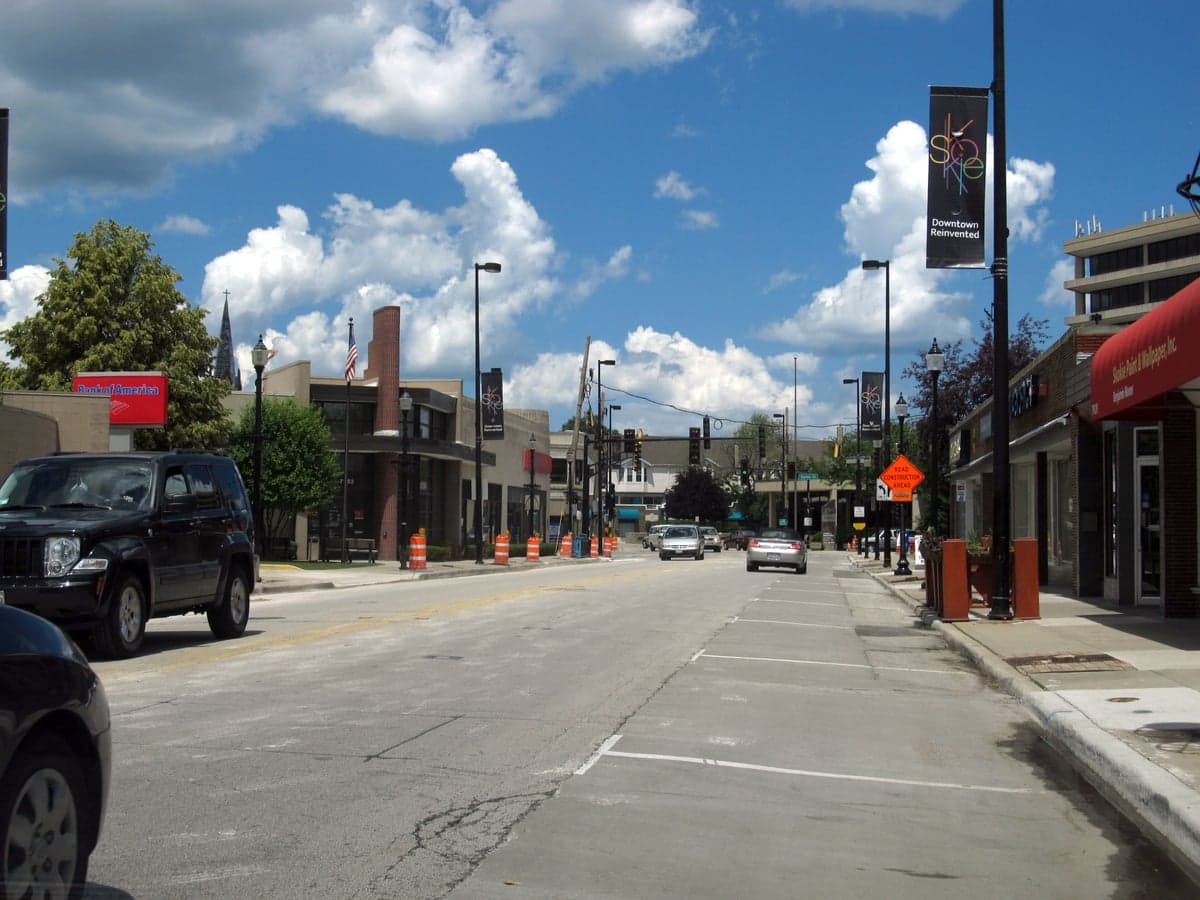
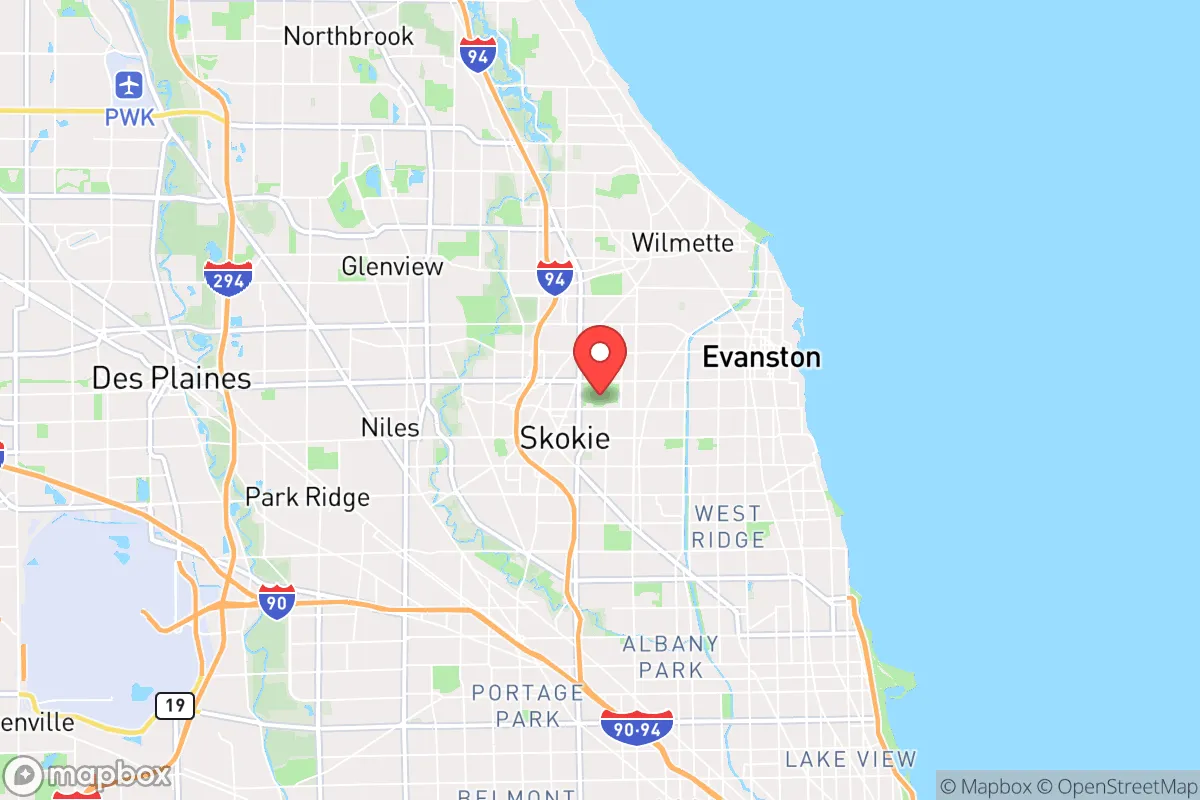
Photo: Wikipedia
Political ClimatePolitical Climate in Skokie, IL
District shown is the primary district for this city’s centroid. Cities may span multiple districts.
Local Political AnalysisPolitical Analysis of Skokie, IL
Skokie has been a reliably blue stronghold for decades, and that’s not changing anytime soon. The Cook County Partisan Voting Index (PVI) sits at D+19, meaning the area votes about 19 points more Democratic than the national average. In the 2024 presidential election, Skokie’s precincts went heavily for the Democratic ticket, with margins often exceeding 70%. This isn’t a new trend—it’s been building since the 1990s, when the village’s older, more moderate Democratic base began shifting toward the progressive wing of the party. If you’re looking for a place where your vote might actually swing an election, Skokie isn’t it.
How it compares
Skokie sits in a political bubble compared to its neighbors. Drive 15 minutes west to Arlington Heights or Mount Prospect, and you’ll find a more balanced mix—those towns lean blue but with a noticeable conservative minority, especially in local races. Head north to Glenview or Northbrook, and you’re in solidly Democratic territory, but with a stronger moderate streak. The real contrast is south and west: Evanston to the east is even more progressive than Skokie, while Niles to the south is slightly more centrist. The biggest difference is with the collar counties—places like Barrington or McHenry County, where Republicans still win local offices. In Skokie, you’d be hard-pressed to find a Republican candidate on the ballot for village trustee or school board. That’s a big shift from the 1980s, when the village had a healthy two-party system and local debates were about taxes and services, not identity politics.
What this means for residents
For a conservative or even a moderate, living in Skokie means your voice is often drowned out. The village council and school board are dominated by progressive Democrats, and that shows in policy. Property taxes are among the highest in the state—the effective rate is around 2.3%—and they keep climbing to fund new social programs and diversity initiatives. The school district, Niles Township High School District 219, has adopted curriculum changes that emphasize critical race theory and gender identity, with little room for parental input. In 2023, the village passed a resolution declaring Skokie a “sanctuary city” for transgender individuals, which critics say prioritizes ideology over public safety. If you value limited government and personal freedom, you’ll find yourself on the losing end of most votes. The local police department is well-funded and professional, but the council has pushed for “defund the police” style reforms, including civilian oversight boards that some residents worry will hamstring law enforcement.
The cultural shift is the most jarring part. Skokie used to be a quiet, family-oriented suburb where the biggest debates were about zoning for new strip malls. Now, the village hosts annual “Pride in the Park” events that draw thousands, and the library has been a battleground over drag queen story hours. The old guard—the Jewish and Eastern European immigrant families who built the town—are being replaced by younger, more diverse residents who see Skokie as a progressive haven. If you’re looking for a place where tradition and common sense still matter, you might want to look west. But if you’re willing to keep your head down and focus on your family, Skokie’s schools are still excellent, and the property values hold steady. Just don’t expect your political views to be welcome at the village hall.

State Political ClimatePolitical Climate in Illinois
State Political AnalysisPolitical Environment in the State
Illinois is a deeply blue state dominated by the Chicago metropolitan area, which accounts for roughly 65% of the state’s population and reliably delivers Democratic majorities statewide. Over the last 20 years, the state has shifted from a competitive purple state to a solidly Democratic stronghold, with Republicans now largely confined to downstate rural counties and a few suburban holdouts. The 2024 presidential election saw Illinois vote for the Democratic candidate by a margin of roughly 11 points, a slight tightening from 2020 but still far from competitive.
Urban vs. rural divide
The political map of Illinois is a textbook case of urban-rural polarization. Chicago and its inner suburbs (Cook County, DuPage County, Lake County) are the engine of Democratic power, with Chicago itself delivering margins of 80%+ for Democratic candidates. The collar counties—DuPage, Lake, Kane, McHenry, and Will—have been trending blue for a decade, driven by diversifying suburbs and professional-class voters. For example, DuPage County, once a Republican stronghold, voted for the Democratic presidential candidate in 2020 and 2024, a seismic shift. Meanwhile, downstate regions like the Metro East (near St. Louis), Peoria, and Rockford are more competitive but still lean Democratic in state races. The true Republican base is in the rural counties of central and southern Illinois—places like Effingham, Marion, and the Wabash Valley—where Trump won by 40-50 points. The divide is stark: Chicago and its suburbs produce about 70% of the state’s Democratic votes, while the rest of the state is a patchwork of red and purple.
Policy environment
Illinois’s policy environment is among the most progressive in the Midwest, with a tax structure that is increasingly burdensome. The state has a flat income tax of 4.95%, but a 2020 constitutional amendment to replace it with a graduated income tax was narrowly defeated. Property taxes are among the highest in the nation, averaging over 2% of home value, which is a major pain point for homeowners. The regulatory posture is heavy: Illinois is a sanctuary state, with the TRUST Act (2017) prohibiting local law enforcement from cooperating with federal immigration authorities. Education policy is dominated by the Chicago Teachers Union, which has successfully pushed for progressive funding formulas and charter school restrictions. Healthcare is heavily regulated, with a state-based insurance exchange and Medicaid expansion under the Affordable Care Act. Election laws are among the most liberal: Illinois has no voter ID requirement, automatic voter registration, and same-day registration, which critics argue undermines election integrity. The state also has a strong gun control regime, including a 2023 ban on assault weapons and high-capacity magazines.
Trajectory & freedom
Illinois is becoming less free by almost any measure, particularly for gun owners, taxpayers, and parents. The 2023 assault weapons ban (HB 5471) is the most restrictive in the Midwest, and a 2024 law (SB 1966) further tightened licensing requirements for gun dealers. On parental rights, the state has moved aggressively in the opposite direction: Illinois is one of the few states that requires schools to allow students to use bathrooms and locker rooms matching their gender identity, and a 2024 law (HB 4875) expanded access to gender-affirming care for minors, overriding parental consent in some cases. Medical autonomy took a hit with the 2023 repeal of the parental notification requirement for minors seeking abortions. Property rights are constrained by high property taxes and a strong eminent domain framework. On the positive side for conservatives, Illinois has no state-level right-to-work law, but it also has no state income tax on retirement income—a rare bright spot. The overall trajectory is one of expanding government control, with the state legislature controlled by a supermajority of Democrats who have shown little appetite for compromise.
Civil unrest & political movements
Illinois has a history of civil unrest, particularly in Chicago, which saw widespread protests and looting in 2020 following the murder of George Floyd. The city also experienced a spike in property crime and carjackings in 2021-2023, which became a major political issue. Organized activist movements are strong on the left: the Chicago Teachers Union is a powerful force, and groups like Indivisible and the Illinois Coalition for Immigrant and Refugee Rights are active. On the right, the Illinois Republican Party is fractured, with a libertarian-leaning faction in the suburbs and a more populist base downstate. Secession talk is common in downstate counties, with several rural counties passing symbolic resolutions to explore leaving Illinois and joining Indiana or Missouri—though none have legal force. Immigration politics are a flashpoint: Chicago’s sanctuary city status has led to tensions with the state over the influx of migrants from the southern border, with Governor JB Pritzker deploying the National Guard to assist but also clashing with the city over costs. Election integrity remains a concern for conservatives, with the 2020 and 2024 elections seeing no major fraud cases but persistent distrust due to the state’s lax voting laws.
Projection
Over the next 5-10 years, Illinois will likely become more Democratic and more progressive, driven by continued in-migration of diverse populations to Chicago’s suburbs and out-migration of conservatives to neighboring states like Indiana, Wisconsin, and Missouri. The state’s population has been declining since 2014, with net domestic out-migration of about 100,000 people per year, many of them middle-class families and retirees fleeing high taxes and crime. The remaining population is increasingly concentrated in the Chicago metro area, which will only amplify the urban-rural divide. A new resident moving in now should expect: higher taxes, more gun control, and a political environment that is hostile to conservative values. The state’s fiscal situation is precarious, with a massive unfunded pension liability (over $140 billion) that will likely lead to tax increases or service cuts. The only countervailing trend is the possibility of a Republican governor in 2026 or 2030, but given the current map, that seems unlikely.
For a conservative-leaning individual or family, Illinois is a tough sell. The state’s political trajectory is firmly leftward, with no signs of reversal. If you value low taxes, gun rights, parental control in education, and a limited government, you’ll find yourself swimming against a strong current. The best you can hope for is to live in a red enclave like Effingham, Quincy, or the far western suburbs like Naperville, where local politics are more balanced, but you’ll still be subject to state-level policies that you likely oppose. Bottom line: Illinois is a state where your vote will be consistently outnumbered, your taxes will be high, and your personal freedoms will be increasingly constrained by state law. If you’re moving here, do it for family or a job, not for the political climate.
* Values derived from national, state, county, city and local statistics and may differ in a specific area. Last updated: 2026-04-30T02:16:55.000Z
Narrative content on this page is AI-generated and may contain mistakes. Verify any details that matter before acting on them.
ReloMaps may earn a commission from affiliate links at no extra cost to you.

