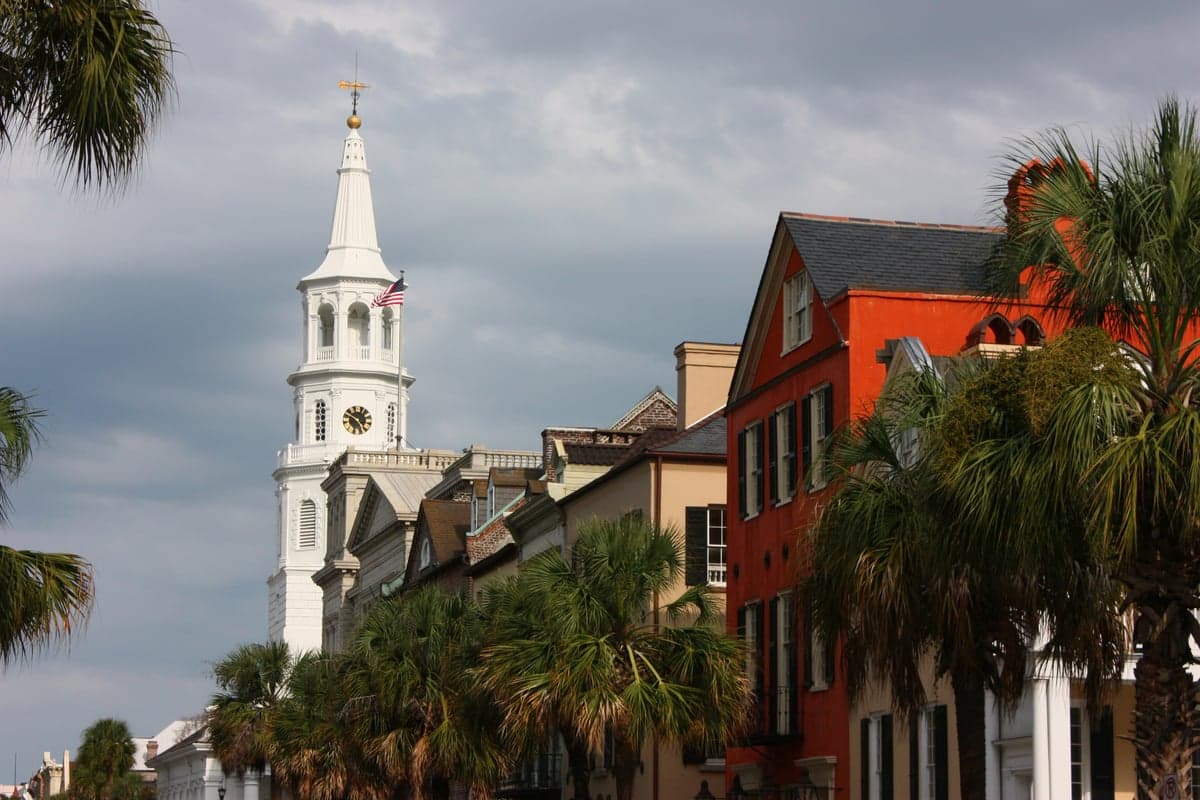
Photo: Wikipedia
Personal Sovereignty in Charleston County
Viable for self-reliance. Generally workable, though some barriers may limit total independence.
What does Personal Sovereignty tell us?
Personal Sovereignty measures your capacity for self-reliance and independence with minimal government friction. Higher scores mean fewer barriers between you and the way you want to live... but it assumes you have the space you need and good neighbors.
What does this tell us?
Personal Sovereignty measures your capacity for self-reliance and independence with minimal government friction. Higher scores mean fewer barriers between you and the way you want to live... but it assumes you have the space you need and good neighbors.
State Policy
Energy independence: Importer (25% of energy produced in-state)
Personal Liberty
Homesteading

Personal Liberty Analysis
Charleston County presents a deeply mixed picture for those prioritizing personal sovereignty, where the historic charm of the Lowcountry masks a regulatory environment that can feel as constrictive as Spanish moss on an old oak. While South Carolina’s state-level posture leans toward individual liberty—with no state income tax on retirement income and a constitutional carry law—the county’s political gravity is pulled by the City of Charleston, a jurisdiction that consistently votes for expanded government oversight. For the survivalist or prepper, the key distinction is not between South Carolina and the Northeast, but between the urban core of Charleston and Mount Pleasant versus the more rural, hands-off pockets of Hollywood, Ravenel, and Awendaw.
Tax burden and regulatory posture in Charleston County
South Carolina’s tax structure is generally favorable, with a flat state income tax rate of 6.2% (phasing down to 6.0% by 2026) and no tax on Social Security benefits. However, Charleston County adds its own layer: a local sales tax of 2% on top of the state’s 6%, bringing the total to 8% in most areas. Property taxes are assessed at 4% of fair market value for owner-occupied homes, with a millage rate that varies by municipality. The City of Charleston imposes a higher millage rate than unincorporated areas, meaning a home in West Ashley or James Island carries a heavier annual tax burden than a comparable property in Ravenel or Hollywood. Regulatory posture is where the county diverges sharply from state-level philosophy. The City of Charleston has a robust historic preservation ordinance that can dictate paint colors, window replacements, and even landscaping in designated districts—a direct infringement on property rights that preppers find galling. Zoning in the urban core is dense and restrictive, with minimum lot sizes of 4,000 to 6,000 square feet in most residential zones, effectively preventing any meaningful homesteading. In contrast, unincorporated areas like Awendaw and McClellanville operate under county zoning that allows for larger lots (often 1-3 acres minimum) and fewer bureaucratic hurdles for outbuildings or agricultural use. The county’s stormwater management regulations, however, apply everywhere—any impervious surface over 2,000 square feet requires a permit, a rule that can complicate even modest self-sufficiency projects like rainwater catchment systems.
Self-defense and gun law specifics in Charleston County
South Carolina is a constitutional carry state as of 2024, meaning no permit is required to carry a concealed firearm for anyone legally allowed to possess one. This is a significant win for personal sovereignty, and it applies uniformly across Charleston County. However, local enforcement attitudes vary. The Charleston Police Department and the Mount Pleasant Police Department are generally professional but operate in jurisdictions where the city councils have passed resolutions supporting "gun safety" measures—though these are largely symbolic, as state preemption law prohibits local governments from enacting their own firearm ordinances. The practical reality is that carrying openly in downtown Charleston or on the beaches of Isle of Palms may draw unwanted attention from law enforcement or private security, even if it remains legal. For the prepper, the more relevant concern is the county’s 72-hour waiting period for firearm purchases—a state law that applies everywhere but feels particularly onerous in a county where the sheriff’s office has publicly stated it will not enforce federal red flag laws. The Charleston County Sheriff’s Office, under Sheriff Kristin Graziano, has taken a more moderate stance on Second Amendment issues compared to some upstate sheriffs, but the county’s concealed weapon permit issuance rate remains high, with over 15,000 active permits as of 2025. Stand-your-ground laws apply statewide, and there is no duty to retreat in any place where one is lawfully present. For those living in Hollywood or Ravenel, where response times from law enforcement can exceed 20 minutes, the ability to defend one’s home and property without legal jeopardy is a non-negotiable aspect of daily life.
Self-reliance and homesteading viability across the county
Homesteading viability in Charleston County is a tale of two landscapes. In the urban and suburban corridors—Charleston, Mount Pleasant, Summerville (partially in Dorchester County)—lot sizes are small, HOAs are common, and zoning prohibits livestock, beekeeping, or even substantial vegetable gardens in many subdivisions. The county’s health department also regulates the sale of raw milk and home-processed foods, making direct farm-to-table commerce difficult without a license. However, the rural northern and western fringes offer a different reality. Awendaw, with its large forested tracts and minimal zoning enforcement, allows for keeping chickens, goats, and even a few head of cattle on parcels as small as 2 acres. Ravenel and Hollywood are even more permissive, with many properties zoned for agricultural use and no HOA oversight. Off-grid feasibility is limited by the county’s building codes, which require connection to the electrical grid for new construction in most areas, though solar panels with battery storage are permitted as supplemental systems. Rainwater collection is legal but must be registered with the county if the cistern exceeds 5,000 gallons. Septic systems are the norm in rural areas, but the county health department requires rigorous soil testing and permits for any new system—a bureaucratic hurdle that can delay a self-reliant build by months. For the serious prepper, the best bet is a property in McClellanville or Huger, where well water, septic, and solar are standard, and the nearest code enforcement officer is a 45-minute drive away.
Personal liberties in daily life: parental rights, medical autonomy, speech, and property
Parental rights in South Carolina are relatively strong, with a state law that requires parental consent for minors to receive most medical treatments, including vaccinations. The county’s school districts—Charleston County School District is the largest—have been battlegrounds over curriculum transparency, with the state’s "Parents’ Bill of Rights" law (passed in 2023) requiring schools to notify parents of any changes to a student’s health or well-being. However, enforcement has been inconsistent, with some schools in Mount Pleasant and James Island being more compliant than others. Medical autonomy is a mixed bag: South Carolina has not expanded Medicaid, which keeps government out of healthcare decisions for many, but the county’s hospital system (MUSC Health) is heavily regulated and mandates COVID-19 vaccines for employees as of 2025, a policy that rankles those who believe in bodily autonomy. Free speech is protected under the First Amendment, but the City of Charleston has a noise ordinance that can be used to shut down political rallies or religious gatherings in residential areas after 10 p.m. Property rights are the most contentious area. The county’s stormwater regulations, tree protection ordinances (which require permits to remove trees over 6 inches in diameter in some areas), and historic district overlays all represent government overreach into what a landowner can do with their own property. In West Ashley, a homeowner can be fined for cutting down a live oak without a permit; in Awendaw, the same action goes unnoticed. For those who value the right to use their land as they see fit, the rural areas of the county are the only viable option.
Overall, Charleston County offers a fragile sovereignty that requires careful geographic selection. The state’s constitutional carry law, low income tax, and parental rights protections provide a solid foundation, but the county’s urban centers—Charleston, Mount Pleasant, and Isle of Palms—are increasingly hostile to the prepper mindset, with high taxes, restrictive zoning, and a culture of regulatory compliance. The rural fringe—Hollywood, Ravenel, Awendaw, and McClellanville—offers a much higher degree of personal autonomy, but even there, the long arm of county stormwater and health regulations can reach. Compared to the upstate counties like Greenville or Spartanburg, Charleston County is more restrictive; compared to the coastal counties of Beaufort or Colleton, it is more densely regulated. For the strategic relocator who values personal sovereignty above all else, the best move is to buy land in the rural northern tier, build off-grid, and treat the urban amenities of Charleston as a resource to be visited, not a government to be lived under.

* Values derived from national, state, county, city and local statistics and may differ in a specific area. Last updated: 2026-05-13T17:05:01.000Z
Narrative content on this page is AI-generated and may contain mistakes. Verify any details that matter before acting on them.
ReloMaps may earn a commission from affiliate links at no extra cost to you.

