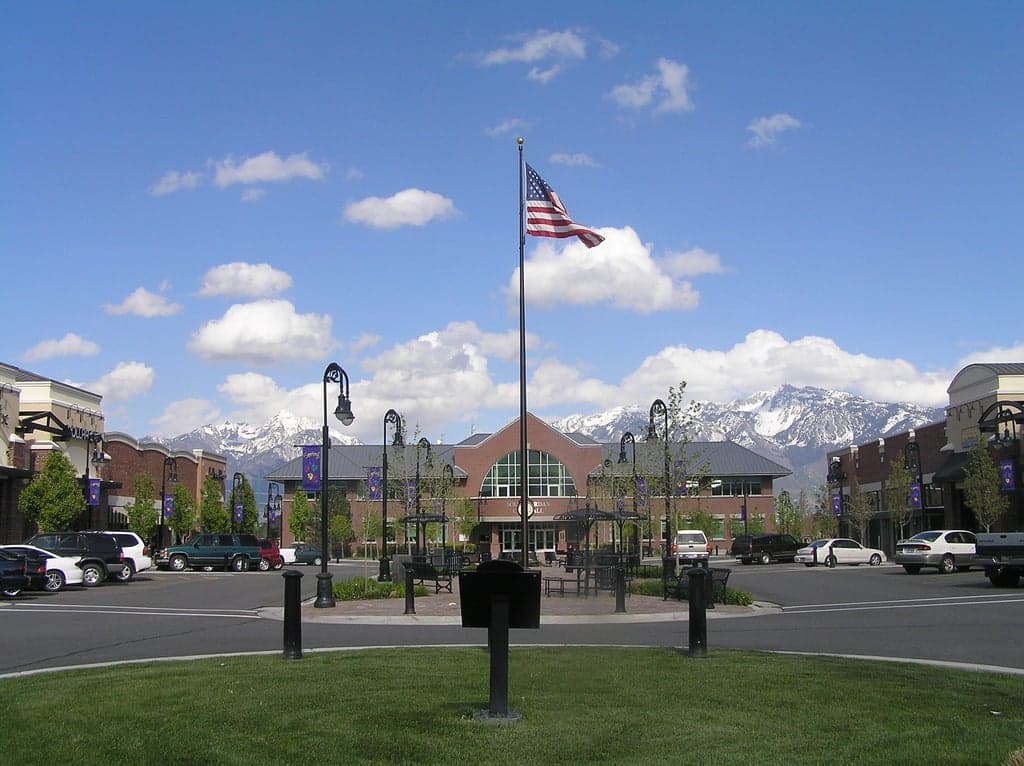
Photo: Wikipedia
Personal Sovereignty in South Jordan, UT
Viable for self-reliance. Generally workable, though some barriers may limit total independence.
What does Personal Sovereignty tell us?
Personal Sovereignty measures your capacity for self-reliance and independence with minimal government friction. Higher scores mean fewer barriers between you and the way you want to live... but it assumes you have the space you need and good neighbors.
What does this tell us?
Personal Sovereignty measures your capacity for self-reliance and independence with minimal government friction. Higher scores mean fewer barriers between you and the way you want to live... but it assumes you have the space you need and good neighbors.
State Policy
Energy independence: Self-sufficient (80% of energy produced in-state)
Personal Liberty
Homesteading

Personal Liberty Analysis
South Jordan, Utah, offers a notably high degree of personal sovereignty compared to most of the urbanized West Coast or Northeast, but it operates within a framework that balances individual liberty with a strong, community-oriented, and often church-influenced social order. For the strategic relocator with a survivalist or prepper mindset, the key takeaway is that the state-level legal environment is exceptionally friendly to self-reliance, while the city itself is a well-managed, growing suburb where local ordinances generally respect property rights but do impose standard HOA-style restrictions in many newer developments. The autonomy you gain here is real, but it is not the raw, unregulated frontier liberty of rural Alaska; it is a structured freedom within a culture that values preparedness, family, and limited government.
Tax burden and regulatory posture for the self-reliant individual
Utah’s tax and regulatory climate is a major draw for those seeking to minimize government extraction from their earnings and choices. The state levies a flat income tax of 4.55% (as of 2025, with a constitutional amendment trending toward a lower rate), and South Jordan’s combined sales tax rate sits around 7.35% (state + county + city). There is no state-level estate or inheritance tax, which matters for those building multigenerational assets. Property taxes are relatively low, with effective rates typically between 0.5% and 0.7% of assessed value, though Salt Lake County reassessments have been aggressive in recent years. The regulatory posture at the state level is explicitly pro-business and anti-red-tape; Utah has a "right-to-work" law and a regulatory sandbox approach that discourages burdensome permitting for small-scale enterprises like home-based food production or light manufacturing. However, South Jordan itself enforces standard suburban zoning codes—you cannot run a heavy industrial operation from a residential lot, and HOA covenants are common in subdivisions built after 1990. For the prepper, this means you can legally stockpile supplies, maintain a large garden, and keep a few chickens (with a permit), but you cannot erect a bunker or keep livestock like goats or pigs on a standard quarter-acre lot without specific zoning variances.
Self-defense and gun law specifics in South Jordan
Utah is a constitutional carry state, meaning any law-abiding adult 21 or older can carry a concealed firearm without a permit. South Jordan does not impose any local restrictions beyond state law, so no magazine capacity bans, no "assault weapon" registrations, and no waiting periods exist for private purchases. The state has a strong "stand your ground" law (Utah Code § 76-2-402) that removes the duty to retreat in any place where you have a lawful right to be, and it extends to defense of others. For the survivalist, this is critical: you can defend your home, vehicle, or occupied property with deadly force if you reasonably believe it is necessary to prevent imminent death or great bodily harm. Utah also has a robust preemption statute that prevents cities like South Jordan from enacting their own gun control ordinances—so you won't see the kind of patchwork bans found in Colorado or California. The Salt Lake County Sheriff’s Office issues concealed carry permits (still useful for reciprocity when traveling to non-constitutional carry states), and the process is straightforward. One practical note: South Jordan is a family-oriented suburb, so discharging a firearm within city limits is illegal except at a licensed range or in a lawful self-defense situation. For regular practice, you will need to drive to one of the many outdoor ranges in Utah County or the West Desert.
Self-reliance and homesteading viability: lot sizes, zoning, and off-grid feasibility
South Jordan’s residential lots are predominantly 0.2 to 0.5 acres in standard subdivisions, with some older neighborhoods offering up to 1-acre parcels near the Jordan River. Newer developments, like those in the Daybreak community, are denser and come with strict CC&Rs that limit external storage, vehicle parking, and even the color of your rain barrel. For serious homesteading—think large gardens, fruit trees, chickens, and a workshop—you want to target the unincorporated areas of Salt Lake County just south of the city limits (near Riverton or Bluffdale) or the agricultural zones in western Utah County. Off-grid feasibility is low within city limits: South Jordan requires connection to municipal water and sewer, and solar panels are allowed but must comply with HOA aesthetic guidelines. That said, Utah state law (HB 430) prohibits HOAs from banning solar panels outright, so you can generate your own power. Rainwater collection is legal and encouraged (Utah Code § 73-3-1.5), and you can install a backup generator without special permits as long as it meets noise ordinances. For the prepper, the realistic play is to buy a home with a basement for food storage (a cultural norm here), install a solar array with battery backup, and use the backyard for intensive gardening. True off-grid living requires moving to rural Juab or Millard County, which is a 45-minute drive from South Jordan.
Personal liberties: parental rights, medical autonomy, speech, and property
Utah is one of the strongest states in the nation for parental rights. The Utah Parental Rights in Education law (HB 261) requires schools to notify parents of any changes in a student’s emotional or physical health, and it prohibits classroom instruction on gender identity without parental consent. This is a major factor for conservative families concerned about government overreach into child-rearing. Medical autonomy is also robust: Utah has no state-level vaccine mandate for adults, and while school vaccine requirements exist, philosophical and religious exemptions are available (though the religious exemption process has been tightened). The state has a Right to Try law for terminally ill patients and a strong conscience clause for medical providers. On speech, Utah has no hate speech laws that criminalize political or religious expression, and the state’s public forums (parks, sidewalks, city council meetings) are genuinely open. Property rights are protected by Utah’s eminent domain laws, which require a public purpose and just compensation, and the state has a "private property protection act" that limits regulatory takings. The one area where personal sovereignty is notably constrained is in the realm of land use—South Jordan’s planning department is efficient but strict, and you cannot simply build a shed or fence without a permit. For the survivalist, this means you must work within the system, but the system is far more reasonable than in states like California or New York.
Overall, South Jordan offers a high degree of personal sovereignty relative to the coastal blue states, particularly in the areas of gun rights, tax burden, and parental control over education. The trade-off is that you are living in a well-regulated, master-planned suburb where HOAs and city codes impose a level of conformity that a rugged individualist might chafe against. If your vision of sovereignty includes a remote cabin with no neighbors and no rules, this is not the place. But if you want a safe, family-oriented community where you can legally carry a firearm, store a year’s worth of food in your basement, teach your children according to your values, and keep most of your income out of the government’s hands, South Jordan is one of the best urban options in the Intermountain West. The real strategic value here is proximity to escape routes—you are 20 minutes from the Wasatch Front’s canyons and 45 minutes from vast public lands where you can bug out if needed. It is a base camp, not a fortress, but it is a base camp with excellent legal cover for the prepared family.

* Values derived from national, state, county, city and local statistics and may differ in a specific area. Last updated: 2026-04-21T09:15:47.000Z
Narrative content on this page is AI-generated and may contain mistakes. Verify any details that matter before acting on them.
ReloMaps may earn a commission from affiliate links at no extra cost to you.

