Photo: Wikipedia
Demographics of South Salt Lake, UT
Affluence Level in South Salt Lake, UT
A middle-class area roughly in line with national averages across income, home values, education, and employment.
People of South Salt Lake, UT
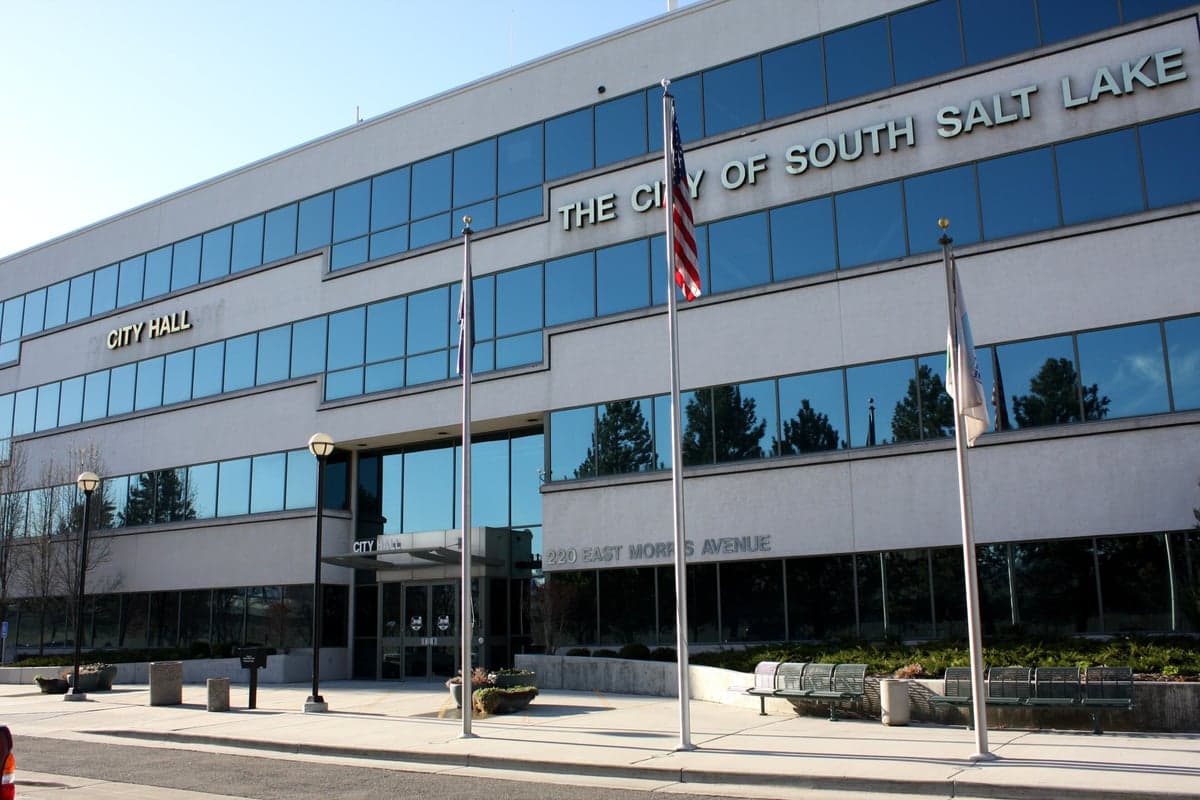
Today, South Salt Lake is a dense, working-class city of 26,277 residents where no single ethnic group holds a majority. Its population is 52.4% white, 28.6% Hispanic, 6.8% Indian (subcontinent), 3.0% Black, and 2.0% East/Southeast Asian, with 11.3% foreign-born. The city’s identity is shaped by its role as a first-ring suburb of Salt Lake City—more industrial, more affordable, and more ethnically diverse than its neighbors. It is a place where immigrant families and native-born Utahns share tight lots, aging postwar housing, and a pragmatic, no-frills sense of community.
How the city was settled and grew
South Salt Lake was not a pioneer settlement. The area was originally farmland and railroad land, annexed piecemeal from Salt Lake City and unincorporated county land. The city incorporated in 1938, driven by a desire for local control over zoning and services as industry expanded along the rail corridor. The earliest residents were white working-class families—many of Mormon pioneer descent—who built small homes in neighborhoods like Central Pointe and Millcreek (the latter now a separate city but historically tied). These families worked in the nearby rail yards, smelters, and warehouses that defined the local economy through the 1950s. The post-World War II boom brought a second wave: returning veterans and their families, who filled new subdivisions like Fairmont and Liberty Wells (the southern portion of which lies within South Salt Lake). By 1960, the population was nearly entirely white, with a small Hispanic presence tied to railroad and agricultural labor.
Modern era (post-1965)
The 1965 Hart-Cellar Act and subsequent immigration reforms reshaped South Salt Lake. The city’s affordable housing stock and proximity to Salt Lake City’s service and construction jobs drew new arrivals. The Hispanic population grew steadily from the 1970s onward, concentrated in the Central Pointe and South Main Street corridor, where older duplexes and apartment blocks offered low rents. By 2000, Hispanics made up roughly 20% of the population; today they are 28.6%. The most dramatic recent shift has been the arrival of Indian (subcontinent) immigrants, who now account for 6.8% of residents—a share that has more than doubled since 2010. These families, many working in tech, healthcare, and hospitality, have settled in the Millcreek and Fairmont neighborhoods, often in newer townhome developments. East/Southeast Asian residents (2.0%) and Black residents (3.0%) are smaller but established communities, with the latter concentrated near the South State Street corridor. The white share has fallen from over 80% in 1990 to 52.4% today, driven by both out-migration to farther suburbs and the city’s role as a landing pad for new Americans.
The future
South Salt Lake is not homogenizing; it is tribalizing into distinct ethnic enclaves. Hispanic families are deepening their roots in Central Pointe and South Main, while Indian families are clustering in Millcreek and Fairmont. The white population, now a bare majority, is aging and slowly declining as younger white families move to newer suburbs. The immigrant communities are growing—particularly the Indian population, which is likely to surpass 10% within a decade—but they are not assimilating into a single melting pot. Instead, the city is becoming a patchwork of ethnic neighborhoods, each with its own churches, markets, and social networks. The foreign-born share (11.3%) is below the national average but rising, and the college-educated share (33.9%) is low for the Salt Lake metro, reflecting the city’s blue-collar base. The next 10-20 years will likely see continued diversification, with the white share dropping below 50% and the Indian and Hispanic shares rising. Gentrification pressure from Salt Lake City is limited by the industrial zoning and aging housing stock, so South Salt Lake will remain a relatively affordable, working-class entry point for immigrants and lower-income families.
For a conservative-leaning individual or parent considering a move, South Salt Lake offers a dense, ethnically diverse, and affordable alternative to the more homogeneous suburbs. It is a city in transition—less stable than its neighbors, but also more dynamic and less expensive. The schools are mixed, the taxes are moderate, and the community is pragmatic. It is not a place for those seeking a quiet, uniform enclave, but for those comfortable with change and diversity, it provides a solid, grounded base in the Salt Lake Valley.

* Values derived from national, state, county, city and local statistics and may differ in a specific area. Last updated: 2026-04-24T13:25:42.000Z
Narrative content on this page is AI-generated and may contain mistakes. Verify any details that matter before acting on them.
ReloMaps may earn a commission from affiliate links at no extra cost to you.

