Strategic Assessment of Southlake, TX
Multiple tactical vulnerabilities. Population density, target proximity, or disaster risk are likely compounding. A retreat property and exit planning is required.
What does the Strategic Assessment tell us?
Our Strategic Assessment grades tactical survivability of an area. Major population centers, military targets, fallout zones, natural disasters, and border exposure all drive risk — lower exposure means a more defensible position in a crisis.
This is heavily inspired by Joel Skousen's Strategic Relocation book. Highly recommended you checkout the book ($)What does this tell us?
Our Strategic Assessment grades tactical survivability of an area. Major population centers, military targets, fallout zones, natural disasters, and border exposure all drive risk — lower exposure means a more defensible position in a crisis.
This is heavily inspired by Joel Skousen's Strategic Relocation book. Highly recommended you checkout the book ($)Strategic Pillars

Key Distances
Regional Safe Places
Below is our recommended "safe zones" in Texas and the surrounding area based on our strategic heuristics. For most people, it's unrealistic to live in a “safe zone” full-time due to work, family or other personal reasons. They tend to be more rural. However, many of these areas are perfect for second homes and retreat properties that double as a vacation home or even a short-term rental.

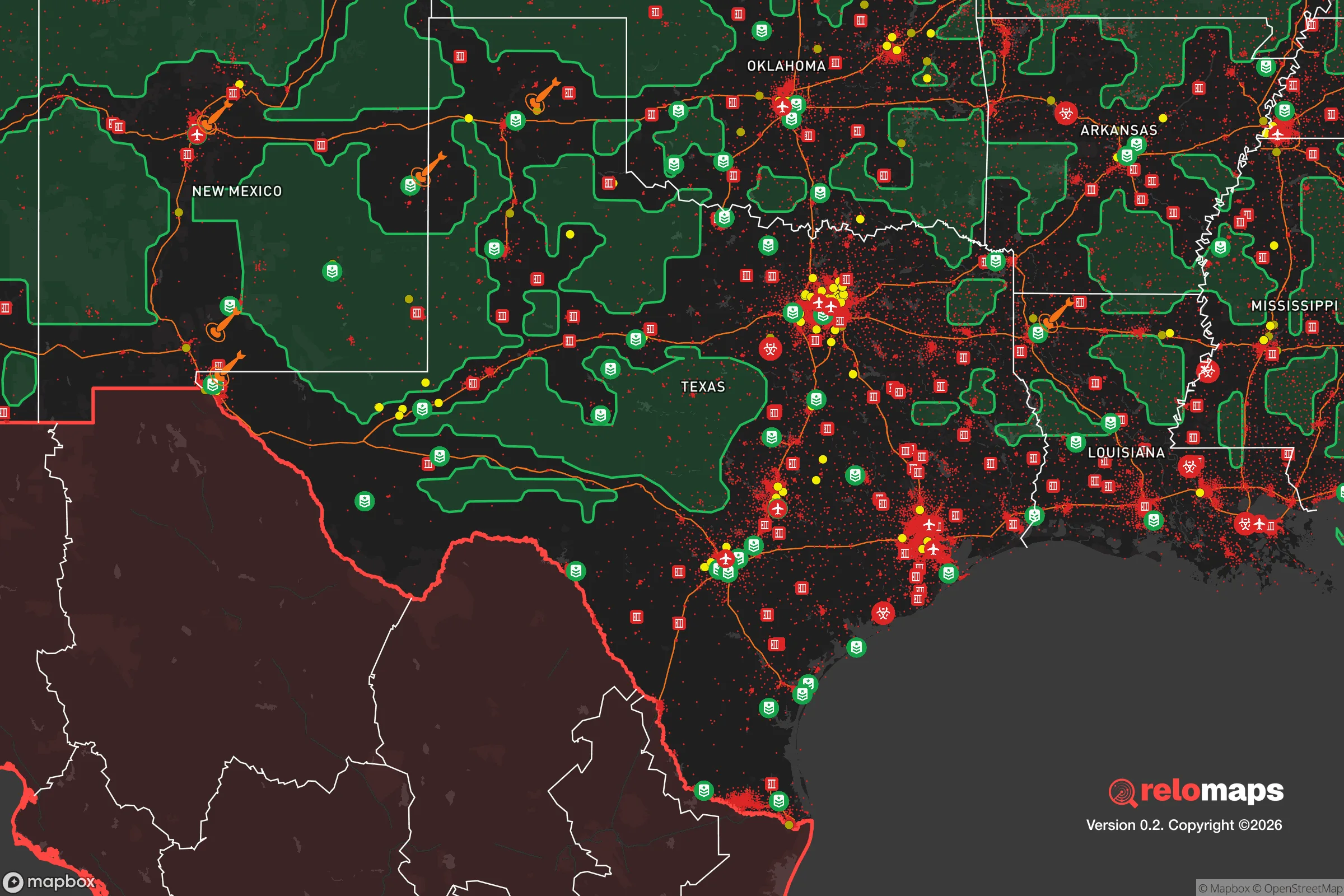


Important Note: For informational purposes only. This does not mean nothing bad ever happens in the green zones. Please use common sense. This is based on public data and modeled with AI. We tried to take a conservative approach but mistakes happen. We update this regularly as new information becomes available.
Solar Generator Recommendations
Backup power matters more here than in safer locations. We've picked three solar generators across budgets and capacity tiers — start with the budget unit if you only need a few essentials, or step up if you want to run a fridge and HVAC for days at a time.

Jackery Portable Power Station Explorer 300
Budget OptionPower on the Go: Weighing only 11 lbs, it's convenient to set up and store with book-sized foldable solar panels

BLUETTI Portable Power Station AC180
Designed for both indoor and outdoor scenarios, AC180 is highly capable as it has a robost capacity and continuous output power.

EF ECOFLOW DELTA Pro Ultra Power Station
Upgraded PickEcoFlow DELTA Pro Ultra is a whole-home energy system designed to grow with your family. Integrated with the Smart Home Panel 2, it scales to meet your evolving energy needs — keeping your home powered, intelligent, and secure through every stage of life.
We earn a commission, at no additional cost to you.
Strategic Assessment Analysis
Southlake, Texas, presents a complex strategic picture for the conservative prepper. Its reputation for affluence and top-tier schools masks a location that is simultaneously a potential fortress and a high-value target. The city’s resilience is not inherent in its geography, but in its community wealth, infrastructure, and political alignment—assets that can be leveraged for preparedness but also create unique vulnerabilities. For the relocator prioritizing long-term survival and stability, Southlake offers a strong base of operations, provided you understand and mitigate its specific exposure risks.
Geographic position and natural advantages for long-term stability
Southlake sits in the heart of the Dallas-Fort Worth Metroplex, a position that is both its greatest strength and its most glaring weakness. The area’s natural advantages are subtle but real. The region is inland, far from hurricane storm surges and seismic activity, and the local climate, while prone to drought and occasional severe storms, does not produce the catastrophic wildfires of the West or the blizzards of the North. The underlying geology is stable, and the Trinity River watershed provides a significant, if often overlooked, freshwater resource. The city’s elevation, around 650 feet, offers no defensive high ground, but it also avoids floodplain risks that plague other parts of the metroplex. For a relocator, the key natural advantage is the sheer economic and agricultural productivity of the surrounding North Texas region. The area is a logistical hub, with multiple interstate highways (I-35W, I-35E, I-30, and the 114/121 corridor) converging nearby, ensuring that in normal times, supply chains are robust. However, in a crisis, these same highways become chokepoints and escape routes for millions of people.
Risks, exposures, and proximity to fallout-relevant landmarks
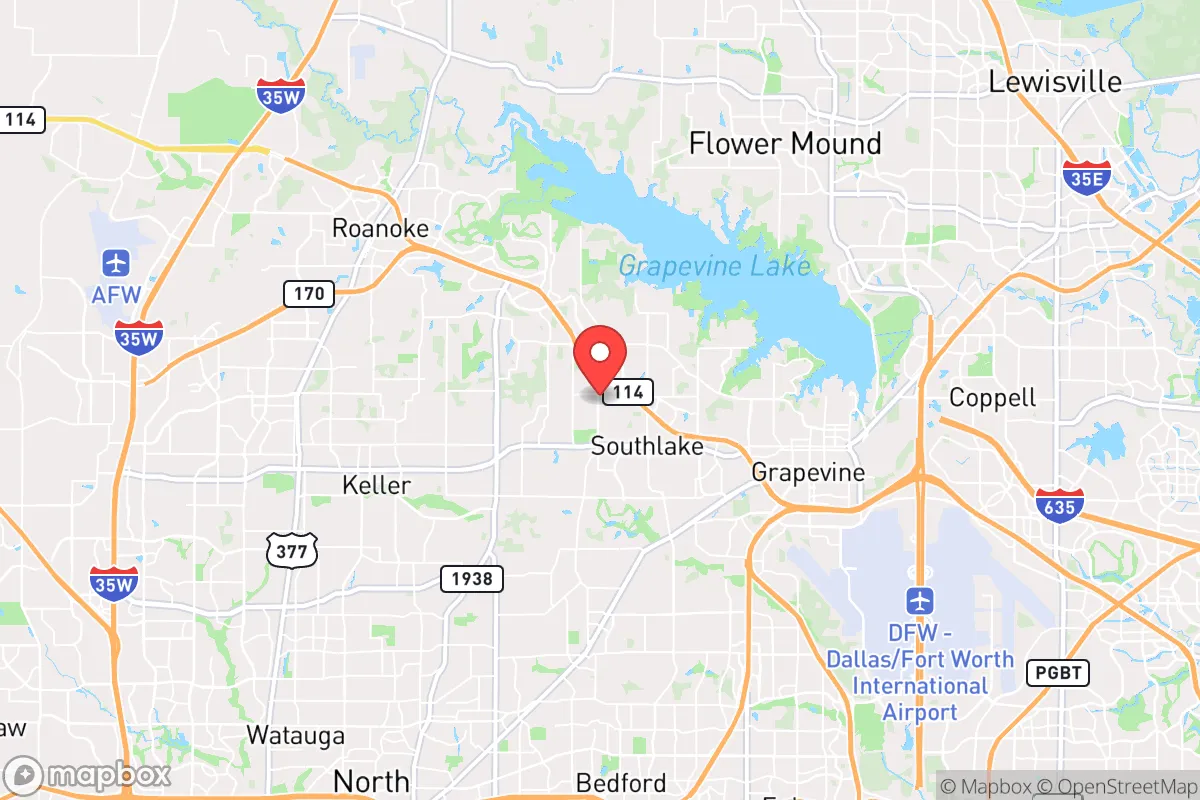
This is where the prepper’s calculus gets serious. Southlake is less than 10 miles from Dallas/Fort Worth International Airport (DFW), one of the busiest in the world. In a mass casualty event, a biological outbreak, or a coordinated attack, DFW is a primary vector for contagion and a likely target. The city is also within 20 miles of the Fort Worth Stockyards and the Naval Air Station Joint Reserve Base Fort Worth, a major military installation. While the base provides a security presence, it also makes the area a potential secondary target. The proximity to downtown Dallas (roughly 25 miles) and Fort Worth (20 miles) means that any civil unrest, power grid failure, or economic collapse in those urban cores will send waves of refugees and opportunistic criminals outward. Southlake’s wealth—median household income exceeding $200,000—makes it a prime looting target. The city’s reliance on the ERCOT power grid is another critical vulnerability. Texas’s independent grid has a documented history of failure under extreme weather, as seen in the 2021 winter storm. A prolonged grid-down scenario would cripple water pumps, fuel stations, and communications, turning Southlake’s modern infrastructure into a liability. Furthermore, the city’s dense suburban layout, with large homes on relatively small lots, offers limited defensible space and few natural barriers against a determined threat.
Practical resilience for a relocator: food, water, energy, and defensibility
For the individual or family looking to establish a resilient household, Southlake requires a proactive, not passive, approach. Water is the most immediate concern. The city’s water comes from the Trinity River and area reservoirs, but treatment plants are vulnerable to power loss and contamination. A prepper must have a minimum of two weeks of stored water per person, plus a reliable filtration system (e.g., Berkey or Sawyer) and a plan for rainwater catchment. The local soil is heavy clay, making gardening a challenge but not impossible; raised beds with imported soil are the standard. Food storage is straightforward—the area has numerous Costco, Sam’s Club, and H-E-B locations, but these will be stripped within hours of a crisis. A deep pantry, freeze-dried stores, and a plan for long-term calorie sources (grains, legumes, canned goods) are non-negotiable. Energy resilience is the biggest hurdle. The ERCOT grid is unreliable, and solar with battery backup (e.g., Tesla Powerwall or Generac) is the most practical solution for maintaining refrigeration, communications, and well pumps (if you have a private well). Most Southlake homes are on municipal water, so a generator or solar system is essential for powering a sump pump and keeping a few lights on. Defensibility is poor by design. The city’s layout—curving streets, cul-de-sacs, and large front windows—is optimized for aesthetics, not security. A prepper should prioritize hardening the home’s entry points, installing impact-resistant windows or storm shutters, and establishing a neighborhood watch or mutual assistance group. The community’s conservative lean means many neighbors are likely armed and sympathetic to self-reliance, which can be a force multiplier. However, the lack of rural escape routes is a major drawback. In a worst-case scenario, the only viable bug-out locations are to the north (toward Denton or the Red River) or west (toward the Hill Country), both of which require navigating gridlocked highways.
The overall strategic picture for Southlake is one of high risk and high reward. It is not a bug-out location; it is a fortress of convenience. For the conservative relocator who can afford the premium, it offers a community of like-minded individuals, excellent schools for family continuity, and a concentration of resources that can be leveraged for preparedness. But the city’s very success—its wealth, its location, its reliance on fragile infrastructure—makes it a target. The prepper in Southlake must be a gray man, blending in while maintaining a low-profile stockpile and a robust plan for self-sufficiency. The key is to treat the city as a base camp, not a final redoubt. Have a vehicle prepped for immediate departure, a secondary location in a more rural county (e.g., Wise or Parker County) scouted, and the skills to operate without the grid. Southlake can work, but only if you acknowledge that its comforts are a veneer over a very real set of vulnerabilities. Prepare accordingly, and you can thrive here. Ignore the risks, and you are just another target waiting to happen.

* Values derived from national, state, county, city and local statistics and may differ in a specific area. Last updated: 2026-04-20T14:03:28.000Z
Narrative content on this page is AI-generated and may contain mistakes. Verify any details that matter before acting on them.
ReloMaps may earn a commission from affiliate links at no extra cost to you.

