
Photo: Wikipedia
Demographics of Spokane, WA
Affluence Level in Spokane, WA
A middle-class area roughly in line with national averages across income, home values, education, and employment.
People of Spokane, WA
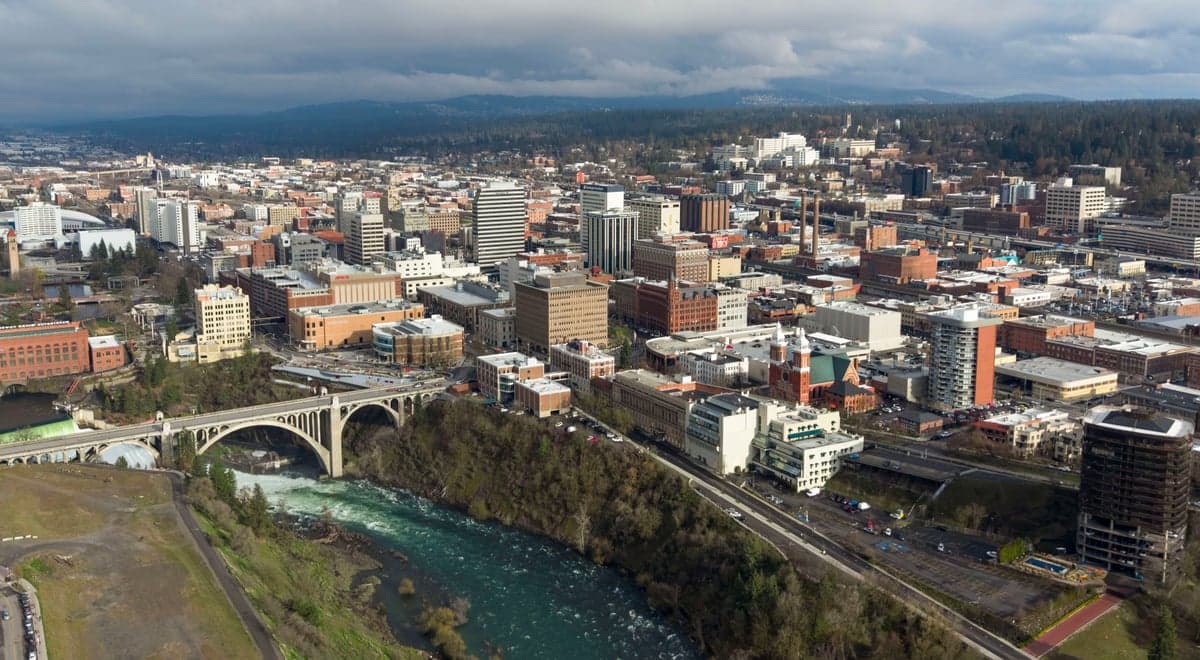
The people of Spokane, Washington, today number 229,228, forming a predominantly white (78.5%) and less diverse city than the national average, with a notably low foreign-born population of just 2.9%. The city’s character is shaped by its history as a regional hub for resource extraction, transportation, and healthcare, with a population that is older and more rooted than many comparable Western cities. Distinctive identity markers include a strong sense of local independence, a growing but still modest Hispanic community (7.8%), and a college-educated rate of 32.6% that lags behind the state average. Spokane feels like a place where the past is still present in its neighborhoods and demographic patterns.
How the city was settled and grew
Spokane’s founding population was drawn by the railroads and the promise of mineral wealth. The city was officially incorporated in 1881, but its real growth began after the arrival of the Northern Pacific Railway in 1883, which turned the Spokane Falls into a power source for sawmills, flour mills, and smelters. The original white settlers were largely Anglo-American Protestants from the Midwest and New England, joined by a significant wave of Irish and German immigrants who worked the railroads and mines. These groups built the core of the city in what is now the Browne’s Addition neighborhood, the city’s first affluent district, with grand Victorian homes reflecting the fortunes made in mining and timber. A smaller but notable wave of Chinese laborers arrived during the railroad construction, settling in a now-vanished Chinatown near the current East Central neighborhood, though most were expelled or driven out by anti-Chinese violence in the 1880s. By 1900, Spokane was a booming railroad and mining supply center, with a population that was overwhelmingly native-born white, with pockets of Scandinavian and Italian immigrants in working-class areas like Hillyard, the railroad yard neighborhood. The city’s growth plateaued after the 1920s as the timber and mining industries declined, leaving a stable, insular population that saw little new immigration for decades.
Modern era (post-1965)
Post-1965 immigration reforms had a minimal impact on Spokane compared to coastal cities. The city’s foreign-born share remained below 3% through the 2020s, and the demographic shifts that did occur were driven primarily by domestic migration. The most notable change has been the growth of the Hispanic population, which rose from under 2% in 1990 to 7.8% today, concentrated in the East Central and Chief Garry Park neighborhoods, where Mexican-American families have established small businesses and community churches. The East/Southeast Asian population (2.6%) is a mix of Vietnamese and Filipino families, many of whom arrived as refugees or through family reunification in the 1980s and 1990s, settling in the South Hill area near the medical centers. The Black population (2.6%) remains small and is largely concentrated in the East Central and West Central neighborhoods, reflecting historical housing patterns. The Indian-subcontinent population (0.2%) is tiny and consists mostly of professionals working at Spokane’s hospitals and universities, living in scattered locations rather than a distinct enclave. Suburbanization has been the dominant trend, with white families moving to the North Side and outlying areas like Mead and Spokane Valley, leaving the core neighborhoods more diverse but also poorer.
The future
Spokane’s population is heading toward slow diversification, but it will remain a predominantly white city for the foreseeable future. The Hispanic share is projected to grow to roughly 12-14% by 2040, driven by higher birth rates and continued domestic migration from other Western states, with the East Central and Chief Garry Park neighborhoods becoming increasingly Latino. The East/Southeast Asian and Black populations are likely to plateau or grow only modestly, as Spokane lacks the job base and ethnic networks that attract larger immigrant flows. The city is not tribalizing into distinct enclaves so much as slowly homogenizing at the edges, with younger white residents moving into downtown and the Perry District while older white families remain in the suburbs. The foreign-born share may rise to 4-5% by 2040, still far below the national average. For a newcomer, this means Spokane offers a stable, culturally familiar environment with low crime in most neighborhoods, but little of the ethnic diversity or immigrant-driven dynamism found in larger Pacific Northwest cities.
Spokane is becoming a slightly more diverse, but still overwhelmingly white, regional hub where the population is aging in place and new growth comes mainly from domestic migration. For a conservative-leaning individual or family, the city offers a predictable social environment with strong community institutions, but those seeking significant ethnic or cultural variety will find it limited. The neighborhoods of Browne’s Addition, Hillyard, East Central, Chief Garry Park, and the South Hill each tell a distinct chapter of this story, from railroad-era immigration to modern Hispanic settlement, and they remain the best places to observe Spokane’s demographic character today.

* Values derived from national, state, county, city and local statistics and may differ in a specific area. Last updated: 2026-04-25T13:52:35.000Z
Narrative content on this page is AI-generated and may contain mistakes. Verify any details that matter before acting on them.
ReloMaps may earn a commission from affiliate links at no extra cost to you.

