Photo: Wikipedia
Strategic Assessment of Spokane, WA
Meaningful friction. Expect exposure to either population pressure, blast zones, or natural disaster risk. Consider buying a retreat property.
What does the Strategic Assessment tell us?
Our Strategic Assessment grades tactical survivability of an area. Major population centers, military targets, fallout zones, natural disasters, and border exposure all drive risk — lower exposure means a more defensible position in a crisis.
This is heavily inspired by Joel Skousen's Strategic Relocation book. Highly recommended you checkout the book ($)What does this tell us?
Our Strategic Assessment grades tactical survivability of an area. Major population centers, military targets, fallout zones, natural disasters, and border exposure all drive risk — lower exposure means a more defensible position in a crisis.
This is heavily inspired by Joel Skousen's Strategic Relocation book. Highly recommended you checkout the book ($)Strategic Pillars

Key Distances
Regional Safe Places
Below is our recommended "safe zones" in Washington and the surrounding area based on our strategic heuristics. For most people, it's unrealistic to live in a “safe zone” full-time due to work, family or other personal reasons. They tend to be more rural. However, many of these areas are perfect for second homes and retreat properties that double as a vacation home or even a short-term rental.
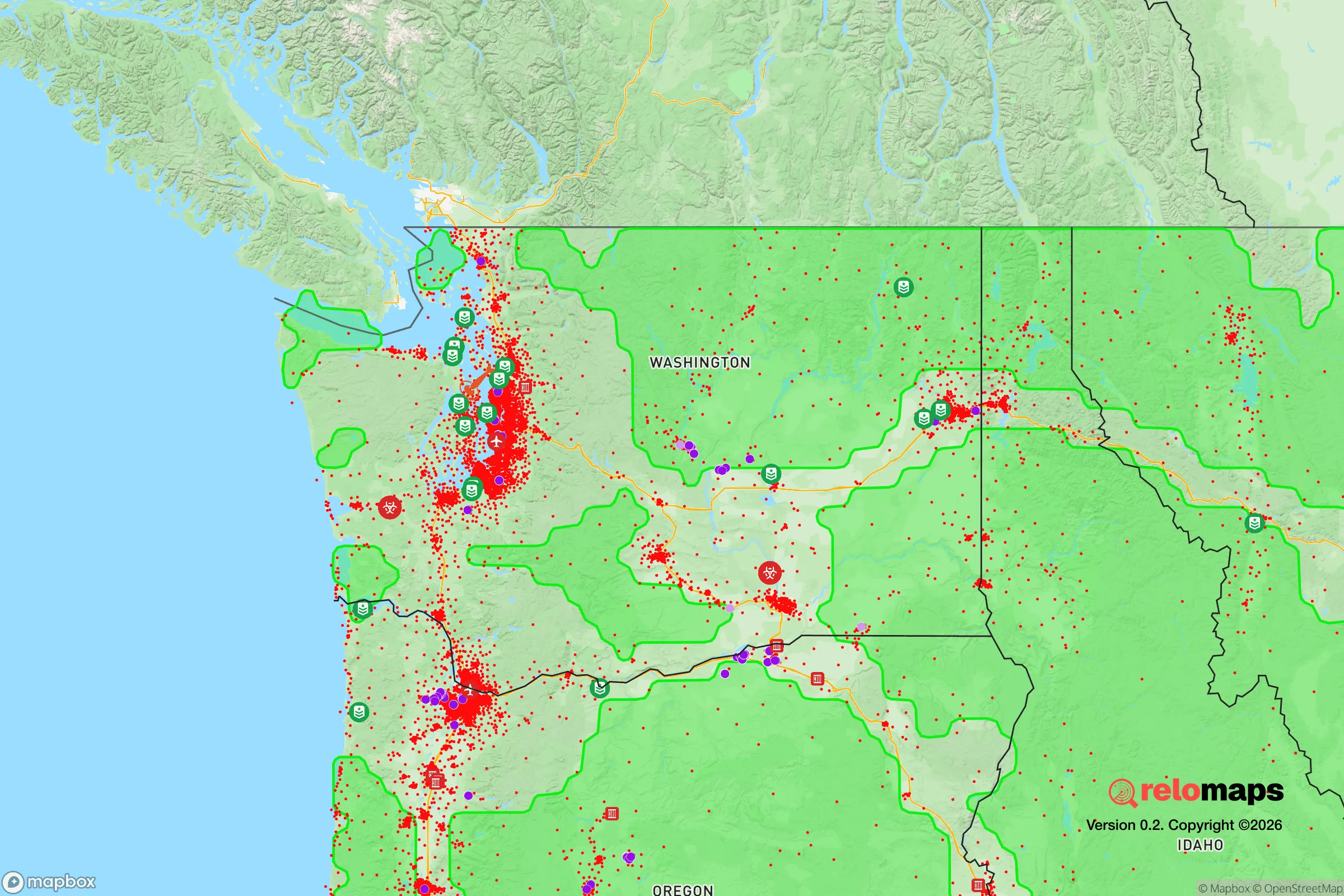
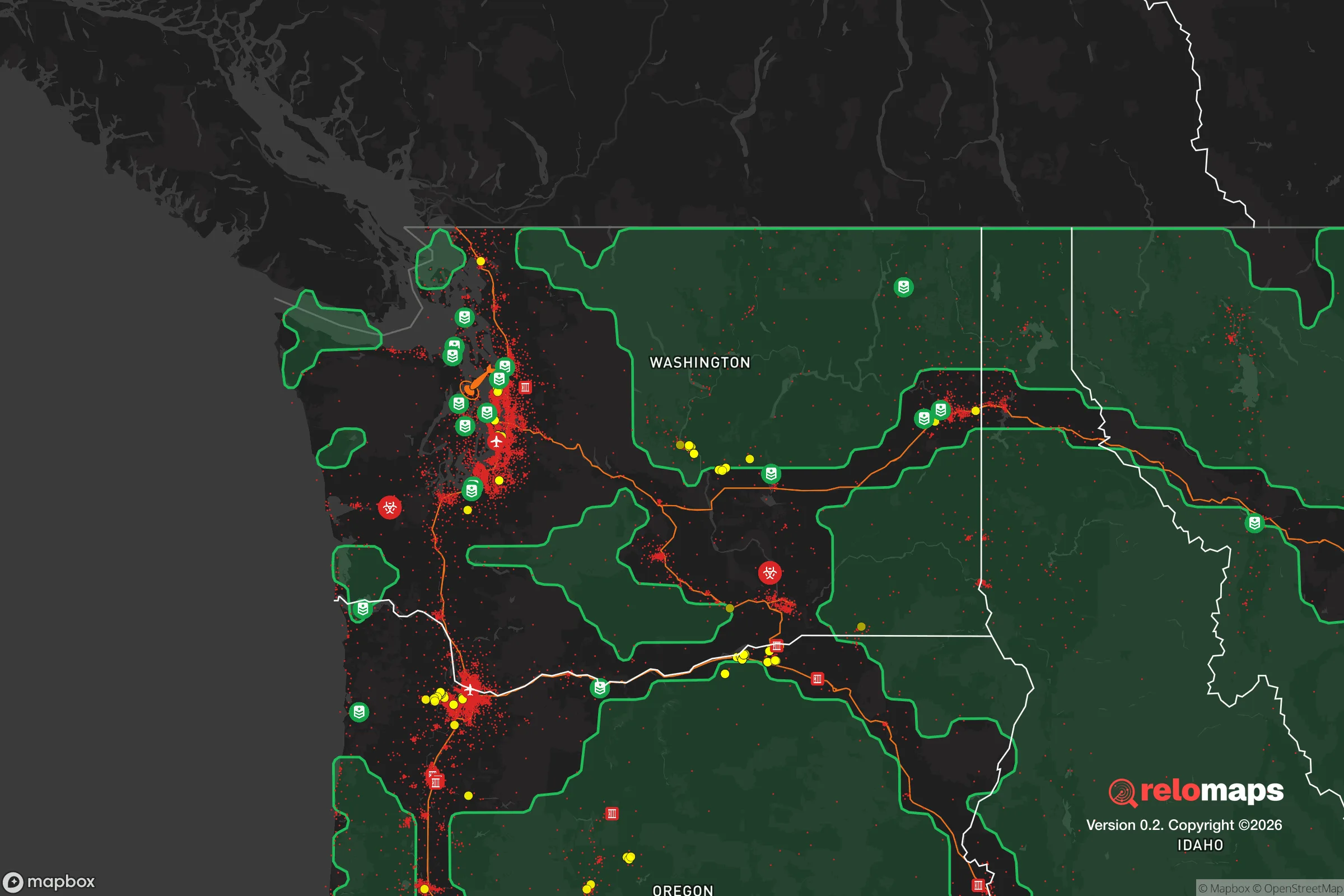


Important Note: For informational purposes only. This does not mean nothing bad ever happens in the green zones. Please use common sense. This is based on public data and modeled with AI. We tried to take a conservative approach but mistakes happen. We update this regularly as new information becomes available.
Solar Generator Recommendations
Backup power matters more here than in safer locations. We've picked three solar generators across budgets and capacity tiers — start with the budget unit if you only need a few essentials, or step up if you want to run a fridge and HVAC for days at a time.

Jackery Portable Power Station Explorer 300
Budget OptionPower on the Go: Weighing only 11 lbs, it's convenient to set up and store with book-sized foldable solar panels

BLUETTI Portable Power Station AC180
Designed for both indoor and outdoor scenarios, AC180 is highly capable as it has a robost capacity and continuous output power.

EF ECOFLOW DELTA Pro Ultra Power Station
Upgraded PickEcoFlow DELTA Pro Ultra is a whole-home energy system designed to grow with your family. Integrated with the Smart Home Panel 2, it scales to meet your evolving energy needs — keeping your home powered, intelligent, and secure through every stage of life.
We earn a commission, at no additional cost to you.
Strategic Assessment Analysis
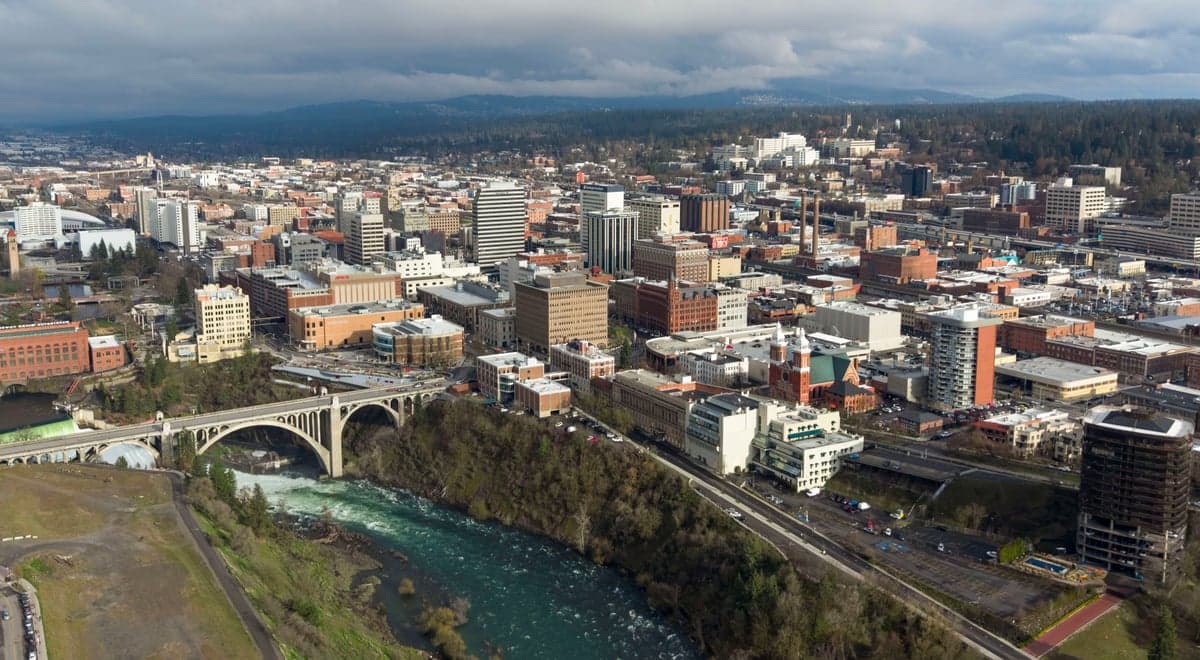
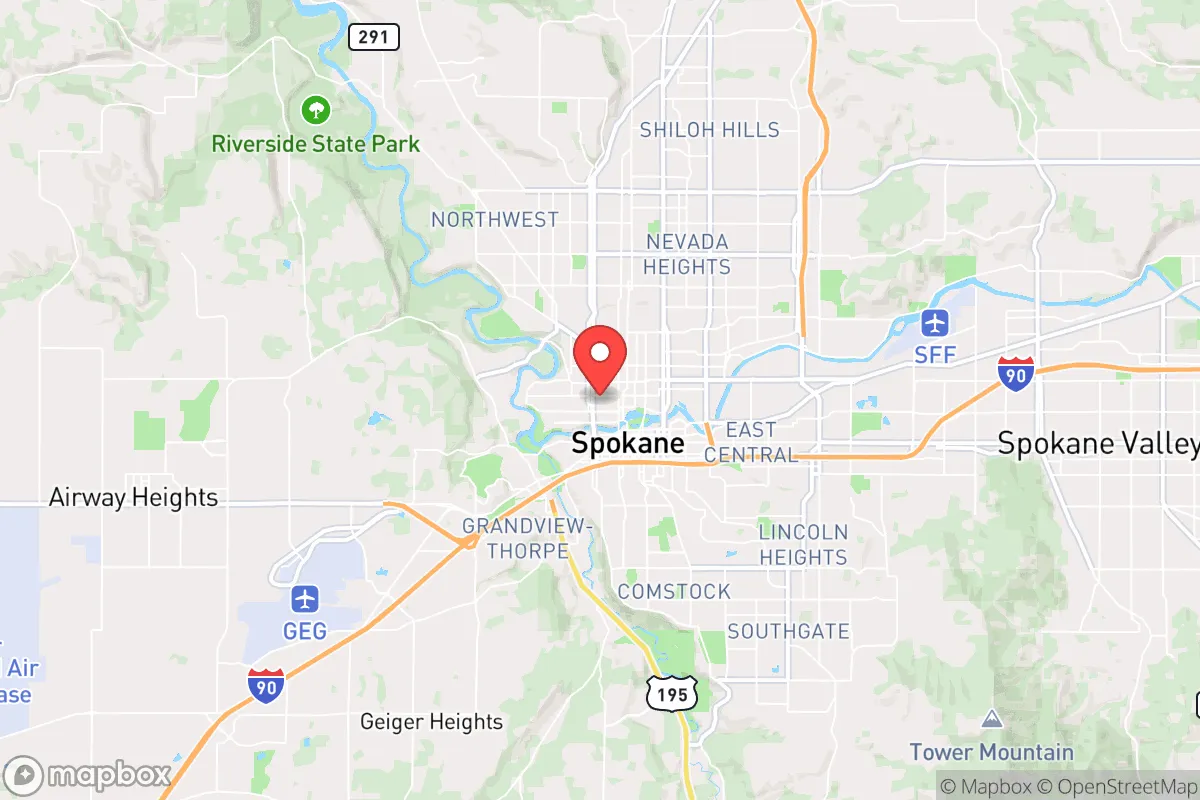
Spokane, Washington, occupies a unique strategic position in the inland Pacific Northwest, offering a blend of geographic isolation and practical self-sufficiency that appeals to those prioritizing resilience. Located roughly 20 miles from the Idaho border and 280 miles from Seattle, the city sits in a rain shadow that provides a drier, more temperate climate than the western side of the state—a significant advantage for long-term food storage and off-grid living. The region’s economy is anchored by healthcare, manufacturing, and the Fairchild Air Force Base, which provides a stabilizing military presence but also introduces a potential target risk. For a relocator concerned with civic unrest, natural disasters, or supply chain disruptions, Spokane offers a balance of access to resources and distance from the most volatile coastal population centers, though it is not without its own vulnerabilities.
Geographic position and natural advantages for long-term survival
Spokane’s location in the Spokane Valley, flanked by the Selkirk and Bitterroot mountain ranges, provides natural defensibility and abundant water resources. The Spokane River runs through the city, and the Spokane Valley-Rathdrum Prairie Aquifer is one of the largest and cleanest freshwater sources in the country, offering a reliable water supply even during drought conditions. The surrounding terrain—forested hills, agricultural valleys, and low mountain passes—creates multiple escape routes and choke points, making it easier to control access to the area in a crisis. The region’s agricultural output is substantial: the Palouse region to the south is a major wheat and lentil producer, and local farms supply dairy, beef, and vegetables. This means a relocator can source food locally without relying on fragile interstate supply chains. The climate, with cold winters and warm summers, supports year-round gardening and livestock raising, though winter preparedness is essential. For a prepper, the ability to grow food, collect rainwater, and access timber for heating and building makes Spokane a strong candidate for a semi-rural or suburban homestead.
Risks, exposures, and proximity to fallout-relevant landmarks
No strategic assessment is complete without acknowledging the downsides. Spokane’s primary risk is its proximity to Fairchild Air Force Base, which houses KC-135 tankers and is a key refueling hub for the U.S. Air Force. In a major conflict, this base could be a high-priority target, potentially drawing conventional or nuclear strikes. The city is also within 200 miles of the Hanford Site, a decommissioned nuclear production facility that still holds massive amounts of radioactive waste—a catastrophic release from Hanford could contaminate the Spokane River and aquifer, though prevailing winds generally blow eastward. Additionally, Spokane lies near the Newport Fault zone, and while major earthquakes are rare, the region is not seismically inert. Wildfire risk is real and growing: the 2021 Gray Fire and Oregon Road Fire burned thousands of acres near the city, threatening suburban neighborhoods and degrading air quality. For a relocator, these risks mean that a home should be chosen carefully—away from the base’s flight path, outside high-fire-risk zones, and with a backup water filtration system capable of handling potential contamination. The city’s population of about 230,000 (metro area ~600,000) is large enough to create congestion and resource competition during a crisis, but small enough that a determined individual can find rural acreage within a 30-minute drive.
Practical resilience for a relocator: food, water, energy, and defensibility
For a single individual or family looking to hunker down, Spokane offers several practical advantages. Water is the most critical resource, and the aquifer provides a deep, renewable supply that is less vulnerable to surface contamination than rivers or reservoirs. Many homes in the outlying areas have private wells, and the city’s water system is gravity-fed from the aquifer, meaning it can function without power for a time. Food security is strong: the Spokane Farmers Market and local co-ops provide direct access to regional produce, and the area has a thriving hunting and fishing culture—deer, elk, and trout are plentiful. Energy resilience is mixed: the grid is served by Avista Utilities, which relies on hydroelectric power from the Columbia River system, making it relatively stable but still vulnerable to cyberattacks or physical sabotage. Solar potential is decent, with about 200 sunny days per year, though winter cloud cover reduces output. Wood heating is common and practical, given the surrounding forests. Defensibility is moderate: the city’s layout, with the Spokane River cutting through the center and hills on the north and south sides, creates natural barriers. However, the sprawl of suburban developments means that a relocator should prioritize a property with a clear line of sight, limited access points, and good soil for a garden. The local gun culture is strong, with many residents owning firearms for hunting and self-defense, and Washington state’s laws are relatively permissive for concealed carry and magazine capacity compared to coastal counties—though recent legislation has tightened restrictions, so a relocator should check current laws.
Overall, Spokane presents a mixed but workable strategic picture for the survivalist-minded relocator. It is not a bunker—it has real exposure to military targets, wildfire, and potential contamination from Hanford. But its water abundance, agricultural base, and distance from the most chaotic coastal cities make it a far better bet than Seattle or Portland. The key is to choose a location carefully: avoid the Air Force base’s blast radius, secure a property with a well and wood heat, and build a network with like-minded locals who value self-reliance. For someone willing to put in the work—digging a root cellar, stocking supplies, and learning to hunt—Spokane offers a defensible, resource-rich base of operations in an increasingly uncertain world. The region’s conservative lean (Spokane County voted +2 R in 2024, with rural areas much redder) means you’ll find neighbors who share your concerns about government overreach and societal fragility. Just don’t expect a utopia—expect a place where you can carve out a resilient life if you’re prepared to handle the cold, the fires, and the occasional F-16 flying overhead.

* Values derived from national, state, county, city and local statistics and may differ in a specific area. Last updated: 2026-04-25T13:52:35.000Z
Narrative content on this page is AI-generated and may contain mistakes. Verify any details that matter before acting on them.
ReloMaps may earn a commission from affiliate links at no extra cost to you.

