Photo: Wikipedia
Political ClimatePolitical Climate in Springdale, AR
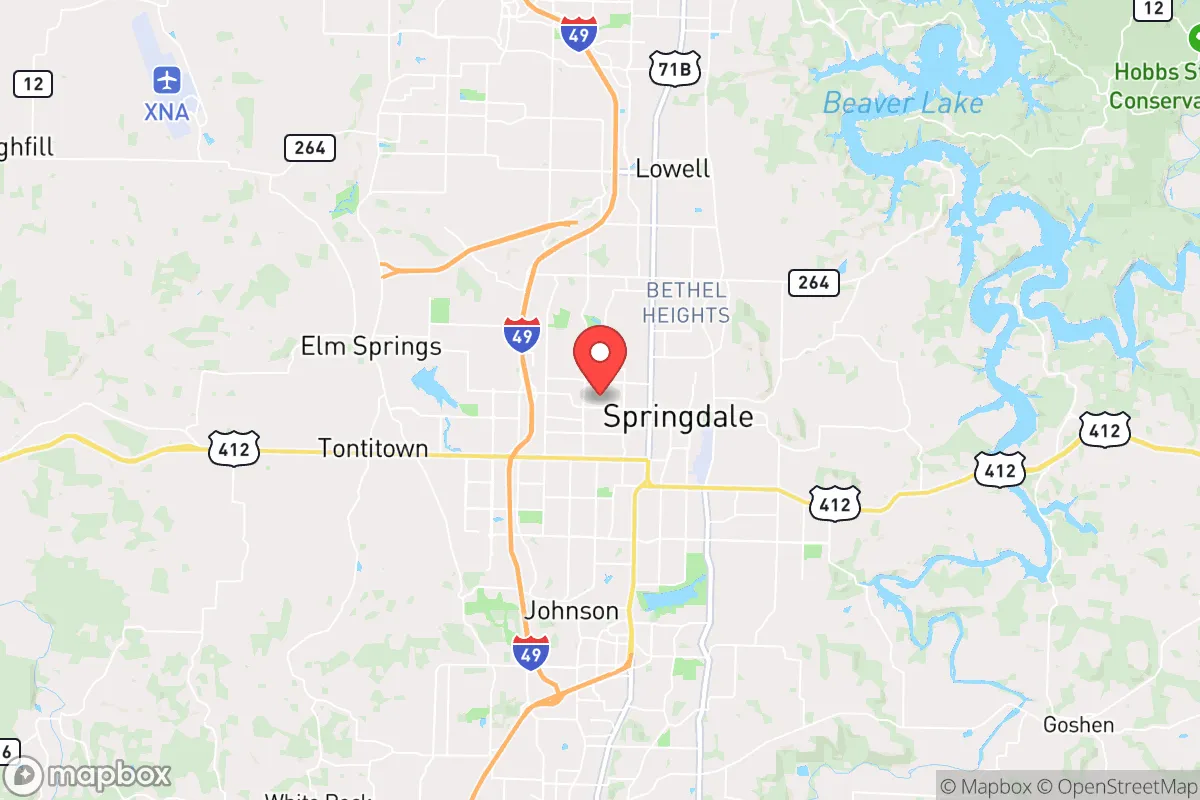
District shown is the primary district for this city’s centroid. Cities may span multiple districts.
Local Political AnalysisPolitical Analysis of Springdale, AR
Springdale, Arkansas, has long been a solidly conservative community, and that hasn't changed much despite the area's rapid growth. The Cook PVI of R+13 tells you the baseline: this is a place where Republican candidates regularly win by double digits, and the local culture reflects that. But if you've lived here as long as I have, you've noticed the political winds shifting in subtle ways, especially as the region's economy booms and new people pour in from all over. The core is still red, but the edges are getting a little more complicated.
How it compares
To really understand Springdale's politics, you have to look at the whole Northwest Arkansas corridor. Fayetteville, just a few miles south, is the liberal outlier—home to the University of Arkansas, with a younger, more transient population that votes reliably blue. Springdale, by contrast, feels more like the rest of the state. It's a working town, with deep roots in poultry processing, logistics, and manufacturing. The surrounding towns—Rogers, Bentonville, and especially the smaller communities like Pea Ridge and Gravette—are even more conservative. What sets Springdale apart is its growing diversity. The Marshallese and Hispanic communities are large here, and while they tend to lean more conservative on social issues than the national average for those demographics, they don't always vote in lockstep with the old guard. That's the wild card. If you're worried about government overreach, you'll find plenty of allies here who feel the same way, but you'll also see a slow, creeping influence from the more progressive policies bubbling up in Fayetteville and Bentonville's corporate headquarters.
What this means for residents
For the average Springdale resident, the political climate means a few concrete things. First, local taxes stay relatively low, and the city government is generally hands-off when it comes to personal freedoms—whether that's owning firearms, running a small business without endless red tape, or sending your kids to a school that isn't pushing a political agenda. The school board here has been a battleground, though. In recent years, there have been fights over library books, curriculum content, and mask mandates. The conservative majority has held the line so far, but it takes constant vigilance. Second, the rapid growth has brought new housing developments and traffic, but also pressure to adopt more "progressive" zoning and environmental regulations. So far, Springdale has resisted the kind of overreach you see in places like Portland or even parts of Fayetteville, but the fight is ongoing. If you value local control and minimal government interference, this is still a good place to be—but you can't afford to be complacent.
One cultural distinction worth noting: Springdale is home to the largest Marshallese community in the continental U.S., and that has shaped local politics in unexpected ways. The community tends to be socially conservative, pro-family, and wary of big government, which aligns well with the traditional Arkansas Republican base. But there's also a strong sense of community self-reliance that resists outside meddling. You'll see that same spirit in the long-time white families who've been here for generations. The biggest long-term concern I hear from neighbors isn't about any single policy—it's about the slow erosion of local control as the region grows. More state and federal mandates, more pressure from corporate interests in Bentonville, and more newcomers who don't share the same values. If you're looking for a place where you can still live your life without the government breathing down your neck, Springdale is still that place. But keep an eye on the school board meetings and city council votes. That's where the real battles are happening.

State Political ClimatePolitical Climate in Arkansas
State Political AnalysisPolitical Environment in the State
Arkansas has been a reliably red state for decades, but it’s not the same Arkansas it was 20 years ago. The state leans solidly Republican at the statewide level — every constitutional office is held by a Republican, and the legislature has a supermajority — but the political energy has shifted from a more moderate, Blue Dog Democrat past to a culturally conservative, populist present. Over the last 10-15 years, the state has moved rightward on guns, taxes, and education, while also seeing a growing tension between its rural, traditionalist base and the more libertarian-leaning newcomers flooding into the Northwest Arkansas corridor.
Urban vs. rural divide
The political map of Arkansas is stark. The rural counties — places like Baxter County (Mountain Home), Cleburne County (Heber Springs), and Pope County (Russellville) — vote Republican by 30-40 points. These areas are the backbone of the state’s conservative majority. The urban centers, however, tell a different story. Pulaski County (Little Rock) has become a Democratic stronghold, voting for Biden by double digits in 2020, driven by the capital city’s growing African American population and white-collar progressive transplants. Washington County (Fayetteville) is the state’s most interesting political battleground: home to the University of Arkansas, it’s a mix of college-town liberals and fiscally conservative tech workers from Walmart and Tyson Foods. Fayetteville itself is increasingly blue, but the surrounding rural parts of the county keep it competitive. Benton County (Bentonville) is the real story — it was reliably red for decades, but the influx of out-of-state corporate families and younger professionals has made it a purple-ish shade of red, with some precincts in Bentonville and Rogers voting for Democrats in local races. The divide isn’t just urban vs. rural; it’s old Arkansas vs. new Arkansas.
Policy environment
Arkansas’s policy environment is aggressively conservative, but with a pragmatic streak. The state has a flat income tax of 4.4% (down from 7% a decade ago), and the legislature is actively working to phase it out entirely. Sales tax is high — around 9.5% in some cities — but there’s no tax on groceries or prescription drugs. The regulatory climate is business-friendly, with right-to-work laws and minimal zoning in most rural areas. On education, the state passed the Arkansas LEARNS Act in 2023, which created universal school choice through Education Freedom Accounts, expanded charter schools, and banned critical race theory and “indoctrination” in public schools. It’s one of the strongest school choice laws in the South. Healthcare is a mixed bag: the state expanded Medicaid under the private option (Arkansas Works), which remains popular, but there’s no state-level abortion protection — a near-total ban is in effect. Election laws are strict: voter ID is required, absentee ballot drop boxes are banned, and early voting is limited to 15 days. The state also passed a law requiring all ballots to be hand-counted in future elections, a move that has drawn both praise and legal challenges.
Trajectory & freedom
On the freedom front, Arkansas is moving in a decidedly more libertarian direction, but it’s not without its contradictions. The state has some of the most expansive gun rights in the country: permitless carry (constitutional carry) was signed into law in 2021, and the state preempts all local gun ordinances. In 2023, the legislature passed a law prohibiting any state or local enforcement of federal gun laws, a direct challenge to federal overreach. On parental rights, the LEARNS Act includes a Parents’ Bill of Rights, giving parents control over curriculum and medical decisions. Medical freedom took a hit during COVID — the state had mask mandates and vaccine passports in some areas — but the backlash led to a 2023 law banning vaccine mandates for state employees and contractors. Property rights are strong, with no state income tax on capital gains and a homestead exemption that protects primary residences from forced sale. The biggest concern for freedom-minded folks is the state’s high incarceration rate and a criminal justice system that still leans punitive, though recent reforms have reduced some mandatory minimums. Overall, Arkansas is becoming more free on economic and cultural issues, but the government still has a heavy hand in certain areas.
Civil unrest & political movements
Arkansas hasn’t seen the kind of large-scale civil unrest you’d find in Portland or Seattle, but it’s had its flashpoints. The 2020 Black Lives Matter protests in Little Rock turned violent on a few occasions, with property damage and clashes with police, but they were small compared to national events. The state’s response was swift: the legislature passed a law in 2021 increasing penalties for rioting and blocking highways during protests. On the right, the Arkansas State Capitol has become a regular site for Second Amendment rallies and anti-vaccine mandate protests, drawing thousands. The most organized political movement in the state is the “Parents’ Rights” movement, which successfully pushed for the LEARNS Act and has been active in school board elections across Springdale and Rogers. Immigration politics are relatively quiet — Arkansas has a small but growing Hispanic population, mostly in Northwest Arkansas, and the state passed a law requiring local law enforcement to cooperate with ICE. There’s been no serious secession talk, but the state did pass a resolution in 2021 asserting its sovereignty under the Tenth Amendment. Election integrity remains a hot topic: the hand-counting law has energized both supporters and critics, with some counties worried about the cost and logistics.
Projection
Over the next 5-10 years, Arkansas is likely to become more conservative, but in a different flavor. The in-migration from California, Texas, and the Midwest — particularly to Northwest Arkansas — is bringing younger, wealthier, and more culturally conservative families who are pro-school choice, pro-gun, and anti-tax. This will likely push the state further on school choice expansion, income tax elimination, and deregulation. However, the same migration is also bringing a small but growing libertarian and even progressive element to places like Fayetteville and Bentonville, which could make those areas more competitive in local races. The rural counties will remain deeply red, but their population is aging and shrinking. The biggest wildcard is the state’s growing Hispanic population, which is still largely conservative on social issues but could shift the political calculus on immigration and labor policy. Expect the state to continue passing laws that prioritize parental rights, gun rights, and tax cuts, while the urban-rural divide becomes more pronounced. A new resident moving in now should expect a state that is culturally conservative but increasingly dynamic, with a political climate that rewards engagement at the local level.
For a new resident, the bottom line is this: Arkansas offers a high degree of personal freedom on the issues that matter most to conservatives — guns, school choice, taxes, and parental rights — but it’s not a libertarian paradise. The government is still active in areas like criminal justice and healthcare, and the political climate can feel like a tug-of-war between old-school rural values and the new energy of Northwest Arkansas. If you’re looking for a place where your vote counts, your voice matters, and the culture aligns with traditional values, Arkansas is a solid bet. Just be prepared for the humidity and the occasional political fight over how far “freedom” should go.
* Values derived from national, state, county, city and local statistics and may differ in a specific area. Last updated: 2026-04-29T19:14:58.000Z
Narrative content on this page is AI-generated and may contain mistakes. Verify any details that matter before acting on them.
ReloMaps may earn a commission from affiliate links at no extra cost to you.

