Photo: Wikipedia
Demographics of St. Augustine, FL
Affluence Level in St. Augustine, FL
A middle-class area roughly in line with national averages across income, home values, education, and employment.
People of St. Augustine, FL
Today, St. Augustine’s 14,979 residents form a predominantly white (82.6%) and highly educated (43.5% college degree) population, with a notably small foreign-born share of just 2.6%. The city’s character is defined by its historic tourism economy, a strong preservationist ethos, and a demographic profile that is older and less diverse than the national average. Hispanic residents make up 8.0% of the population, while Black residents account for 3.8%, and East/Southeast Asian communities represent 0.7%, with Indian-subcontinent residents at 1.1%.
How the city was settled and grew
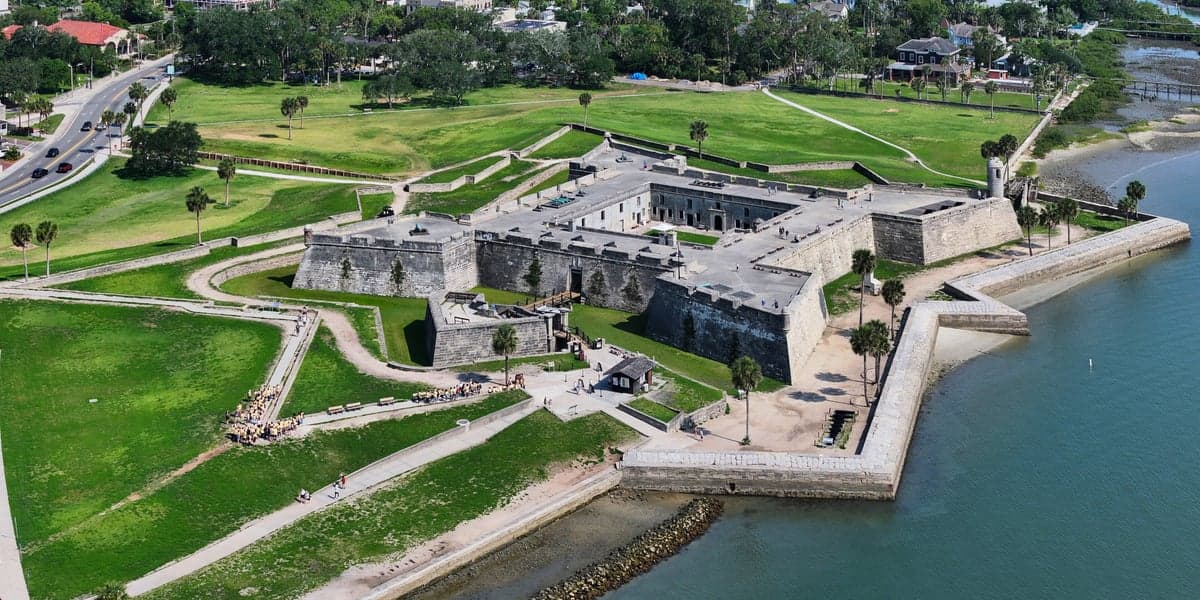
Founded in 1565 by Spanish admiral Pedro Menéndez de Avilés, St. Augustine is the oldest continuously occupied European-established settlement in the continental United States. Its original population was a mix of Spanish soldiers, settlers, and enslaved Africans, with the Lincolnville neighborhood later becoming the historic heart of the city’s Black community after the Civil War, settled by formerly enslaved people and freedmen. The 18th and 19th centuries brought waves of Minorcan, Greek, and Italian laborers, many of whom settled in the Old City district near the Castillo de San Marcos, working in fishing, farming, and the coquina quarries. By the early 20th century, tourism and railroad expansion—driven by Henry Flagler’s hotels and rail lines—drew a new wave of white, middle-class workers and entrepreneurs, who built homes in the Model Land Company subdivision (now part of the historic district) and the Davis Shores neighborhood, a planned community on Anastasia Island developed in the 1920s. The city’s population remained small and relatively homogeneous through the mid-20th century, with limited industrial growth and a heavy reliance on seasonal tourism.
Modern era (post-1965)
After the 1965 Hart-Cellar Act, St. Augustine saw only modest immigration due to its small job base and lack of major industry. The foreign-born population remains low at 2.6%, with the largest immigrant groups being Hispanic (primarily from Mexico and Central America) and a small Indian-subcontinent community. Domestic in-migration has been the primary driver of change, particularly from retirees and remote workers drawn to the city’s historic charm and coastal lifestyle. These newcomers have concentrated in newer subdivisions like World Golf Village (west of the city proper) and the Anastasia Island beach communities, while the historic core—including Lincolnville—has experienced significant gentrification. Lincolnville, once a predominantly Black neighborhood, has seen its Black population decline as property values have risen, with many longtime residents displaced by white, college-educated arrivals. The city’s racial composition has shifted accordingly: the Black share dropped from roughly 12% in 2000 to 3.8% today, while the white share increased from 75% to 82.6% over the same period. Hispanic growth has been modest, rising from 5% to 8.0%, with most Hispanic residents living in the West Augustine area, a historically working-class district with lower housing costs.
The future
St. Augustine’s population is likely to continue homogenizing along racial and economic lines. The city’s high housing costs (median home value above $400,000) and limited rental stock are pricing out younger families and minority households, while attracting affluent retirees and remote workers. The Black population is expected to remain stable or decline further, as Lincolnville’s gentrification shows no signs of slowing. Hispanic and Indian-subcontinent communities are growing slowly, but from a very small base, and are unlikely to reach double-digit shares within the next decade. The East/Southeast Asian population (0.7%) is plateauing, with no major employer or cultural anchor drawing new arrivals. The city’s college-educated share (43.5%) will likely rise, reinforcing its character as a high-amenity, low-diversity enclave for professionals and retirees. New development is concentrated in the World Golf Village area and along the SR 16 corridor, which are attracting mostly white, middle-class families from elsewhere in Florida and the Northeast.
For a conservative-leaning individual or family considering relocation, St. Augustine offers a stable, safe, and culturally rich environment with a strong sense of place, but it is becoming less diverse and more expensive. The city’s demographic trajectory points toward a whiter, older, and more affluent population—a trend that aligns with the preferences of many conservative movers but may limit the kind of community diversity some families seek. The bottom line: St. Augustine is a historic, high-cost, low-diversity city that rewards those who can afford its premium on charm and safety.

* Values derived from national, state, county, city and local statistics and may differ in a specific area. Last updated: 2026-04-15T23:48:50.000Z
Narrative content on this page is AI-generated and may contain mistakes. Verify any details that matter before acting on them.
ReloMaps may earn a commission from affiliate links at no extra cost to you.

