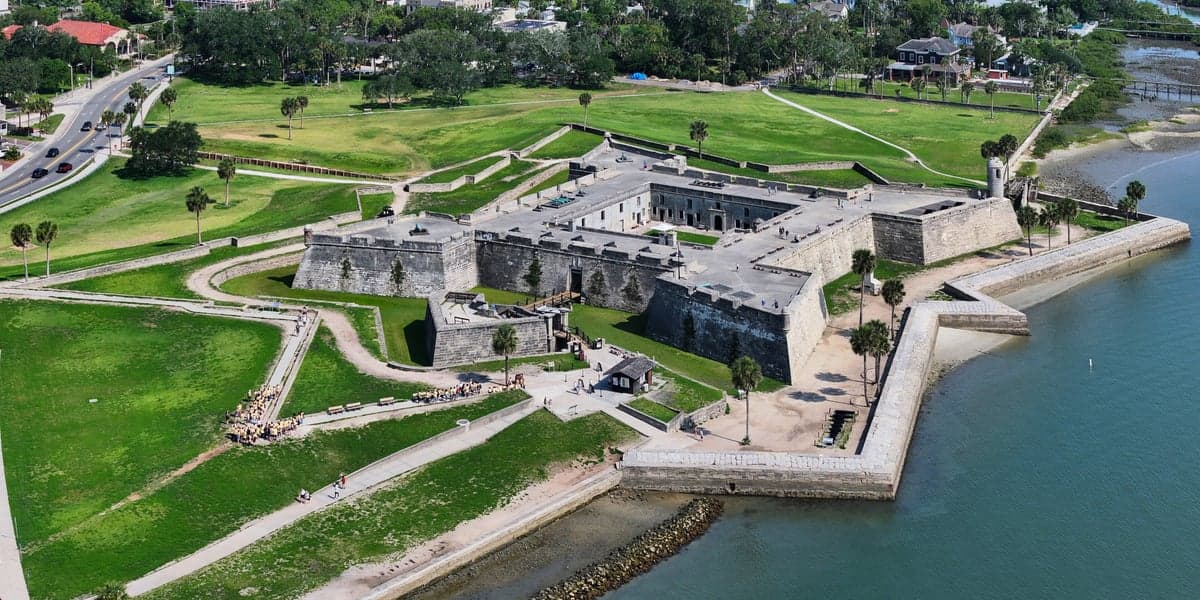
Photo: Wikipedia
Political ClimatePolitical Climate in St. Augustine, FL
District shown is the primary district for this city’s centroid. Cities may span multiple districts.
Local Political AnalysisPolitical Analysis of St. Augustine, FL
St. Augustine, Florida, has long been a conservative stronghold, with a Cook PVI of R+10 that reflects its deep-rooted Republican leanings, but if you’ve lived here as long as I have, you’ve seen the political winds start to shift in ways that give a guy pause. The city itself—especially the historic downtown and areas near Flagler College—has been slowly drifting toward a more progressive, government-heavy mindset, while the surrounding St. Johns County remains reliably red. It’s a tale of two worlds, and the trajectory is something to keep an eye on if you value personal freedoms and limited government.
How it compares
When you stack St. Augustine up against its neighbors, the contrast is stark. Head west to Jacksonville, and you’ll find a much more liberal-leaning city, with a Democratic mayor and a county that’s been trending blue for years—think higher taxes, more regulations, and a general acceptance of government overreach into things like property rights and business operations. Drive south to Palm Coast in Flagler County, and it’s a mixed bag, but still more purple than St. Johns County. Meanwhile, towns like Ponte Vedra Beach and Nocatee, just a few miles east, are solidly conservative, with lower crime, better schools, and a general “leave us alone” attitude. The real worry is that St. Augustine’s historic charm is being used as a wedge to push progressive policies—like stricter zoning, bike lane mandates, and noise ordinances—that feel more like control than community improvement.
What this means for residents
For folks who’ve been here a while, the political climate means you’ve got to stay vigilant. The city council has been flirting with ideas like rent control and “equity” initiatives that sound nice on paper but usually lead to higher costs and less freedom for property owners. On the plus side, St. Johns County as a whole still votes overwhelmingly Republican, so state-level issues—like school choice, Second Amendment protections, and tax limits—are safe for now. But the local elections are where the rubber meets the road. If you’re a family looking to move here, know that your day-to-day life will be shaped by whether you’re inside city limits or out in the county. Inside, you might deal with more red tape; outside, it’s still the Florida you remember from the 90s.
One thing that sets St. Augustine apart culturally is its heavy reliance on tourism, which has created a weird political dynamic. The city government loves to cater to visitors—think more parking fees, stricter short-term rental rules, and a general “we know what’s best” attitude—while long-time residents get squeezed. There’s also a growing push for “historic preservation” that’s less about keeping the old town pretty and more about controlling what you can do with your own property. If you’re coming from a place where personal rights are respected, you’ll notice the difference. My advice? Keep an eye on those local elections, and don’t let the progressive wave wash over what makes this area great. It’s still a conservative gem, but it’s getting harder to ignore the cracks.

State Political ClimatePolitical Climate in Florida
State Political AnalysisPolitical Environment in the State
Florida has transformed from a quintessential swing state into a solidly Republican-leaning powerhouse over the past two decades, driven by a massive influx of conservative-leaning transplants from the Northeast and Midwest. The state now boasts a GOP voter registration advantage of over 600,000, and in 2024, Donald Trump carried Florida by more than 13 points—a stark contrast to the nail-biters of 2000 and 2012. The dominant coalition is a blend of traditional Southern conservatives, Cuban-American exiles in Miami-Dade, and a growing wave of fiscally conservative retirees and families fleeing high-tax states like New York and California. This shift has been accelerating since 2018, with Governor Ron DeSantis’s aggressive pandemic-era policies cementing Florida as a national laboratory for conservative governance.
Urban vs. rural divide
The political map of Florida is a tale of three distinct regions. The sprawling Miami-Dade County, once a Democratic stronghold, has been trending right for a decade, driven by the Cuban-American and Venezuelan communities in Hialeah and Doral who are fiercely anti-socialist. In 2024, Trump won Miami-Dade by 11 points—a seismic shift from Obama’s 20-point win there in 2012. Meanwhile, the I-4 corridor, anchored by Orlando and Tampa, remains the state’s primary battleground, with suburban counties like Pinellas and Seminole flipping red in recent cycles. The rural Panhandle, from Pensacola to Tallahassee, is deeply conservative, with counties like Santa Rosa and Okaloosa routinely voting 70%+ Republican. The only remaining blue strongholds are Gainesville (home to the University of Florida) and parts of Broward County (Fort Lauderdale), but even there, Democratic margins are shrinking as conservative retirees move into coastal condos.
Policy environment
Florida’s policy environment is a deliberate contrast to high-tax, high-regulation states. There is no state income tax, which is the single biggest draw for relocating families and remote workers. Property taxes are capped by the Save Our Homes amendment, and the state’s regulatory posture is famously business-friendly—permitting for new construction is streamlined, and occupational licensing has been reduced for dozens of professions. On education, Governor DeSantis signed the Parental Rights in Education Act (HB 1557) in 2022, which prohibits classroom instruction on sexual orientation and gender identity in grades K-3, and the state has expanded school choice through universal Education Savings Accounts (HB 1 in 2023). Healthcare policy is market-oriented: Florida did not expand Medicaid under the ACA, and the state has banned vaccine mandates for private employers (HB 1 in 2023). Election laws were tightened after 2020, with SB 90 requiring stricter voter ID, limiting drop boxes, and banning ballot harvesting—a move that withstood legal challenges. The state also passed a 15-week abortion ban (HB 5) in 2022, later extended to six weeks in 2023, reflecting the conservative legislature’s priorities.
Trajectory & freedom
On the freedom index, Florida is clearly moving in the direction of expanded personal liberty for conservatives, but with notable caveats. The state has become a national leader on gun rights: permitless carry (HB 543) was signed in 2023, allowing any law-abiding adult to carry a concealed firearm without a permit. Property rights were strengthened by the “Live Local Act” (SB 102) in 2023, which preempts local zoning to allow more affordable housing development, though some conservatives argue it infringes on local control. Medical autonomy saw a win with the ban on vaccine passports and mandates, but the state also cracked down on COVID-19 restrictions by fining local governments that imposed mask mandates. On the downside, the state’s “Don’t Say Gay” law and the six-week abortion ban represent expansions of government power into personal medical and family decisions—a tension that some libertarian-leaning residents find concerning. The state also has a history of aggressive homeowner association (HOA) enforcement, which can feel like a local government overreach for those in planned communities.
Civil unrest & political movements
Florida has seen relatively little civil unrest compared to states like Oregon or Minnesota, but flashpoints exist. In 2020, Miami and Orlando saw Black Lives Matter protests that turned violent in isolated incidents, but the state’s “law and order” posture under DeSantis led to quick crackdowns. The most visible political movement is the growing Cuban-American activism in Miami-Dade, where groups like the Cuban American National Foundation organize against any normalization with the Castro regime. On the right, the “Florida Freedom Alliance” and local Moms for Liberty chapters have been highly active in school board elections, successfully flipping several districts in Pasco and Volusia counties. Immigration politics are a constant flashpoint: Florida passed SB 1718 in 2023, the toughest anti-illegal immigration law in the country, requiring E-Verify for all employers and banning local “sanctuary” policies. This has led to protests from immigrant rights groups in Immokalee and Homestead, but the law enjoys broad support among the state’s conservative base. Election integrity remains a live issue, with the state’s new Office of Election Crimes and Security actively prosecuting voter fraud cases—a move that has drawn both praise and criticism.
Projection
Over the next 5-10 years, Florida is likely to become even more conservative, driven by demographic trends that show no sign of slowing. The state is adding roughly 1,000 new residents per day, most of whom are coming from blue states like New York, California, and Illinois. These transplants tend to be older, wealthier, and more fiscally conservative than the national average. The Hispanic vote, particularly among Cubans, Venezuelans, and Nicaraguans in Miami-Dade, will continue to shift right, potentially making the county reliably red by 2030. The biggest wildcard is the growing population of Puerto Ricans in Orlando and Tampa, who tend to vote more Democratic but are less ideologically rigid than mainland Hispanics. If the state’s housing costs continue to rise—home prices in Naples and Sarasota have doubled since 2020—it could slow in-migration and shift the political calculus. However, the state’s low-tax, low-regulation model is a proven draw, and the GOP’s supermajority in the legislature is likely to persist, meaning more conservative policies on education, immigration, and healthcare are coming.
For a new resident, the bottom line is this: Florida offers a political environment that is increasingly aligned with conservative values on taxes, parental rights, and public safety, but it is not a libertarian paradise. The state government is active in shaping social policy, from classroom content to medical decisions, and local HOAs can be a source of frustration. If you value low taxes, school choice, and a business-friendly climate, Florida is a strong bet. But if you want maximum personal autonomy with minimal government interference, you’ll want to choose your county carefully—rural Panhandle counties offer more freedom than the heavily regulated coastal enclaves like Miami Beach or Key West. The trajectory is clear: Florida is doubling down on its conservative identity, and for those who share that vision, it’s a welcoming place to put down roots.
* Values derived from national, state, county, city and local statistics and may differ in a specific area. Last updated: 2026-04-15T23:48:50.000Z
Narrative content on this page is AI-generated and may contain mistakes. Verify any details that matter before acting on them.
ReloMaps may earn a commission from affiliate links at no extra cost to you.

