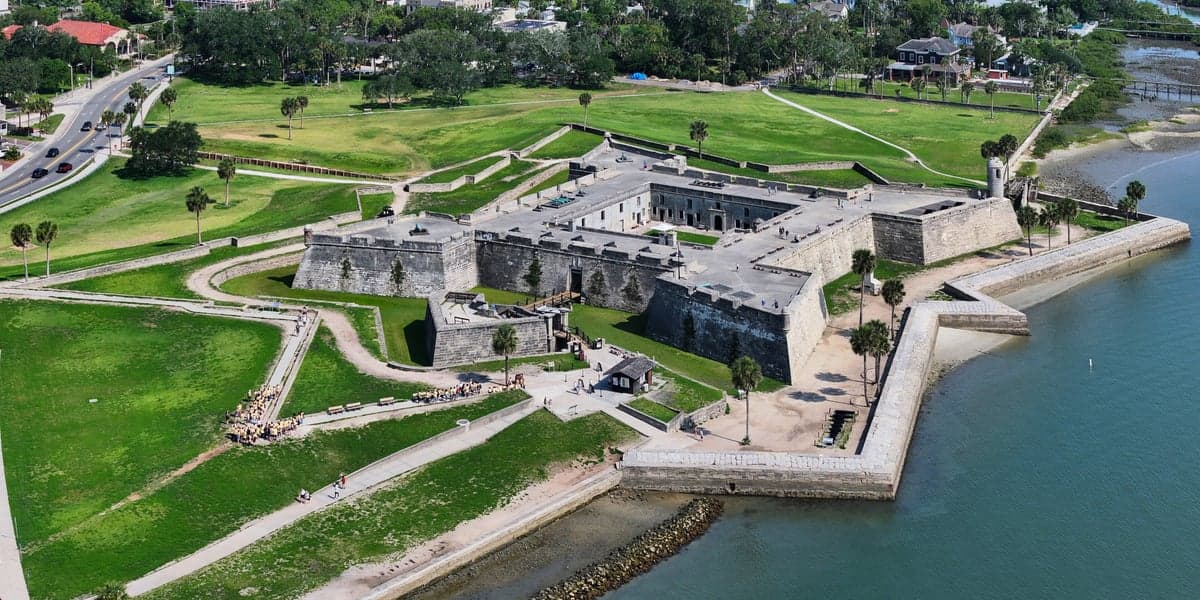
Photo: Wikipedia
Personal Sovereignty in St. Augustine, FL
Viable for self-reliance. Generally workable, though some barriers may limit total independence.
What does Personal Sovereignty tell us?
Personal Sovereignty measures your capacity for self-reliance and independence with minimal government friction. Higher scores mean fewer barriers between you and the way you want to live... but it assumes you have the space you need and good neighbors.
What does this tell us?
Personal Sovereignty measures your capacity for self-reliance and independence with minimal government friction. Higher scores mean fewer barriers between you and the way you want to live... but it assumes you have the space you need and good neighbors.
State Policy
Energy independence: Importer (10% of energy produced in-state)
Personal Liberty
Homesteading

Personal Liberty Analysis
St. Augustine, Florida, offers a mixed bag for those prioritizing personal sovereignty, with the state’s strong preemption laws and lack of income tax providing a solid foundation, but local zoning and municipal codes introduce friction points that a survivalist or prepper must navigate carefully. While Florida’s constitutional carry law and broad Stand Your Ground protections are clear wins, the city’s historic district overlay and coastal development restrictions can limit off-grid living and property modifications. For single individuals and parents seeking to minimize government overreach, St. Augustine requires strategic property selection and a clear-eyed understanding of where local ordinances can override state-level freedoms.
Tax burden and regulatory posture: what it means for your autonomy
Florida’s lack of a state income tax is a direct boost to personal sovereignty, allowing residents to keep more of their earnings without funding a sprawling state bureaucracy. St. Augustine, however, imposes a 7.5% sales tax (6% state plus 1.5% local option), which is slightly above the state average but still lower than many northeastern states. Property taxes in St. Johns County average around 0.78% of assessed value, which is moderate for Florida, but the county’s high property values—median home price near $500,000—mean a significant annual outlay. The regulatory posture is generally business-friendly at the state level, with no corporate income tax and limited licensing requirements for trades like welding or small-scale manufacturing. However, St. Augustine’s Historic Preservation Board wields considerable power over exterior modifications, fence heights, and even paint colors in the historic district, which can frustrate those wanting to install solar panels, rainwater catchment systems, or reinforced doors without permits. For a prepper, this means choosing a property outside the historic overlay—ideally in unincorporated St. Johns County—to avoid these aesthetic-based restrictions.
Self-defense and gun law specifics: what you can and cannot do
Florida’s gun laws are among the most permissive in the South, and St. Augustine residents benefit directly. As of July 2023, Florida is a constitutional carry state, meaning no permit is required to carry a concealed firearm for anyone 21 or older who is legally allowed to possess a gun. Open carry is generally prohibited except in specific situations like hunting or fishing, but the concealed carry allowance is broad. Stand Your Ground laws apply statewide, with no duty to retreat in any place where you have a legal right to be, including your vehicle. Magazine capacity is unrestricted, and there is no state-level assault weapons ban. However, local governments in Florida are preempted from enacting their own gun ordinances, so St. Augustine cannot impose additional restrictions—a critical protection against city council overreach. For parents, this means you can keep firearms in your home or vehicle without local interference, and you can train your children in firearm safety on your own property without needing a range membership. The only notable limitation is the federal Gun-Free School Zones Act, which prohibits firearms within 1,000 feet of K-12 schools unless you have a concealed carry permit—so a permit is still advisable for daily carry near schools or on public transit.
Self-reliance and homesteading viability: lot sizes, zoning, and off-grid feasibility
St. Augustine’s urban core is not conducive to serious homesteading, but the surrounding St. Johns County offers more room. Minimum lot sizes in the county’s agricultural zoning (A-1) are 5 acres, which allows for chickens, goats, and small livestock without special permits. Within the city limits, lot sizes are typically smaller—often under a quarter-acre—and zoning restricts livestock to non-commercial fowl only, with no roosters allowed. Off-grid feasibility is limited by Florida building codes that require connection to municipal water and sewer in most developed areas, though rainwater collection for irrigation is permitted without a permit if the system holds less than 1,000 gallons. Solar panels are allowed but must comply with the Florida Building Code and, in historic districts, may require approval from the preservation board. A more viable option for self-reliance is purchasing land in the western part of the county, near Hastings or Elkton, where well and septic systems are standard, and zoning is more permissive. Even there, however, Florida’s wetland protection laws and the St. Johns River Water Management District can restrict clearing land or building ponds, so a prepper should budget for environmental consultants before buying raw land.
Personal liberties: parental rights, medical autonomy, speech, and property
Florida has been a battleground for parental rights, and recent state laws have strengthened parents’ control over their children’s education and medical decisions. The Parental Rights in Education Act (HB 1557) prohibits classroom instruction on sexual orientation or gender identity in grades K-3, and the state’s medical consent laws require parental approval for most treatments for minors, including vaccinations. This aligns with a conservative view of family sovereignty, though parents should note that Florida’s compulsory vaccination laws for school attendance still apply—medical and religious exemptions are available but require paperwork and, for religious exemptions, a signed statement. Medical autonomy for adults is strong: Florida does not have a state-level vaccine mandate, and the 2023 law prohibiting COVID-19 vaccine mandates for private employers (HB 1) reinforces individual choice. Speech protections are robust under the Florida Constitution, which explicitly protects political speech, and the state has preempted local governments from regulating signs or political expression on private property. Property rights are generally strong, with Florida’s “Right to Farm” Act protecting agricultural operations from nuisance lawsuits, and the state’s homestead exemption protecting a primary residence from creditors (up to 160 acres in rural areas, half an acre in urban). However, St. Augustine’s strict tree protection ordinance requires permits to remove any tree over 4 inches in diameter, which can limit clearing for gardens or defensive perimeters.
Overall, St. Augustine offers a solid baseline for personal sovereignty thanks to Florida’s state-level protections—no income tax, constitutional carry, strong parental rights, and property protections—but the city’s historic district and coastal regulations create friction for those wanting maximum self-reliance. Compared to areas like rural Texas or the Florida Panhandle, St. Augustine is more restrictive on land use and off-grid living, but it still outpaces most of the Northeast and West Coast in terms of gun rights and tax freedom. For a single individual or family willing to live outside the city limits and navigate the permitting process, the area can support a high degree of autonomy. The key is to avoid the historic overlay, buy at least 5 acres in the county, and budget for legal fees if you plan to push back against local code enforcement. In a world of increasing government overreach, St. Augustine is a decent defensive position—not a fortress, but far from a surrender.

* Values derived from national, state, county, city and local statistics and may differ in a specific area. Last updated: 2026-04-15T23:48:50.000Z
Narrative content on this page is AI-generated and may contain mistakes. Verify any details that matter before acting on them.
ReloMaps may earn a commission from affiliate links at no extra cost to you.

