
Photo by Katie Musial on Unsplash
Political ClimatePolitical Climate in St Helens, OR
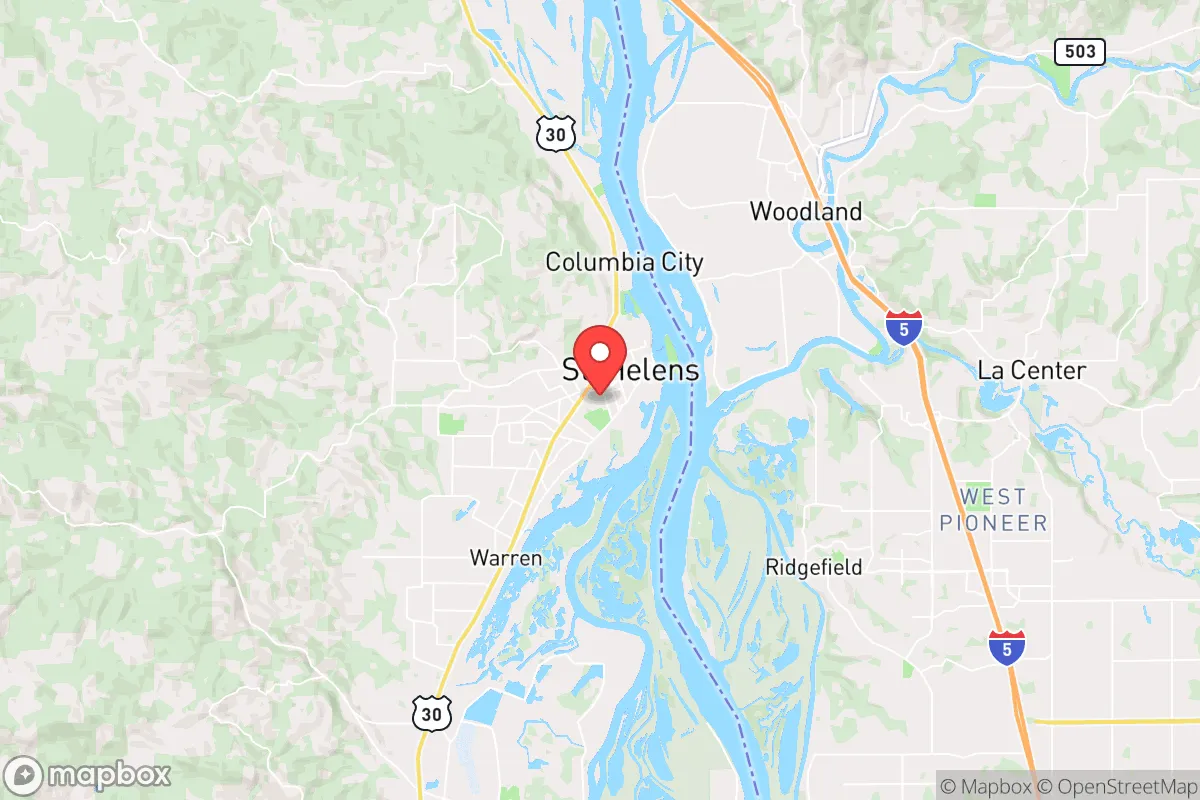
District shown is the primary district for this city’s centroid. Cities may span multiple districts.
Local Political AnalysisPolitical Analysis of St Helens, OR
St Helens, Oregon, leans heavily Democratic, with a Cook PVI of D+20 that puts it squarely in the blue column, but that number doesn't tell the whole story of how things have shifted here over the past decade. I've lived in this Columbia County town my whole life, and I remember when local elections were genuinely competitive—you'd see yard signs for both parties on the same block, and folks would hash things out over coffee at the Logger Restaurant. Now, the political machine has tightened its grip, and the progressive agenda coming out of Salem and Portland is increasingly calling the shots here, even in a town that used to pride itself on being a little more independent-minded.
How it compares
To understand St Helens, you have to look at the contrast with the rest of Columbia County. Head east to Scappoose or Vernonia, and you'll find a more mixed political landscape—Scappoose still has a strong conservative base, and Vernonia leans redder than you'd expect for a small timber town. But St Helens, as the county seat, has become a blue island in a county that voted for Trump in 2020. Drive 20 minutes south to Warren or Deer Island, and you'll hear folks grumbling about the same overreach we're seeing here: zoning rules that make it hard to build a shed without a permit, and school board meetings that feel more like political rallies than discussions about kids' education. The contrast is stark—St Helens feels like a Portland suburb now, while the surrounding rural areas still hold onto that "leave us alone" attitude.
What this means for residents
For those of us who value personal freedoms, the shift is concerning. The city council and county commission have pushed through land-use restrictions that make it harder to run a small business from your property or even put up a fence without jumping through hoops. There's a growing sense that government overreach is creeping into daily life—new fees for things that used to be simple, and a push for "equity" policies that sound good on paper but end up favoring certain groups over others. Property taxes have climbed steadily, and while some of that goes to schools and roads, a chunk of it funds programs that feel more like social engineering than practical governance. Longtime residents are starting to feel like their voice doesn't matter as much, especially when the progressive bloc votes in lockstep on issues like homeless services and density zoning that change the character of our neighborhoods.
Culturally, St Helens has always been a river town with a blue-collar backbone—logging, fishing, and the paper mill were the lifeblood here. But as Portland's influence has spread, we've seen a push for sanctuary city policies and a focus on climate activism that feels out of touch with the folks who actually work the land. The annual Christmas parade and waterfront festivals still draw crowds, but the political undercurrent is harder to ignore. If this trajectory continues, I worry we'll lose the independent spirit that made St Helens a good place to raise a family—where your neighbor's business was their own, and the government stayed out of your garage and your backyard.

State Political ClimatePolitical Climate in Oregon
State Political AnalysisPolitical Environment in the State
Oregon has long been painted as a deep-blue state, but the reality on the ground is far more fractured. The state’s overall partisan lean is Democratic, with every statewide office and both U.S. Senate seats held by Democrats, but that dominance is almost entirely driven by the Portland metro area. Over the last 10-20 years, the state has lurched leftward on social and environmental policy, yet large swaths of eastern and southern Oregon have swung hard in the opposite direction, creating one of the most pronounced urban-rural political chasms in the country. For a conservative considering relocation, the key takeaway is that Oregon is not a monolith—your experience will depend almost entirely on which county you choose to call home.
Urban vs. rural divide
The political map of Oregon is a tale of two states. Multnomah County (Portland) alone delivers roughly 20% of the state’s total vote, and it reliably votes Democratic by margins of 70-80%. The Portland metro area, including Washington and Clackamas counties, forms the engine of the state’s progressive politics. Meanwhile, the rest of Oregon is a sea of red. Eastern Oregon counties like Union, Baker, and Malheur routinely vote Republican by 30-40 point margins, and even the more populous Willamette Valley counties—Marion, Linn, and Douglas—lean conservative outside of their college towns. A notable flashpoint is Bend (Deschutes County), which was once a reliably red stronghold but has become a competitive swing county as Californians and out-of-state transplants have poured in. In 2024, Deschutes County voted for Trump by a slim margin, but the county commission flipped to Democratic control, signaling a slow but steady shift. Conversely, Grants Pass (Josephine County) and Medford (Jackson County) have become bastions of conservative resistance, with local officials openly defying state mandates on land use, gun control, and COVID-era restrictions.
Policy environment
Oregon’s state-level policy environment is a mixed bag that leans heavily progressive, but with some notable exceptions. There is no state sales tax, which is a major draw for many, but property taxes are relatively high and income taxes are among the steepest in the nation—top marginal rate hits 9.9%. The state has a strict land-use planning system (Senate Bill 100) that heavily restricts rural development, making it difficult to build on large parcels outside urban growth boundaries. On education, Oregon has one of the lowest high school graduation rates in the country (around 80%), and the state’s public schools are increasingly dominated by progressive curriculum mandates, including ethnic studies and LGBTQ-inclusive materials. Healthcare is heavily regulated, with a state-run insurance exchange and Medicaid expansion under the Oregon Health Plan. Election laws are among the most accessible in the nation: Oregon was the first state to vote entirely by mail, and automatic voter registration is the norm. For conservatives, the policy environment is a double-edged sword—low sales tax and some property tax caps are appealing, but the regulatory and fiscal climate can feel stifling.
Trajectory & freedom
Over the past decade, Oregon has become demonstrably less free by most conservative metrics. The 2019 Student Success Act imposed a $2 billion corporate activities tax to fund education, but much of that money has been funneled into administrative bloat rather than classroom outcomes. On gun rights, Oregon passed Measure 114 in 2022, which requires a permit to purchase a firearm and bans magazines over 10 rounds—though it remains tied up in court challenges. Parental rights have been eroded by laws like the 2021 HB 2502, which allows minors to access reproductive health services without parental consent, and the 2023 HB 2005, which banned conversion therapy for minors. Medical autonomy took a hit with the 2023 HB 2002, which expanded taxpayer-funded abortion access and gender-affirming care for minors without parental notification. On the property rights front, the state’s land-use system remains a chokehold on rural landowners, and a 2023 law (HB 2001) effectively eliminated single-family zoning in most cities, allowing duplexes and triplexes in residential neighborhoods. The trajectory is clear: the state legislature, controlled by Democrats, is actively expanding government reach into personal decisions.
Civil unrest & political movements
Oregon has a long history of political activism, but the last five years have been particularly volatile. The 2020 Portland protests were among the most sustained and destructive in the nation, with nightly clashes between left-wing demonstrators and federal law enforcement. The Pacific Northwest Youth Liberation Front and other far-left groups remain active, though at a lower intensity. On the right, the Oregon Republican Party has become increasingly militant, with several county-level GOP organizations calling for secession or the creation of a “Greater Idaho” movement—11 eastern Oregon counties have voted to explore joining Idaho, citing cultural and political alienation from Portland. Immigration politics are a flashpoint: Portland is a “sanctuary city” under state law (SB 1110), and local law enforcement is prohibited from cooperating with federal immigration authorities. Election integrity remains a hot-button issue, with the 2020 and 2022 cycles seeing widespread allegations of ballot harvesting and mail-in ballot irregularities, though no major fraud has been proven. A new resident would notice the stark contrast between the “Keep Portland Weird” bumper stickers and the “Don’t California My Oregon” flags flying in rural areas.
Projection
Looking ahead 5-10 years, Oregon’s political trajectory is likely to continue its current path, but with increasing friction. Demographic trends favor the left: the Portland metro area continues to grow, while many rural counties are losing population. However, the in-migration of conservatives from California to places like Redmond, Prineville, and Klamath Falls is creating new pockets of red resistance. The “Greater Idaho” movement is unlikely to succeed legislatively, but it will remain a powerful symbol of rural discontent. State-level policy will likely continue to tighten on gun rights, parental rights, and land use, but ballot initiatives remain a wild card—Oregon voters have a history of bucking the legislature on issues like tax increases and drug decriminalization (Measure 110, which decriminalized hard drugs, was partially rolled back in 2024). A new resident moving in now should expect a state that is increasingly polarized, with a government that is actively expanding its reach into personal freedoms, but also a growing grassroots movement pushing back.
For a conservative individual or family, Oregon offers a mixed bag. The no sales tax and natural beauty are undeniable draws, but the erosion of parental rights, gun rights, and property rights is a serious concern. The smart move is to choose your county carefully—avoid Multnomah and Washington counties if you value local control, and look instead at Deschutes, Jackson, or Union counties, where conservative values still hold sway. Be prepared for a state government that will often work against you, but also for a community of like-minded neighbors who are fighting to keep Oregon from becoming a West Coast California. It’s a beautiful state, but it’s not for the faint of heart politically.
* Values derived from national, state, county, city and local statistics and may differ in a specific area. Last updated: 2026-05-01T07:57:03.000Z
Narrative content on this page is AI-generated and may contain mistakes. Verify any details that matter before acting on them.
ReloMaps may earn a commission from affiliate links at no extra cost to you.

