Photo: Wikipedia
Demographics of Stockton, CA
Affluence Level in Stockton, CA
A middle-class area roughly in line with national averages across income, home values, education, and employment.
People of Stockton, CA
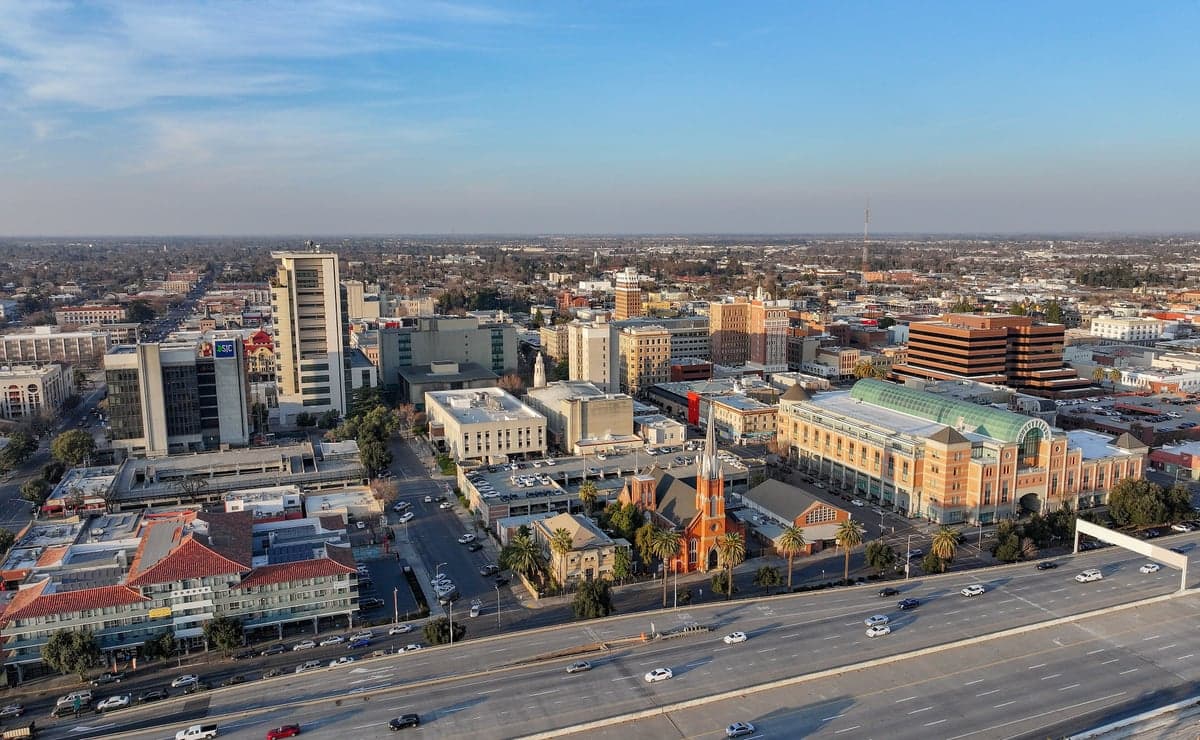
Today, Stockton, California is a majority-minority city of 320,470 residents defined by its deep ethnic diversity and working-class character. The population is 45.2% Hispanic, 17.9% East and Southeast Asian, 17.5% White, 11.0% Black, and 2.6% Indian (subcontinent), with only 19.1% holding a college degree. This is a city of immigrants and their descendants, where nearly one in eight residents (12.1%) is foreign-born, and where distinct neighborhoods still echo the arrival patterns of the groups that built them. Stockton’s identity is less a melting pot than a mosaic of enclaves, each with its own history of arrival, settlement, and adaptation.
How the city was settled and grew
Stockton’s human history begins with the 1848 California Gold Rush, which turned a small Mexican-era settlement into a boomtown almost overnight. Located at the head of the San Joaquin River’s deepwater channel, it became the primary supply hub for miners heading to the Sierra Nevada foothills. The city’s first major wave of settlers were Anglo-American merchants and miners, followed quickly by Chinese laborers who built levees, railroads, and farms. By the 1870s, Stockton’s Chinatown (centered around Washington Street) was one of the largest in California, housing thousands of Chinese immigrants who worked in agriculture and domestic service. A second wave came with the transcontinental railroad and the rise of agribusiness: Japanese and Filipino farmworkers arrived in the early 1900s, settling in what became Little Manila (around Lafayette and El Dorado streets), a dense Filipino neighborhood that was the largest outside the Philippines by the 1930s. Meanwhile, Black migrants from the South began arriving during World War I and the Great Depression, drawn by railroad and cannery jobs, and concentrated in the South Stockton area (roughly south of Charter Way). These early waves laid a pattern of ethnic clustering that persists today.
Modern era (post-1965)
The 1965 Hart-Cellar Immigration Act reshaped Stockton’s demographics dramatically. The city’s White population, which had been a solid majority through the 1950s, began a steady decline as suburbanization pulled middle-class families to outlying areas like Lincoln Village and Morada. Into their place came new immigrant streams: Southeast Asian refugees—Vietnamese, Cambodian, Hmong, and Laotian—arrived in large numbers after the Vietnam War, settling in the Park District and East Stockton neighborhoods, where they established Buddhist temples, grocery stores, and community centers. At the same time, Mexican and Central American immigration surged, driven by agricultural labor demand and family reunification. Hispanic residents grew from roughly 20% of the city in 1980 to over 45% today, with the heaviest concentrations in South Stockton and the Seaport District. The Black population, which peaked at around 15% in the 1990s, has declined slightly as some families moved to suburbs or other states, but remains anchored in South Stockton and the Van Buskirk area. The Indian (subcontinent) population, though small at 2.6%, is a newer and more affluent wave, concentrated in the Brookside and Spanos Park areas near the University of the Pacific. The East/Southeast Asian share (17.9%) is now split between older Chinese and Japanese families in central neighborhoods and newer Vietnamese and Cambodian communities in the east side.
The future
Stockton’s population is not homogenizing; if anything, it is tribalizing further into distinct ethnic enclaves. Hispanic growth continues to drive overall population increases, while the White share is projected to fall below 15% within a decade. The East/Southeast Asian communities are plateauing, with younger generations often moving to Sacramento or the Bay Area for jobs, while the Indian population is growing slowly but steadily, drawn by the university and healthcare sectors. The Black population is stable but aging, with limited new in-migration. The foreign-born share (12.1%) is lower than in gateway cities like San Francisco or Los Angeles, suggesting that Stockton is now a second-tier destination—a place where immigrants settle after initial arrival elsewhere. Over the next 10-20 years, the city will likely become even more Hispanic and more working-class, with a growing divide between the older, poorer enclaves (South Stockton, Seaport) and the newer, more diverse middle-class suburbs (Brookside, Spanos Park). The college attainment rate (19.1%) is well below the national average, which may limit economic mobility unless local industries diversify beyond logistics, healthcare, and agriculture.
For someone moving to Stockton now, the city offers a genuinely multicultural environment where no single group dominates, but where economic opportunity is unevenly distributed. The neighborhoods that feel safest and most stable—Lincoln Village, Brookside, Morada—are also the most segregated by income and race. The historic enclaves of South Stockton and Little Manila remain vibrant but struggle with poverty and crime. Stockton is becoming a city of working-class immigrants and their children, with a strong sense of community in each enclave but limited integration across them. It is a place where your experience will depend heavily on which neighborhood you choose and which community you connect with.

* Values derived from national, state, county, city and local statistics and may differ in a specific area. Last updated: 2026-04-30T03:55:20.000Z
Narrative content on this page is AI-generated and may contain mistakes. Verify any details that matter before acting on them.
ReloMaps may earn a commission from affiliate links at no extra cost to you.

