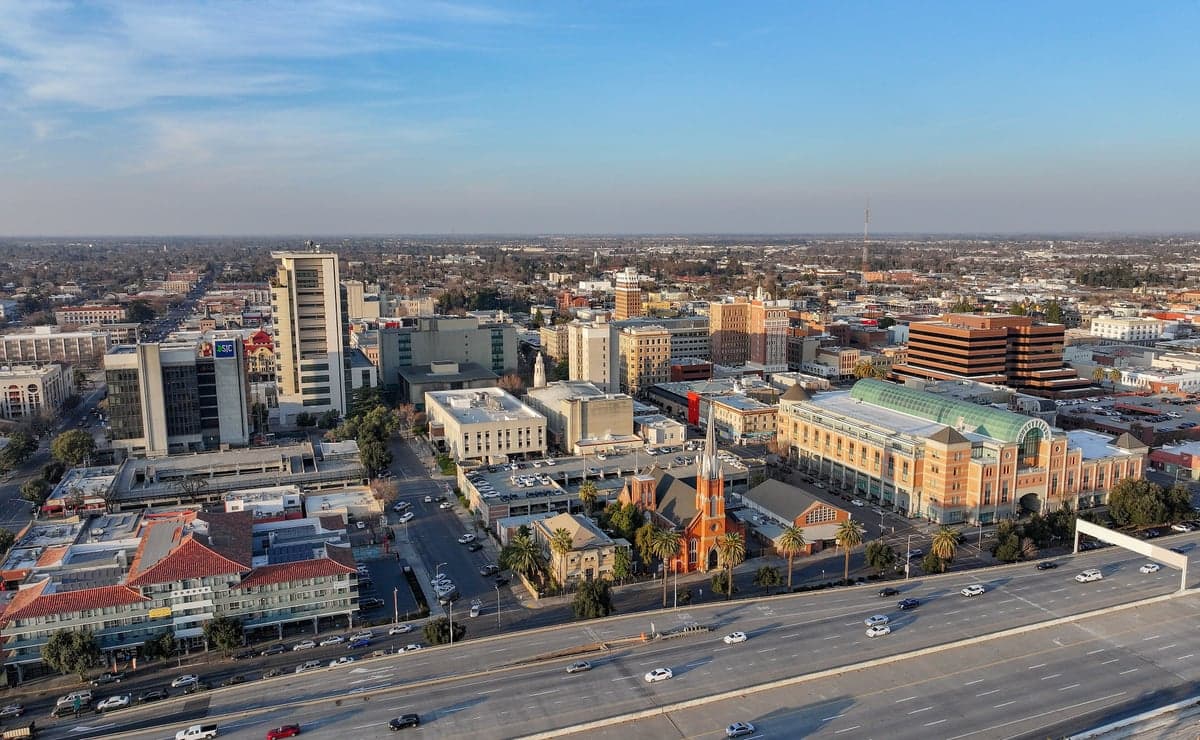
Photo: Wikipedia
Personal Sovereignty in Stockton, CA
Viable for self-reliance. Generally workable, though some barriers may limit total independence.
What does Personal Sovereignty tell us?
Personal Sovereignty measures your capacity for self-reliance and independence with minimal government friction. Higher scores mean fewer barriers between you and the way you want to live... but it assumes you have the space you need and good neighbors.
What does this tell us?
Personal Sovereignty measures your capacity for self-reliance and independence with minimal government friction. Higher scores mean fewer barriers between you and the way you want to live... but it assumes you have the space you need and good neighbors.
State Policy
Energy independence: Importer (33% of energy produced in-state)
Personal Liberty
Homesteading

Personal Liberty Analysis
Stockton, California, presents a deeply constrained environment for personal sovereignty, where state-level overreach systematically erodes individual autonomy in ways that should concern any freedom-minded relocator. The city operates under California’s expansive regulatory apparatus, which reaches into nearly every aspect of daily life—from what you can grow in your yard to how you can defend your home. For a survivalist or prepper evaluating Stockton as a potential base, the sobering reality is that the state’s political machinery actively works against self-reliance, property rights, and the ability to live without government permission. While Stockton itself has a gritty, independent character born from its working-class roots, the legal and tax framework imposed by Sacramento makes genuine personal sovereignty a constant uphill battle.
Tax burden and regulatory posture: what you pay and what you can’t do
California’s tax burden is among the highest in the nation, and Stockton residents feel it acutely. The state’s progressive income tax tops out at 13.3% for high earners, and the sales tax in San Joaquin County is 8.75%—meaning every purchase funds a government that increasingly dictates personal choices. Property taxes, while capped at 1% of assessed value under Proposition 13, are still a significant cost, and the state’s Mello-Roos districts can add special assessments for infrastructure that you have no say in. The regulatory posture is even more intrusive: California’s California Environmental Quality Act (CEQA) can be weaponized to block any construction or land-use change, making it nearly impossible to build a workshop, install a rainwater catchment system, or expand a garden without months of permitting. For a prepper, this means that even basic improvements to increase self-sufficiency—like adding a backup generator or converting a garage into a food storage area—can trigger inspections and fees. The state’s California Air Resources Board (CARB) also restricts the use of certain generators and off-road equipment, limiting options for off-grid power. In short, Stockton’s tax and regulatory climate is designed to keep you dependent on government services, not to empower individual initiative.
Self-defense and gun law specifics: what you can and cannot do
California’s gun laws are among the most restrictive in the nation, and Stockton residents must navigate a dense web of limitations that directly impact self-defense capabilities. The state requires a 10-day waiting period and a Firearm Safety Certificate for all purchases, and the roster of approved handguns is limited to models with microstamping technology—effectively banning many popular defensive firearms. Assault weapons are banned by name and feature, including common AR-15 platforms, and magazines are capped at 10 rounds. For concealed carry, San Joaquin County is a “may-issue” jurisdiction, meaning the sheriff has discretion to deny permits even if you meet the basic requirements. In practice, obtaining a CCW in Stockton is difficult and expensive, often requiring a “good cause” statement that goes beyond self-defense. Open carry is prohibited entirely. For a survivalist, this means that the ability to defend your home or family in a crisis is severely hamstrung by law. The state’s red flag laws also allow for temporary firearm seizure based on a complaint, without a criminal conviction—a tool that can be abused by neighbors or estranged family members. If self-reliance includes the right to keep and bear arms, Stockton is a place where that right is heavily regulated and subject to bureaucratic whim.
Self-reliance and homesteading viability: lot sizes, zoning, and off-grid feasibility
Stockton’s urban and suburban zoning makes traditional homesteading difficult, but not entirely impossible for those willing to navigate the system. Typical residential lots in the city range from 5,000 to 7,000 square feet, which limits space for large gardens, livestock, or extensive food storage. The city’s zoning code restricts chickens to a maximum of four hens (no roosters) and prohibits goats, pigs, or other livestock on most residential parcels. Backyard beekeeping is allowed with a permit, but the process is bureaucratic. Off-grid feasibility is nearly zero: the city requires connection to municipal water and sewer, and solar panels must be grid-tied with net metering approval from the local utility. Rainwater harvesting is legal but limited to two 50-gallon barrels per property without a permit, and any larger system requires engineering review. For a prepper, this means that true self-sufficiency—growing your own food, storing water, generating power independently—is heavily constrained by code. The best option for homesteading in the Stockton area is to look at unincorporated San Joaquin County, where lot sizes can be 1 acre or more and zoning is more permissive. Even there, however, California’s California Building Standards Code and county health regulations impose strict requirements on wells, septic systems, and structures. The regulatory environment is designed to prevent independent living, not enable it.
Personal liberties: parental rights, medical autonomy, speech, and property
California’s progressive governance has systematically eroded several key personal liberties that matter to conservative-leaning individuals. Parental rights are under direct assault: the state’s AB 1955 prohibits school districts from requiring parental notification when a child changes their gender identity or pronouns, effectively cutting parents out of decisions about their own children’s health and education. The state also mandates comprehensive sexual health education starting in elementary school, with no opt-out for parents who object. Medical autonomy is similarly constrained: California has some of the strictest vaccine mandates in the country, including for school attendance, and the state’s SB 277 eliminated personal belief exemptions for childhood vaccines. During the COVID-19 pandemic, the state imposed some of the longest-lasting lockdowns and mask mandates in the nation, demonstrating a willingness to override individual health decisions. Free speech is protected under the First Amendment, but California’s hate speech laws and workplace harassment regulations can be used to chill political expression, particularly on topics like immigration, gender, and religion. Property rights are weak: the state’s California Coastal Commission and other agencies can restrict land use without compensation, and the California Environmental Quality Act allows third parties to sue over any development, effectively giving activists veto power over what you do with your own land. For a freedom-minded individual, Stockton offers little refuge from the state’s encroachment on personal liberties.
Overall, Stockton’s personal sovereignty environment ranks among the most restrictive in the nation, comparable to other deep-blue California cities like San Francisco or Los Angeles. The combination of high taxes, heavy regulation, restrictive gun laws, limited homesteading potential, and eroded parental and medical rights creates a system that actively discourages self-reliance and independence. For a survivalist or prepper, the city’s strategic location near the Delta and its affordable housing might seem appealing, but the legal and political framework makes it a poor choice for anyone seeking to live outside the government’s shadow. If you value personal sovereignty, you would be better served looking at states like Texas, Idaho, or Montana, where the regulatory burden is lighter and individual rights are more robustly protected. Stockton is a place to pass through, not to dig in.

* Values derived from national, state, county, city and local statistics and may differ in a specific area. Last updated: 2026-04-30T03:55:20.000Z
Narrative content on this page is AI-generated and may contain mistakes. Verify any details that matter before acting on them.
ReloMaps may earn a commission from affiliate links at no extra cost to you.

