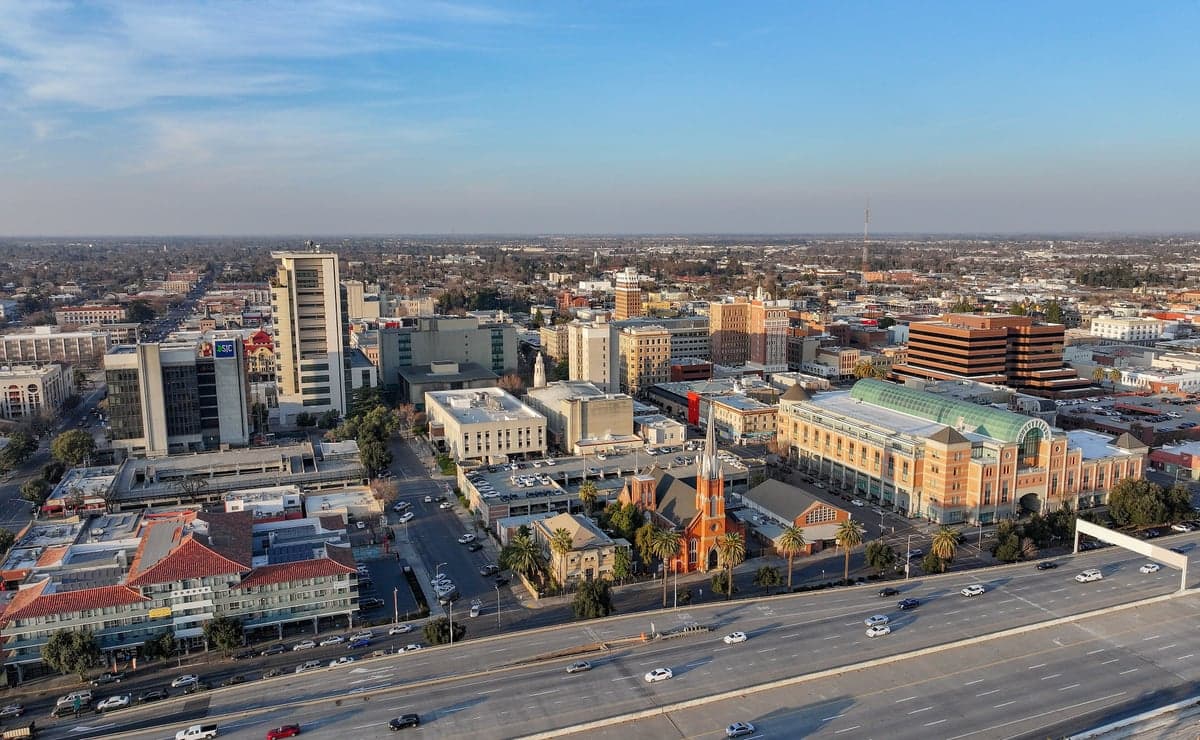
Photo: Wikipedia
Political ClimatePolitical Climate in Stockton, CA
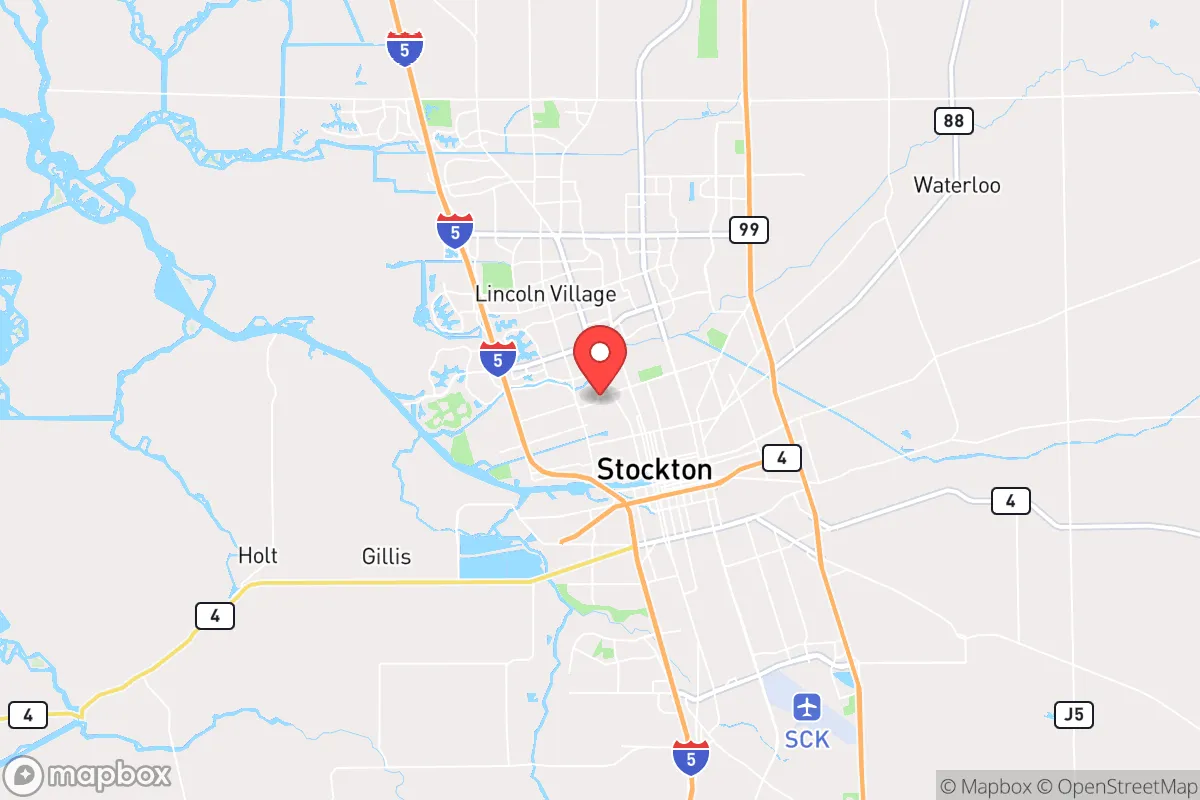
District shown is the primary district for this city’s centroid. Cities may span multiple districts.
Local Political AnalysisPolitical Analysis of Stockton, CA
Stockton’s political climate has shifted noticeably over the past decade, and if you’ve lived here as long as I have, you’ve felt it. The city sits at a Cook PVI of D+1, which on paper looks like a toss-up, but in practice, the local government has been leaning further left with each election cycle. We used to be a place where common-sense, live-and-let-live attitudes ruled the day, but lately, there’s been a steady push toward progressive policies that feel more like Sacramento’s agenda than Stockton’s own. The trajectory is concerning if you value limited government and personal freedom—more regulations, higher taxes, and a growing appetite for social engineering from city hall.
How it compares
To understand Stockton’s political drift, you have to look at the surrounding areas. Drive 20 minutes north to Lodi or east to Manteca, and you’ll find communities that still vote reliably conservative, with lower crime rates and a stronger emphasis on property rights. Even Modesto, just 30 miles southeast, has a more balanced political mix. Stockton, by contrast, has become an outlier in San Joaquin County—more aligned with the Bay Area’s politics than with its own neighbors. The city council has pushed zoning changes that make it harder to run a small business, and the school board has adopted curriculum mandates that prioritize ideology over academics. Meanwhile, rural towns like Lockeford and Clements still operate with a fraction of the bureaucracy, and you can feel the difference in how freely people live their lives.
What this means for residents
For the average Stockton resident, the political shift translates into real, everyday friction. Property taxes have crept up as the city funds new social programs, and business licenses come with more red tape than ever. If you own a firearm or want to exercise your Second Amendment rights, you’ll find the local permitting process increasingly burdensome—something that wasn’t the case 15 years ago. The push for “sanctuary city” policies has also strained relations with federal law enforcement, which doesn’t help when you’re trying to keep your neighborhood safe. On the plus side, if you lean left, you’ll find plenty of like-minded neighbors and city initiatives that align with your values. But for those of us who believe in personal responsibility and minimal government interference, it feels like we’re fighting a losing battle against a tide of well-intentioned but overreaching policies.
Culturally, Stockton has always been a working-class town with a strong sense of independence, but that’s eroding. The city has embraced a “progressive” branding that prioritizes equity over opportunity, and you see it in the way public spaces are managed—more signs, more rules, more permits. One notable distinction is the city’s stance on housing: Stockton has aggressively pursued rent control and tenant protections, which sounds good on paper but has discouraged new development and driven up costs for everyone else. In the long term, I worry we’ll see more families and small businesses leave for places like Tracy or Ripon, where the tax burden is lighter and the government stays out of your way. For now, Stockton remains a place of potential, but the political direction is something to watch closely if you value your freedoms.

State Political ClimatePolitical Climate in California
State Political AnalysisPolitical Environment in the State
California is a one-party Democratic state where registered Democrats outnumber Republicans by nearly 2-to-1, and no Republican has won statewide office since 2006. The state’s political trajectory over the past 20 years has been a steady march leftward, driven by massive population growth in coastal metros and a shrinking rural base. While the state still has conservative strongholds in the Central Valley and inland regions, the overall lean is now solidly blue, with Democrats holding supermajorities in both legislative chambers and every statewide constitutional office.
Urban vs. rural divide
The political map of California is a tale of two worlds. The coastal metros — Los Angeles, San Francisco, San Jose, Oakland, and San Diego — are the engine of Democratic dominance, delivering margins of 70-85% in presidential elections. These cities are home to the state’s tech, entertainment, and finance industries, and their voters consistently back progressive candidates on issues like housing, immigration, and climate policy. In contrast, the inland regions — Bakersfield, Fresno, Redding, and the Central Valley — are deeply conservative. Kern County (Bakersfield) voted +26 for Trump in 2020, while Shasta County (Redding) went +35. The Inland Empire (Riverside and San Bernardino counties) is a battleground: once reliably red, it has shifted purple as Latino voters and ex-Los Angeles residents move in, but it still leans right in local races. The Bay Area suburbs like Walnut Creek and Pleasanton are now reliably blue, while Orange County — once the heart of Reagan conservatism — flipped blue in 2016 and hasn’t looked back. The rural north, from Yreka to Susanville, remains deeply red but is too sparsely populated to offset the coastal vote.
Policy environment
California’s policy environment is aggressively progressive, with a tax-and-regulate posture that conservatives find stifling. The state has the highest income tax rate in the nation (13.3% for top earners), a 7.25% sales tax floor (with local add-ons pushing it to 10.25% in many cities), and some of the highest gas taxes in the country. Property taxes are capped at 1% of assessed value under Prop 13, but reassessment upon sale means new buyers face steep hikes. Regulatory costs are immense: the California Environmental Quality Act (CEQA) is weaponized by NIMBY groups to block housing and infrastructure projects, while the California Air Resources Board (CARB) imposes strict emissions rules that drive up vehicle and energy costs. Education policy is dominated by the California Teachers Association, a powerful union that opposes school choice and charter expansion. Healthcare is heavily regulated, with a state-run insurance exchange (Covered California) and mandates that push toward single-payer. Election laws are among the most liberal in the nation: universal mail-in voting, same-day registration, and no voter ID requirement — a system that conservatives argue invites fraud, though no widespread evidence has emerged. The state also has a “sanctuary state” law (SB 54) that limits local law enforcement cooperation with federal immigration authorities.
Trajectory & freedom
California is becoming less free by nearly every measure of personal liberty that conservatives care about. On gun rights, the state has some of the strictest laws in the nation: an assault weapons ban, a 10-day waiting period, universal background checks, and a “may-issue” concealed carry regime that was effectively a ban until the Supreme Court’s Bruen decision forced a shift. In 2023, the legislature passed a law (SB 2) that created “sensitive places” where guns are banned, including parks, hospitals, and public transit — a direct response to Bruen. On parental rights, the state has moved aggressively: AB 1955 (2024) prohibits school districts from requiring parental notification when a child changes their gender identity, overriding local policies in places like Chino Valley and Murrieta that had passed notification rules. On speech, the state has a law (AB 587) requiring social media platforms to report their content moderation policies, which critics say is a backdoor to censorship. Medical autonomy took a hit with the state’s COVID-19 vaccine mandates for healthcare workers and schoolchildren, though the school mandate was later paused. Property rights are under constant pressure from rent control (AB 1482 caps annual rent increases at 5% plus inflation) and a 2024 ballot measure that expanded local rent control authority. Taxation is the biggest freedom issue: the state’s top marginal rate kicks in at just $68,000 for single filers, meaning middle-class families are hit hard.
Civil unrest & political movements
California has a long history of civil unrest, and recent years have been no exception. The 2020 George Floyd protests in Los Angeles and Oakland saw widespread looting and property destruction, with the latter city experiencing a sustained wave of smash-and-grab robberies that continued into 2023. The state’s sanctuary policies have made it a flashpoint in the immigration debate: in 2023, the Biden administration sued California over a law (AB 1266) that restricted the transfer of state land for border wall construction. Secession rhetoric is alive on both sides: the “Calexit” movement (pushing for California to leave the U.S.) gained traction after Trump’s 2016 win, while the “State of Jefferson” movement in the rural north — encompassing counties like Siskiyou and Modoc — has long sought to break away and form a conservative state. Election integrity is a hot-button issue: the state’s universal mail-in voting system, combined with no voter ID, has led to persistent allegations of fraud, though courts have largely rejected these claims. In 2024, the state legislature passed a law (AB 421) that criminalizes the distribution of “false election information,” which conservatives argue could chill legitimate speech. Visible flashpoints for a new resident include the homeless encampments that blanket San Francisco, Los Angeles, and Oakland, and the regular protests outside school board meetings over curriculum and parental rights.
Projection
Over the next 5-10 years, California is likely to become even more progressive, driven by demographic shifts and in-migration patterns. The state’s population has been declining since 2020, with net out-migration of over 500,000 people — mostly middle-class families and conservatives fleeing to Texas, Arizona, and Idaho. Those who remain are increasingly concentrated in coastal urban centers, while rural areas continue to hollow out. The Latino population, which makes up 40% of the state, is trending leftward, especially among younger voters. The state’s supermajority Democratic legislature will likely continue to pass laws on rent control, gun restrictions, and climate mandates, while the governor’s office remains blue for the foreseeable future. A new resident moving in now should expect to find a state where the cost of living continues to rise, personal freedoms (especially on guns and parental rights) continue to shrink, and the political culture becomes more uniformly progressive. The one wild card is a potential economic downturn: if the tech sector crashes or housing costs trigger a mass exodus, the state’s fiscal house of cards could collapse, forcing a reckoning. But for now, the trajectory is clear.
For a conservative considering a move to California, the bottom line is this: you will be in a political minority, and your values will be increasingly at odds with state law. If you choose to come, you’ll find like-minded communities in the Central Valley, the Inland Empire, and the far north — but you’ll also face high taxes, heavy regulation, and a government that actively works against your priorities on guns, education, and parental rights. It’s a beautiful state with a world-class economy, but the price of admission is high, and it’s only getting higher.
* Values derived from national, state, county, city and local statistics and may differ in a specific area. Last updated: 2026-04-30T03:55:20.000Z
Narrative content on this page is AI-generated and may contain mistakes. Verify any details that matter before acting on them.
ReloMaps may earn a commission from affiliate links at no extra cost to you.

