
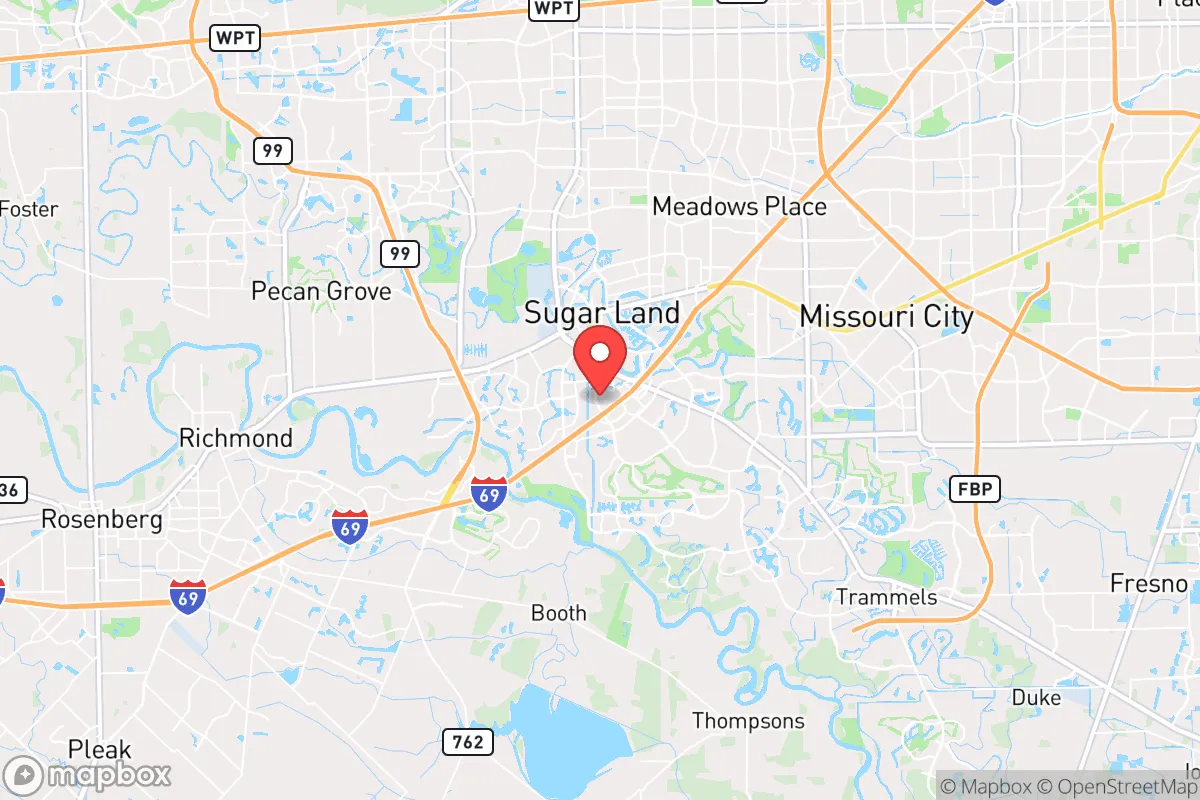
Demographics of Sugar Land, TX
Affluence Level in Sugar Land, TX
An upper-middle-class area. Household wealth, education levels, and homeownership run ahead of national benchmarks.
People of Sugar Land, TX
Sugar Land, Texas, is a city of 109,735 residents defined by its high educational attainment—62.4% hold a college degree—and a distinctive dual-Asian demographic profile: East and Southeast Asian communities make up 21.2% of the population, while Indian-subcontinent residents account for 17.8%. The city is majority-minority, with White residents at 36.7%, Hispanic residents at 12.3%, and Black residents at 7.5%. Foreign-born residents constitute 11.1% of the population, a figure that understates the deep multigenerational roots of its Asian and Indian communities, who arrived in distinct waves and now anchor specific neighborhoods.
How the city was settled and grew
Sugar Land’s human history begins not with colonial settlement but with industrial agriculture. The city was founded in the early 20th century as a company town for the Imperial Sugar Company, which drew its first major workforce from Mexican and Tejano laborers who built the refinery and surrounding infrastructure. These workers settled in the Mayfield Park and Dunbar neighborhoods, historically the city’s oldest residential areas, where Hispanic and Black families established roots. The sugar industry dominated until the mid-20th century, with the company providing housing, schools, and a tight-knit, hierarchical social structure. By the 1950s, the population remained small—under 5,000—and overwhelmingly White and Hispanic, with a small Black community centered in the Dunbar area.
Modern era (post-1965)
The 1965 Hart-Cellar Immigration Act reshaped Sugar Land’s population more dramatically than almost any other Texas suburb. The first wave of East and Southeast Asian immigrants—primarily Chinese, Vietnamese, and Filipino professionals—arrived in the 1970s and 1980s, drawn by Houston’s energy and medical sectors and the newly developed master-planned communities west of the city. These families concentrated in Riverstone and Greatwood, neighborhoods built around golf courses and top-rated schools, where Asian residents now represent over 30% of the population. A second wave of Indian-subcontinent immigrants—engineers, physicians, and IT professionals—followed in the 1990s and 2000s, settling heavily in Telfair and Oyster Creek, where Indian residents now approach 25% of the population. The White population, which was over 70% in 1980, declined to 36.7% by 2024, as native-born families aged in place or moved to exurban areas like Richmond and Fulshear. The Hispanic share has remained stable at 12.3%, with many families still rooted in Mayfield Park, while the Black population (7.5%) is dispersed but has a historic anchor in Dunbar.
The future
Sugar Land’s population is not homogenizing but rather tribalizing into distinct, stable enclaves. The East and Southeast Asian communities in Riverstone and Greatwood are plateauing, with second-generation adults often leaving for college and not returning at the same rate as their parents. The Indian-subcontinent population in Telfair and Oyster Creek, by contrast, is still growing, driven by continued H-1B visa arrivals and chain migration from the same regions of Gujarat and Punjab. The White population is aging and declining slowly, while the Hispanic and Black shares are projected to remain flat, as younger families in those groups increasingly choose more affordable suburbs farther out. The foreign-born share (11.1%) is likely to edge upward slightly as Indian immigration continues, but the city is becoming more native-born overall as the second generation matures. The next 10-20 years will see Sugar Land solidify as a majority-Asian and Indian suburb, with distinct neighborhood identities persisting rather than blending into a single melting pot.
For a conservative-leaning mover, Sugar Land offers a stable, high-achieving environment where property values are supported by strong schools and low crime, but where the social fabric is increasingly segmented by ethnicity and neighborhood. The city is not becoming more diverse in the sense of mixing—it is becoming more diverse in the sense of parallel communities living side by side. New arrivals should expect to find a place where their neighbors’ backgrounds are likely to be similar to their own, and where the dominant culture is one of professional ambition and family-centric privacy rather than any single ethnic tradition.

* Values derived from national, state, county, city and local statistics and may differ in a specific area. Last updated: 2026-04-22T02:01:47.000Z
Narrative content on this page is AI-generated and may contain mistakes. Verify any details that matter before acting on them.
ReloMaps may earn a commission from affiliate links at no extra cost to you.

