
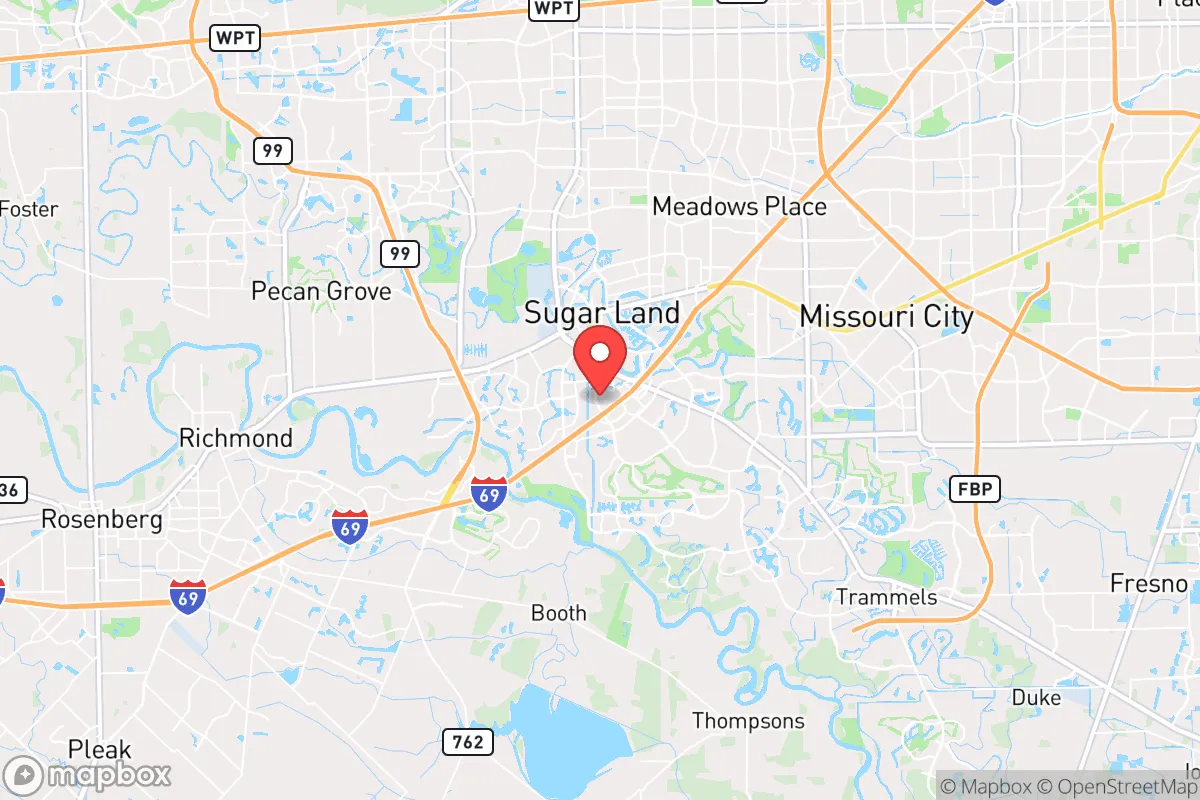
Political ClimatePolitical Climate in Sugar Land, TX
District shown is the primary district for this city’s centroid. Cities may span multiple districts.
Local Political AnalysisPolitical Analysis of Sugar Land, TX
Look, I’ve lived in Sugar Land long enough to remember when this place was a rock-ribbed conservative stronghold—a place where folks minded their own business and the local government kept its nose out of your wallet and your backyard. But the numbers tell a different story now. The Cook Partisan Voting Index (PVI) for Sugar Land is D+12, meaning the area leans a solid 12 points more Democratic than the national average. That’s a seismic shift from even a decade ago. The trajectory is clear: this suburb southwest of Houston has been trending blue for years, driven by an influx of professionals from diverse backgrounds, many of whom bring a more progressive, government-friendly mindset. If you’re a conservative who values limited government and personal freedom, you’re not alone here—but you’re increasingly in the minority, and the local politics reflect that.
How it compares
To really grasp Sugar Land’s shift, you have to look at the neighbors. Drive 20 minutes north to Katy, and you’ll find a much redder vibe—still reliably conservative, with a PVI that leans Republican by a few points. Head east to Missouri City, and you’re in a D+15 zone, even more progressive than Sugar Land. The contrast is stark: Katy’s city council still fights to keep property taxes low and zoning loose, while Sugar Land’s leadership has embraced things like density bonuses for developers and a more active role in social policy. Even Richmond and Rosenberg, just to the southwest, remain more conservative, with a slower pace and less appetite for government expansion. Sugar Land used to be the conservative anchor of Fort Bend County; now it’s the bellwether for the county’s overall leftward drift.
What this means for residents
For a conservative resident, the practical effects are hard to ignore. The city council and school board have become more willing to push policies that feel like government overreach—think mask mandates that lasted longer than state law required, or zoning changes that prioritize high-density apartments over single-family homes, all in the name of “smart growth.” Property taxes have crept up as the city funds more programs and services, and there’s a growing push for things like diversity, equity, and inclusion initiatives in local schools. If you value the right to make your own choices—whether it’s about your kids’ education, your property, or your business—you’ll find yourself butting heads with a local government that’s increasingly comfortable telling you what’s best. The silver lining? The conservative community here is tight-knit and vocal, and there are still plenty of folks who remember when Sugar Land was a place where freedom meant something more than a slogan.
One cultural distinction that stands out is the city’s embrace of a “global” identity. Sugar Land’s diversity is real—about 35% Asian, 25% Hispanic, and a growing mix of other groups—and that’s brought a lot of great food and festivals. But it’s also brought a political shift where “community harmony” often translates into government-led initiatives that can feel like social engineering. The long-term trend is concerning: if the current trajectory holds, Sugar Land could become a reliably blue suburb, with all the tax-and-regulate instincts that come with it. For now, it’s still a great place to live if you keep your head down and your vote counted, but the days of small-government, live-and-let-live Sugar Land are fading fast.

State Political ClimatePolitical Climate in Texas
State Political AnalysisPolitical Environment in the State
Texas remains a solidly Republican state, but the margin has tightened noticeably over the past decade. In 2024, Donald Trump won the state by roughly 9 points, down from the 11-point margin in 2020 and the 16-point margin in 2016. The dominant coalition is still a mix of rural conservatives, suburban families, and business-oriented moderates, but explosive growth in the urban cores of Austin, Dallas, Houston, and San Antonio is steadily injecting progressive votes into the electorate. The long-term trajectory is a slow, uneven shift leftward, driven by in-migration from blue states and natural demographic change, though the state’s constitutional structure and gerrymandered districts have so far kept the legislature firmly in GOP control.
Urban vs. rural divide
The political map of Texas is a study in stark contrasts. The big four metros — Houston, Dallas-Fort Worth, San Antonio, and Austin — are the engines of Democratic growth. Austin is the most liberal major city in the state, with Travis County delivering a 50-point margin for Biden in 2020. El Paso and the Rio Grande Valley have historically been Democratic strongholds, though the Valley shifted sharply right in 2020 and 2024, with counties like Zapata and Starr flipping to Trump. Meanwhile, the vast rural expanse — from the Panhandle down through West Texas and into East Texas — is deeply Republican. Lubbock and Amarillo are conservative anchors, while the suburbs around Dallas and Houston are the true battlegrounds. Collin County (north of Dallas) was once a GOP fortress but is now trending purple, with Biden winning 46% there in 2020. The divide isn’t just geographic; it’s cultural, with urbanites pushing for transit, density, and progressive social policies while rural Texans prioritize property rights, gun access, and local control.
Policy environment
Texas has no state income tax, a fact that remains the single biggest draw for relocating families and businesses. Property taxes are high to compensate — averaging around 1.6% of assessed value — but there is no statewide cap on how fast appraisals can rise, which has become a growing pain point. The regulatory posture is famously business-friendly: no state-level occupational licensing for many trades, weak union protections, and a tort reform system that caps noneconomic damages in medical malpractice cases. On education, the state funds schools through a Robin Hood system that redistributes property tax revenue from wealthy districts to poor ones, but per-pupil spending still lags the national average. School choice has expanded slowly, with education savings accounts passed in 2023 for special needs students but a broader voucher bill failing in 2024. Healthcare policy is minimal: Texas refused Medicaid expansion under the ACA, leaving roughly 18% of residents uninsured, the highest rate in the nation. Election laws tightened after 2020 with Senate Bill 1, which added ID requirements for mail-in ballots, limited drive-through voting, and banned 24-hour polling places. For a conservative audience, the policy environment is largely favorable — low taxes, light regulation, and a state government that actively resists federal overreach — but the cracks are showing in rising property taxes and underfunded infrastructure.
Trajectory & freedom
On the freedom front, Texas has been a mixed bag in recent years. The good news: constitutional carry (permitless handgun carry) became law in 2021, and the state has aggressively defended gun rights against federal encroachment, including a 2023 law prohibiting state enforcement of any future federal gun bans. Parental rights were strengthened with the 2023 passage of the READER Act, which requires schools to post curriculum materials online and allows parents to challenge books. Medical autonomy took a hit with the near-total abortion ban (trigger law from 2021, effective 2022), which conservatives celebrate but which has created legal uncertainty for doctors treating miscarriages and ectopic pregnancies. The bad news: property rights are under pressure from the Texas Supreme Court’s 2024 ruling that allows cities to impose tree preservation ordinances without compensation, and from the continued use of eminent domain for private pipeline projects. Taxation freedom is eroding as property taxes rise faster than incomes, though the 2023 property tax cut package (SB 2 and SB 3) did provide some relief by raising the homestead exemption and compressing school tax rates. The overall trajectory is one of expanding personal liberty on guns and education, but contracting on property and tax freedom — a trade-off that long-time residents are starting to grumble about.
Civil unrest & political movements
Texas has seen its share of political flashpoints. The 2020 Black Lives Matter protests in Austin and Houston were large and occasionally violent, leading to property damage and a lasting rift between city leaders and state Republicans. The state legislature responded with the 2021 “Back the Blue” law that increased penalties for rioting and protected officers from civil liability. Immigration politics are a constant source of tension: Governor Abbott’s Operation Lone Star has deployed state troopers and National Guard to the border, bused migrants to sanctuary cities like New York and Chicago, and installed razor wire along the Rio Grande — all of which have drawn federal lawsuits. The “sanctuary city” ban (SB 4 from 2017) remains in effect, requiring local law enforcement to cooperate with federal immigration authorities. Secession rhetoric, while fringe, has a real presence: the Texas Nationalist Movement claims tens of thousands of supporters, and a 2023 poll found 18% of Texans support independence. Election integrity remains a live issue, with ongoing audits in Harris County (Houston) and a 2024 law that created a new election police unit. A new resident would notice the heavy police presence at the border, the constant political ads about immigration, and the palpable distrust between urban and rural residents.
Projection
Over the next 5-10 years, Texas will continue to trend purple, but not flip. The in-migration from California and New York is slowing as housing costs rise, and many of those newcomers are actually conservatives or moderates fleeing blue-state policies. The real driver of Democratic growth is the Hispanic vote, which is not monolithic — the Valley’s shift right in 2020 and 2024 suggests that cultural conservatism on abortion and religion may outweigh economic leftism. The state legislature will remain Republican through at least 2030 due to gerrymandering, but the governorship could become competitive if a moderate Democrat emerges. The biggest wildcard is the property tax crisis: if the legislature fails to rein in appraisal growth, a populist backlash could upend the current coalition. For someone moving in now, expect a state that remains broadly conservative on culture and economics, but with growing friction between the old guard and the new arrivals. The freedom you’re moving for — low taxes, gun rights, school choice — is still intact, but you’ll need to stay engaged locally to keep it that way.
Bottom line: Texas is still a great bet for conservatives who want a low-tax, high-freedom environment, but it’s not the lock it was 20 years ago. The urban-rural divide is widening, property taxes are a creeping burden, and the political battles over immigration and education are only going to intensify. If you’re moving here, pick your county carefully — Collin County or Montgomery County north of Houston will feel very different from Travis County or Harris County. The state’s trajectory is still rightward on most issues, but the margin for error is shrinking. Stay informed, vote in every primary, and don’t assume the culture you’re moving to will stay the same without effort.
* Values derived from national, state, county, city and local statistics and may differ in a specific area. Last updated: 2026-04-22T02:01:47.000Z
Narrative content on this page is AI-generated and may contain mistakes. Verify any details that matter before acting on them.
ReloMaps may earn a commission from affiliate links at no extra cost to you.

