
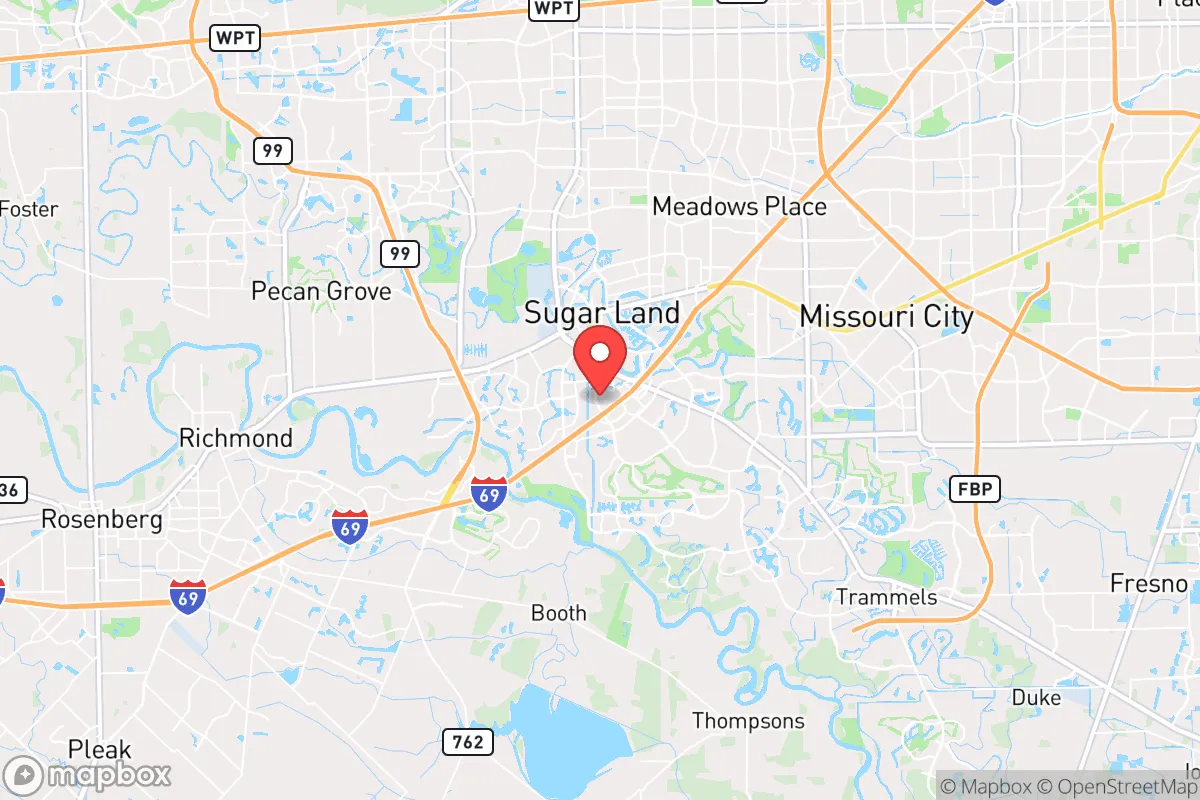
Personal Sovereignty in Sugar Land, TX
Strong independent fundamentals that actively favor personal liberty and low regulation.
What does Personal Sovereignty tell us?
Personal Sovereignty measures your capacity for self-reliance and independence with minimal government friction. Higher scores mean fewer barriers between you and the way you want to live... but it assumes you have the space you need and good neighbors.
What does this tell us?
Personal Sovereignty measures your capacity for self-reliance and independence with minimal government friction. Higher scores mean fewer barriers between you and the way you want to live... but it assumes you have the space you need and good neighbors.
State Policy
Energy independence: Net exporter (220% of energy produced in-state)
Personal Liberty
Homesteading

Personal Liberty Analysis
Sugar Land offers a notably high degree of personal sovereignty relative to most major U.S. metros, anchored by Texas’s strong preemption laws, no state income tax, and a deeply ingrained culture of self-reliance. For the strategic relocator—whether a single professional or a parent—this translates into fewer layers of government interference in daily life, from property use to family decisions. The city operates within a broader state framework that consistently pushes back against federal overreach, but local ordinances and HOA governance still present real friction points that require careful navigation.
Tax burden and regulatory posture: how much the state and city take
The most immediate sovereignty win in Sugar Land is the absence of a state income tax, which Texas has maintained since 1919. This means every dollar earned stays in your pocket, with no state-level claim on your wages. The trade-off is a reliance on property taxes, which in Fort Bend County average around 2.3% of assessed value—higher than the national median but typical for Texas. A $500,000 home carries roughly $11,500 in annual property taxes, though the state’s 10% appraisal cap on homesteads provides some predictability. Sales tax in Sugar Land is 8.25% (6.25% state, 2% local), which is moderate for the region. Regulatory posture is light: Texas has no state-level building codes beyond basic structural safety, and the city’s zoning is largely permissive for single-family residential. However, HOA covenants are aggressively enforced in many Sugar Land subdivisions—restrictions on fences, outbuildings, and landscaping can feel like a local government overreach for those accustomed to rural autonomy. The city itself has a reputation for efficient permitting, with most residential renovations approved within 30 days. For the prepper, the key takeaway is that the state leaves you alone on income and business regulation, but local HOAs can be a persistent nuisance.
Self-defense and gun law specifics: what you can carry and where
Texas is a constitutional carry state as of 2021, meaning no license is required to carry a handgun openly or concealed for anyone 21 or older who can legally possess a firearm. Sugar Land does not impose any additional restrictions beyond state law, so carrying in your vehicle, home, or on your person is fully legal without a permit. The city has no local magazine capacity bans or waiting periods. However, there are critical carve-outs: carrying in schools, polling places, and government buildings is prohibited under state law, and private businesses can post 30.06 (concealed) or 30.07 (open carry) signage to ban firearms on their premises. In practice, many Sugar Land restaurants and retail stores do not post these signs, but the upscale Town Square area has a higher concentration of posted establishments. Stand-your-ground laws apply statewide, with no duty to retreat in any place you are lawfully present. Castle doctrine is also in effect, creating a legal presumption that force used against an unlawful intruder in your home is justified. For the survivalist, the legal environment is favorable, but the urban-suburban setting means you must remain aware of posted restrictions—especially around the many schools and medical facilities in the area. The Fort Bend County Sheriff’s Office is generally pro-2A and processes license-to-carry applications (still useful for reciprocity in other states) within 30-45 days.
Self-reliance and homesteading viability: lot sizes, zoning, and off-grid feasibility
This is where Sugar Land’s suburban character creates the most tension with a prepper mindset. The city’s typical residential lot sizes range from 6,000 to 12,000 square feet in older neighborhoods, with newer developments often squeezing homes onto 5,000-square-foot lots. Zoning is strictly single-family residential in most areas, with no allowance for agricultural use, livestock, or commercial-scale gardening. Chickens are permitted on lots of 10,000 square feet or more, but only up to six hens with no roosters, and a permit is required. Beekeeping is allowed with registration. Off-grid living is effectively impossible: the city requires connection to municipal water and sewer, and solar panels are allowed but must comply with HOA aesthetic guidelines. Rainwater collection is legal under state law (Texas has a strong rainwater harvesting statute), but practical storage is limited by lot size. For serious homesteading, you would need to look at unincorporated Fort Bend County or neighboring counties like Austin or Colorado, where 1-5 acre lots are common and no HOA exists. Within Sugar Land, the best option for self-reliance is intensive raised-bed gardening and food preservation, which is feasible on a standard suburban lot. The city’s community garden program at Oyster Creek Park offers additional space for those without adequate yard area. Overall, Sugar Land supports a moderate level of self-reliance but is not a homesteading destination—it’s a place to live securely while building resources for a more remote retreat.
Personal liberties: parental rights, medical autonomy, speech, and property
Texas has been a national leader in protecting parental rights, and Sugar Land families benefit directly. The state’s Parental Bill of Rights (HB 101, 2023) affirms that parents have the fundamental right to direct their children’s education, healthcare, and moral upbringing. This means no school or government entity can override parental decisions on medical treatment, curriculum objections, or religious instruction without a court order. Fort Bend ISD, which serves most of Sugar Land, has a conservative-leaning board that generally respects these rights, though parents should remain vigilant about local policies. Medical autonomy is strong: Texas has no state-level vaccine mandates for adults, and while schools require certain immunizations, exemptions are available for medical, religious, and philosophical reasons. The state also prohibits COVID-19 vaccine mandates by private employers in most cases. Free speech is robust under the Texas Religious Freedom Restoration Act, which provides stronger protections than federal law. Property rights are protected by the state’s private property rights law (SB 421), which limits eminent domain abuse and requires just compensation. However, Sugar Land’s zoning and HOA restrictions do constrain what you can do with your land—no backyard workshops, no unapproved structures, no commercial activity. For the liberty-minded individual, the state provides a strong legal shield, but the city’s suburban governance model introduces friction that requires either compliance or a move to less regulated areas.
Compared to other major Texas suburbs like Frisco or The Woodlands, Sugar Land offers a similar baseline of state-level sovereignty but with tighter local restrictions due to its older, more established HOA infrastructure. For the survivalist or prepper, the calculus is clear: Sugar Land provides excellent legal protections for self-defense, low taxes, and strong parental rights, but the suburban density and HOA oversight limit self-reliance and off-grid potential. It is a strong choice for those who want a secure, low-interference base of operations while maintaining a separate rural property for more intensive preparedness activities. The city’s overall sovereignty score is high for a suburban environment, but it demands that you work within its rules rather than against them.

* Values derived from national, state, county, city and local statistics and may differ in a specific area. Last updated: 2026-04-22T02:01:47.000Z
Narrative content on this page is AI-generated and may contain mistakes. Verify any details that matter before acting on them.
ReloMaps may earn a commission from affiliate links at no extra cost to you.

