
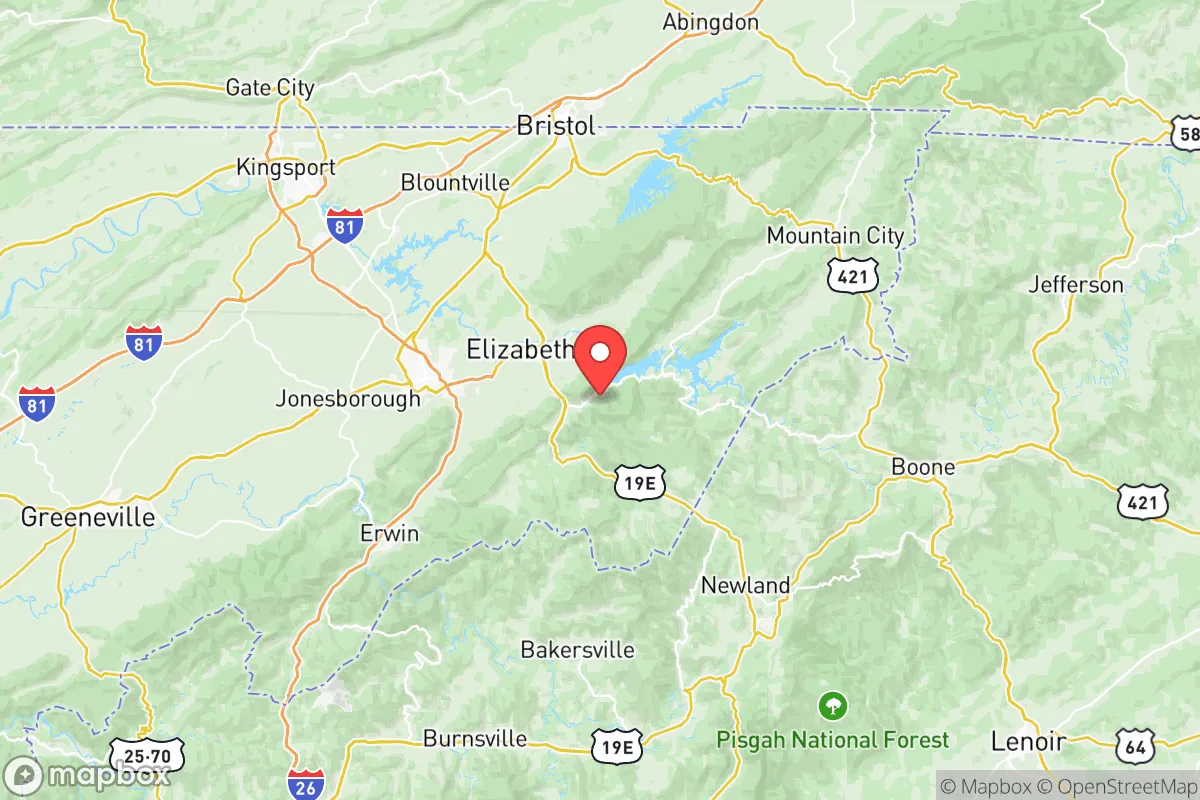
Photo: Wikipedia
Personal Sovereignty in Carter County
Viable for self-reliance. Generally workable, though some barriers may limit total independence.
What does Personal Sovereignty tell us?
Personal Sovereignty measures your capacity for self-reliance and independence with minimal government friction. Higher scores mean fewer barriers between you and the way you want to live... but it assumes you have the space you need and good neighbors.
What does this tell us?
Personal Sovereignty measures your capacity for self-reliance and independence with minimal government friction. Higher scores mean fewer barriers between you and the way you want to live... but it assumes you have the space you need and good neighbors.
State Policy
Energy independence: Importer (25% of energy produced in-state)
Personal Liberty
Homesteading

Personal Liberty Analysis
Carter County, Tennessee, offers a notably high degree of personal sovereignty, shaped by Tennessee’s strong state-level preemption laws, a low tax burden, and a culture of self-reliance that is deeply embedded in the Appalachian foothills. For individuals and families who prioritize autonomy—whether in self-defense, property use, or medical decisions—the county provides a legal and regulatory environment that is among the most permissive in the Southeast, particularly when compared to neighboring states like Virginia or North Carolina. The county seat of Elizabethton anchors a region where local governance tends to be light-touch, and the surrounding unincorporated areas—such as Hampton, Roan Mountain, and Watauga—offer even fewer restrictions on daily life, making the area a strategic choice for those seeking to minimize government entanglement.
Tax burden and regulatory posture in Carter County
Tennessee’s absence of a state income tax on wages is a foundational advantage for personal sovereignty, and Carter County compounds this with some of the lowest property tax rates in the state. The county’s property tax rate sits at approximately $2.20 per $100 of assessed value, which is roughly 30% lower than the state average and significantly below rates in metropolitan areas like Nashville or Knoxville. Sales tax is a consideration—Tennessee’s combined state and local rate in Carter County is around 9.5%—but the lack of an income tax means residents retain more control over their earnings. Regulatory posture is similarly restrained: the county has no countywide zoning ordinance for unincorporated areas, meaning that in communities like Butler and Stoney Creek, residents can build, fence, or operate small-scale businesses on their property without navigating a thicket of permits. Elizabethton does have a zoning code, but it is relatively permissive for a city of its size, with minimal restrictions on home-based enterprises and accessory structures. This light-touch approach extends to environmental regulations; the Tennessee Department of Environment and Conservation (TDEC) oversees state-level rules, but local enforcement is sparse, particularly in rural areas where agricultural and forestry uses are presumed lawful.
Self-defense and gun law specifics in Carter County
Tennessee is a constitutional carry state, and Carter County reflects that ethos fully. Since 2021, any law-abiding adult 21 or older can carry a handgun openly or concealed without a permit, and the county’s sheriff’s office—led by Sheriff Dexter Lunceford—has publicly stated it will not enforce federal firearm regulations it deems unconstitutional. This is not merely rhetorical: in 2023, the Carter County Commission passed a resolution affirming the county as a “Second Amendment Sanctuary,” and local law enforcement has a track record of declining to assist federal agencies in firearm confiscation efforts. For those who prefer a permit for reciprocity purposes, the Tennessee enhanced handgun carry permit requires an eight-hour course and a background check, but the process is straightforward and typically processed within 30 days. Stand-your-ground laws are in full effect, with no duty to retreat in any place where a person has a legal right to be. In practical terms, this means that in Elizabethton’s commercial districts or on a rural property in Roan Mountain, the legal framework for self-defense is unambiguous and protective of the individual. Gun ranges and firearms retailers are common; the Elizabethton Gun Club and several independent dealers in Hampton serve a community where firearm ownership is the norm, not the exception.
Self-reliance and homesteading viability in Carter County
Homesteading and off-grid living are not just feasible in Carter County—they are a visible part of the local culture, particularly in the unincorporated areas. Lot sizes in the county’s rural zones typically start at one acre, but parcels of five to twenty acres are common and affordable, with prices ranging from $3,000 to $8,000 per acre depending on proximity to the Cherokee National Forest. There is no countywide building code for single-family dwellings in unincorporated areas, meaning that owner-builders can construct homes using alternative methods like straw bale, earthbag, or timber framing without the expense of engineered plans or mandatory inspections. Off-grid utilities are legally straightforward: rainwater collection is unrestricted, and solar panel installations require no county permit, though interconnection with the Tennessee Valley Authority (TVA) grid requires a standard application. Septic systems must meet state health department standards, but the county’s environmental health office is known for practical, common-sense oversight rather than bureaucratic obstruction. In communities like Watauga and Butler, residents routinely keep chickens, goats, and even small livestock on parcels under five acres, and the county’s right-to-farm ordinance protects agricultural uses from nuisance complaints. For those seeking deeper self-reliance, the nearby Cherokee National Forest offers opportunities for foraging, hunting, and timber harvesting under state and federal permits, though the U.S. Forest Service does impose some restrictions on commercial extraction.
Personal liberties in Carter County: parental rights, medical autonomy, speech, and property
Tennessee’s legal environment strongly favors parental rights, and Carter County’s school board and local government align with that priority. The county’s public school system—Carter County Schools—operates under a policy that requires parental notification for any health services beyond basic first aid, and parents can opt their children out of any curriculum they find objectionable under Tennessee’s “Parents’ Bill of Rights” law (Tenn. Code Ann. § 49-6-7001). Medical autonomy is more nuanced: Tennessee has not expanded Medicaid, and the state’s certificate-of-need (CON) laws limit the number of healthcare facilities, which can constrain choice. However, for those willing to travel, Johnson City Medical Center (15 minutes from Elizabethton) provides a full range of services, and the county has a robust network of independent primary care providers who accept direct-pay patients. Speech and assembly are protected under the Tennessee Constitution, and the county has no local ordinances restricting political signage, leafleting, or public gatherings. Property rights are particularly strong: Tennessee’s “Private Property Protection Act” requires government entities to compensate owners for any regulatory taking that reduces property value by more than 20%, and Carter County’s planning commission rarely initiates eminent domain proceedings. In Elizabethton, the city does enforce a noise ordinance after 10 p.m., but in unincorporated areas like Stoney Creek, such restrictions are absent, allowing for late-night work, music, or gatherings without municipal interference.
Overall, Carter County ranks among the top-tier areas in Tennessee for personal sovereignty, comparable to more rural counties like Hawkins or Johnson but with better access to regional services in the Tri-Cities metro area. The combination of no income tax, constitutional carry, minimal zoning, and strong property rights creates an environment where individuals and families can exercise a high degree of control over their lives without constant friction with local government. For a conservative-leaning reader weighing relocation, the county offers a rare balance: the autonomy of deep rural living in places like Roan Mountain or Butler, with the practical conveniences of Elizabethton within a 20-minute drive. It is not a libertarian utopia—sales tax is high, and TVA’s monopoly on electricity limits energy independence—but for those who prioritize self-reliance and minimal regulatory overhead, Carter County is a compelling choice in the Appalachian region.

* Values derived from national, state, county, city and local statistics and may differ in a specific area. Last updated: 2026-10-05T13:01:46.000Z
Narrative content on this page is AI-generated and may contain mistakes. Verify any details that matter before acting on them.
ReloMaps may earn a commission from affiliate links at no extra cost to you.

