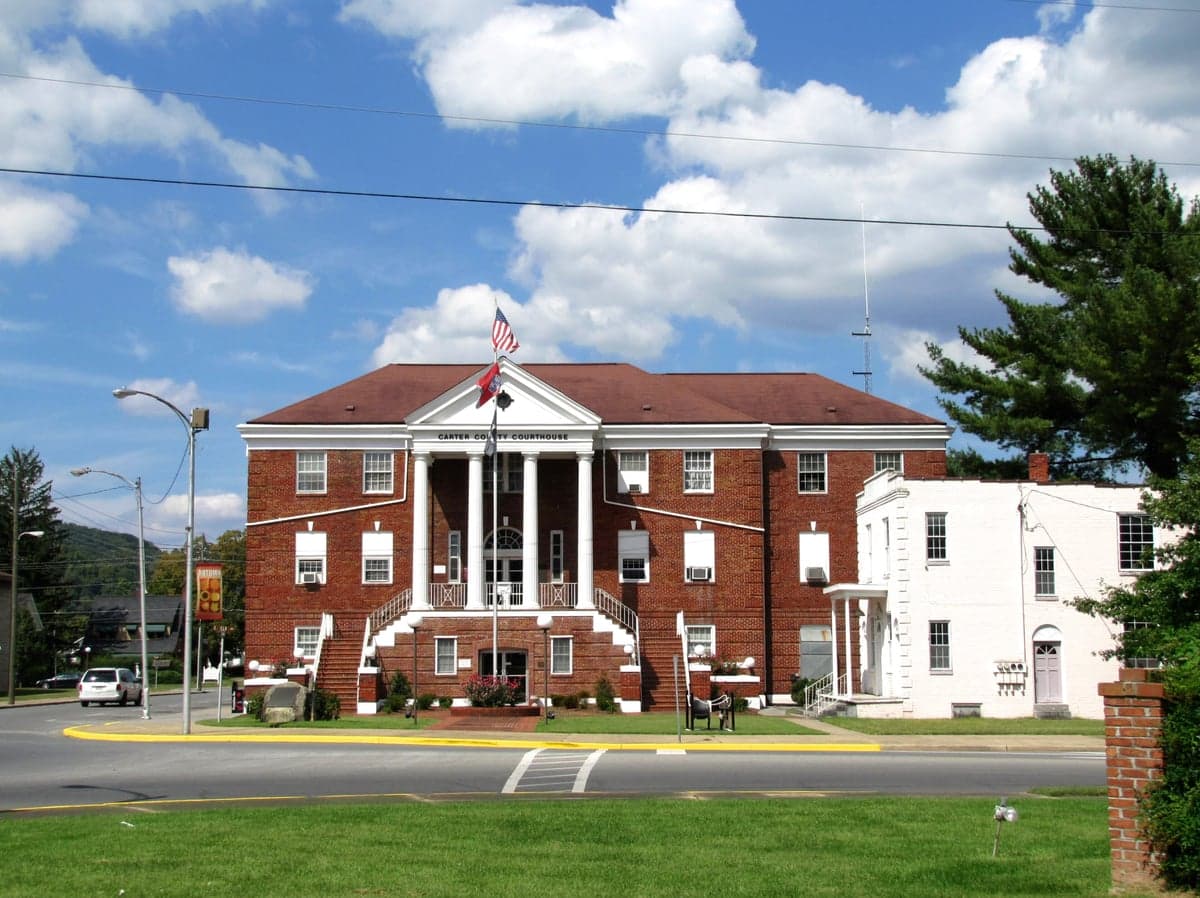
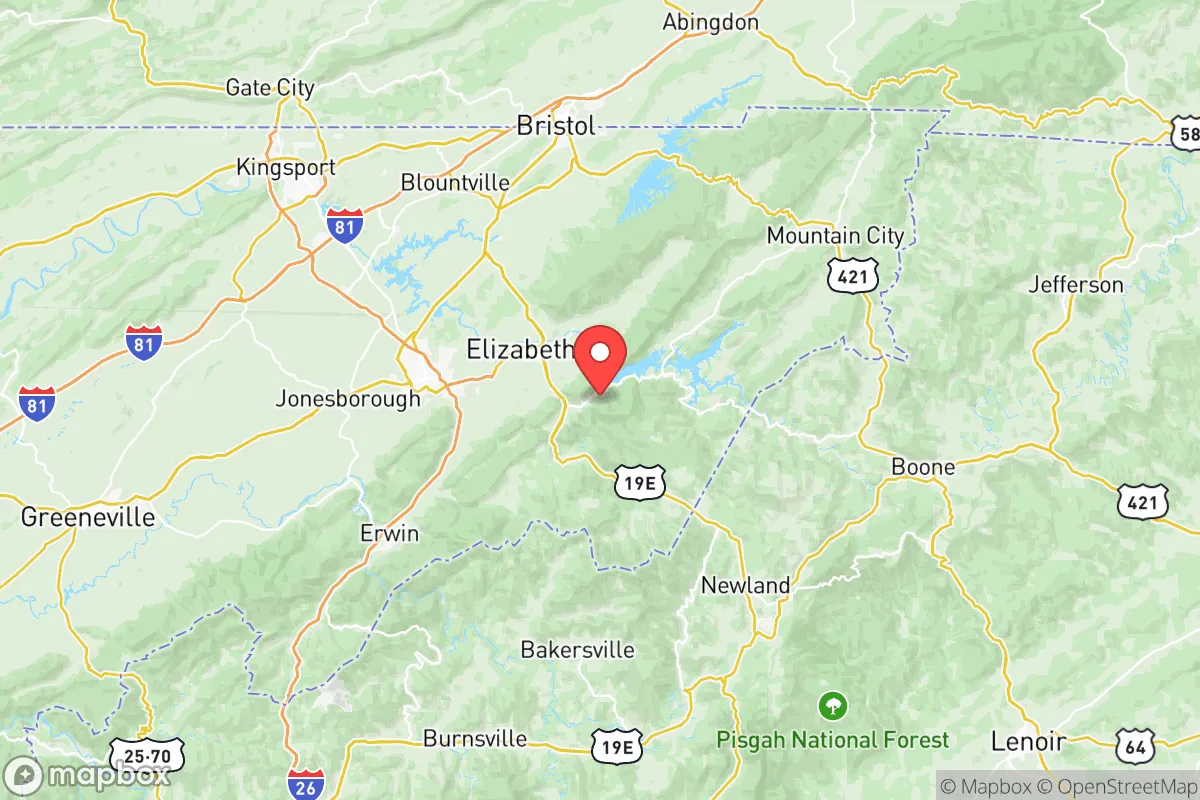
Photo: Wikipedia
Political ClimatePolitical Climate in Carter County
Showing district-level results — no local-only data available.
Local Political AnalysisPolitical Analysis of Carter County
Carter County, Tennessee, is one of the most reliably Republican counties in the entire state, with a Cook Partisan Voting Index (PVI) of R+29. That’s more than double the statewide Tennessee PVI of R+13, meaning the county is about 16 points more conservative than the state average. This isn’t a new trend—the area has been a GOP stronghold for decades, but the margin has widened significantly since 2016, driven by a combination of cultural conservatism, a strong evangelical presence, and a rural economy that feels disconnected from the growth in Nashville or Knoxville. If you’re looking at the political trajectory, it’s not shifting left; if anything, the county is solidifying its red identity as younger, more moderate voters leave for job centers and the remaining population becomes more entrenched in its views.
How it compares
To understand how deep Carter County’s red lean is, look at the numbers. Tennessee as a whole is R+13, which already makes it a solidly Republican state. Carter County’s R+29 puts it in the same league as the most conservative counties in the nation. For context, the county voted for Donald Trump by roughly 78% in 2020, compared to about 61% statewide. That’s a 17-point gap. But the county isn’t a monolith. Elizabethton, the county seat and largest town, is the most moderate area—it has a few precincts near downtown and the college (TCAT Elizabethton) that can swing closer to 60-40 Republican, and occasionally a Democratic candidate for local office can pull 45% there. In contrast, the rural precincts around Hampton, Roan Mountain, and Watauga routinely hit 85-90% Republican. The only real “blue” pockets are tiny: a handful of precincts in the more mountainous, less populated parts near the North Carolina border where a few old-line Democratic families still hold sway, but they’re statistically negligible. The county’s trajectory is clear: as Elizabethton’s small manufacturing base (like the Bush’s Beans plant and Stanley Black & Decker facility) holds steady, the rural areas are aging and becoming even more conservative.
What this means for residents
For conservative residents, Carter County is a comfortable environment. Local government, school boards, and law enforcement are overwhelmingly Republican, and policy debates tend to center on taxes, gun rights, and religious freedom. There’s little friction in daily life—most businesses, churches, and civic groups reflect the dominant political culture. For liberal or moderate residents, the reality is more nuanced. You’re not going to face open hostility in Elizabethton, but you’ll be in a clear minority. Political discussions in public settings (like the Elizabethton Farmers Market or at Covered Bridge Days) tend to assume a conservative baseline. There’s no organized progressive infrastructure—no local Democratic Party office, no regular activist meetups. That said, the county’s small size means personal relationships often override politics; your neighbors might disagree with your vote but still help you with a snowed-in driveway. The practical effect is that local elections are often decided in the Republican primary, and general elections are a formality. If you’re a liberal moving here, you’ll find the community polite but politically homogeneous.
Culturally, Carter County stands apart from Tennessee’s more urban or suburban areas. There’s a strong Appalachian identity here—independent, self-reliant, and skeptical of government overreach, whether from Nashville or Washington. You’ll see more “Don’t Tread on Me” flags than “Blue Lives Matter” flags, and the local gun culture is intense (open carry is common). The county also has a notable streak of libertarian-leaning independence: many residents vote Republican but grumble about the party’s spending or foreign policy. The biggest policy distinction from the rest of Tennessee is the county’s fierce opposition to any form of land-use regulation or zoning—a stance that has kept development slow and property taxes low, but also means strip malls and mobile homes sit next to historic homes with no buffer. If you’re moving here, understand that the politics aren’t just about party labels—they’re about a deep-seated belief in local control and minimal interference, which shapes everything from school curriculum debates to how the county handles broadband expansion. It’s a place where the past and present politics are tightly woven, and change comes slowly, if at all.

State Political ClimatePolitical Climate in Tennessee
State Political AnalysisPolitical Environment in the State
Tennessee is a solidly Republican state with a Cook PVI of R+13, meaning it votes about 13 points more Republican than the national average in presidential elections. The state has shifted rightward over the past 20 years, driven by a combination of rural consolidation, suburban growth in conservative-leaning exurbs, and the political realignment of working-class white voters. While Democrats once held a competitive position statewide as recently as the 1990s and early 2000s, the GOP now controls every statewide office, both chambers of the legislature, and both U.S. Senate seats. The last Democrat to win a statewide race was Governor Phil Bredesen in 2006, and the last Democrat to carry the state in a presidential election was Bill Clinton in 1996.
Urban vs. rural divide
The political geography of Tennessee is starkly split between its four major metro areas and the rest of the state. Nashville (Davidson County) and Memphis (Shelby County) are the Democratic strongholds, delivering margins of 60-70% for Democratic candidates. Chattanooga (Hamilton County) and Knoxville (Knox County) are more competitive but lean Republican, with Hamilton County flipping to Trump in 2024 after backing Biden in 2020 by a narrow margin. The real engine of the state's GOP dominance is the vast rural and exurban territory: counties like Williamson (south of Nashville), Rutherford (southeast of Nashville), and Sumner (northeast of Nashville) have grown rapidly and vote 65-75% Republican. The Tri-Cities region (Johnson City, Kingsport, Bristol) in northeast Tennessee is among the most conservative areas in the state, with some counties voting 80%+ Republican. The Memphis suburbs like Collierville and Germantown are reliably red, while the rural Mississippi Delta counties in West Tennessee are deeply conservative outside of Memphis proper.
Policy environment
Tennessee's policy environment is defined by low taxes, limited regulation, and a strong conservative social agenda. The state has no personal income tax on wages or salaries (only a limited tax on interest and dividends, which is being phased out). Sales tax is high — the state rate is 7%, with local add-ons pushing it to 9.55% in some areas — making it one of the most regressive tax structures in the country. Property taxes are low by national standards. The state is a right-to-work state with weak labor unions. Education policy is dominated by school choice: Tennessee has a robust charter school sector, a voucher program for students with disabilities, and a new Education Savings Account (ESA) program for low-income families in Nashville and Memphis that is being expanded statewide. The state has some of the most restrictive abortion laws in the country, with a near-total ban (no exceptions for rape or incest, only to save the mother's life). Healthcare is a mixed bag: Tennessee did not expand Medicaid under the ACA, leaving a coverage gap for low-income adults, but the state has a relatively high rate of private insurance coverage. Election laws are moderately restrictive: voter ID is required, early voting is available for two weeks, and absentee voting is limited to specific excuses. The state has no straight-ticket voting and no automatic voter registration.
Recent policy direction
Over the past five years, Tennessee has moved aggressively to the right on a broad range of issues. On gun rights, the state enacted permitless carry in 2021, allowing any law-abiding adult 21 or older to carry a handgun without a permit. The state also passed a "Second Amendment Sanctuary" resolution in 2021. On parental rights and education, the state passed the "Age-Appropriate Materials Act" in 2022, restricting classroom discussion of sexual orientation and gender identity in K-3, and later expanded it to all grades. The state also banned diversity, equity, and inclusion (DEI) programs at public universities in 2023. On medical and bodily autonomy, the state enacted a near-total abortion ban in 2022 (triggered by Dobbs) and has resisted efforts to add exceptions. On property rights, the state has a strong eminent domain law but has not passed a broad "property rights" bill beyond standard zoning reform. On taxation, the state has cut the corporate tax rate and is phasing out the Hall income tax on investment income. On voting and ballot access, the state passed a law in 2023 requiring all absentee ballots to be notarized or signed by two witnesses, and it has purged inactive voters from rolls. On privacy and surveillance, the state has no comprehensive data privacy law, but it passed a law in 2023 requiring social media companies to verify the age of users under 18. On speech, the state has not passed a broad "anti-cancel culture" law but has seen local school board battles over library books and curriculum.
Civil unrest & political movements
Tennessee has seen its share of political flashpoints. In 2023, the Covenant School shooting in Nashville sparked massive protests at the state capitol, with thousands of activists demanding gun control measures. The legislature responded by passing a law allowing teachers to carry firearms on campus and expanding mental health funding, but did not pass any gun restrictions. The Tennessee Three — two Black Democratic state representatives expelled for participating in a gun control protest on the House floor — became a national story, with both later reinstated. Immigration politics are less visible than in border states, but the legislature passed a law in 2024 requiring local law enforcement to cooperate with federal immigration authorities and penalizing "sanctuary" policies. There is no serious secession or nullification movement in Tennessee, though some rural counties have passed symbolic "Second Amendment Sanctuary" resolutions. Election integrity controversies have been minimal compared to states like Georgia or Arizona, though the state did conduct a limited audit of the 2020 election in 2021 that found no evidence of widespread fraud. The most visible political movements are the Moms for Liberty chapter in Williamson County, which has been active in school board races, and the Tennessee Stands group, which organizes around conservative social issues.
Projection
Over the next 5-10 years, Tennessee is likely to remain solidly Republican, but the margins may narrow slightly as the Nashville and Memphis metros continue to grow and attract more diverse, younger, and more Democratic-leaning populations. The state's population is projected to grow by about 10% by 2035, with most of that growth concentrated in the Nashville and Knoxville suburbs. The Williamson County and Rutherford County exurbs are likely to remain deeply red, but the inner suburbs of Nashville (like Brentwood and Franklin) may become more competitive as they densify and attract more white-collar professionals. The state's political trajectory will be shaped by two forces: the continued in-migration of conservative-leaning families from California and the Northeast, and the slow but steady growth of the Democratic-leaning urban core. The legislature is likely to continue passing conservative social legislation, but the state's business-friendly posture (low taxes, right-to-work, limited regulation) is unlikely to change. A new resident moving in now should expect a state that is politically stable, with a strong Republican majority that is unlikely to be seriously challenged in the next decade, but with growing cultural and political friction in the Nashville area.
For a new resident, the bottom line is straightforward: Tennessee offers a low-tax, limited-government environment with a strong conservative social agenda. If you are a conservative, you will find a state that aligns with your values on guns, abortion, education, and taxes. If you are a liberal, you will find a state where your vote is unlikely to matter in statewide elections, but where you can live comfortably in Nashville or Memphis with like-minded neighbors. The state's political climate is stable and predictable, with no major upheavals expected. The practical takeaway: choose your county carefully — the difference between living in Nashville and living in a rural county 30 miles away is the difference between a Democratic and a Republican world, and that divide is only getting wider.
* Values derived from national, state, county, city and local statistics and may differ in a specific area. Last updated: 2026-10-05T13:01:46.000Z
Narrative content on this page is AI-generated and may contain mistakes. Verify any details that matter before acting on them.
ReloMaps may earn a commission from affiliate links at no extra cost to you.

