Photo: Wikipedia
Demographics of Hamilton County
Affluence Level in Hamilton County
A middle-class area roughly in line with national averages across income, home values, education, and employment.
People of Hamilton County
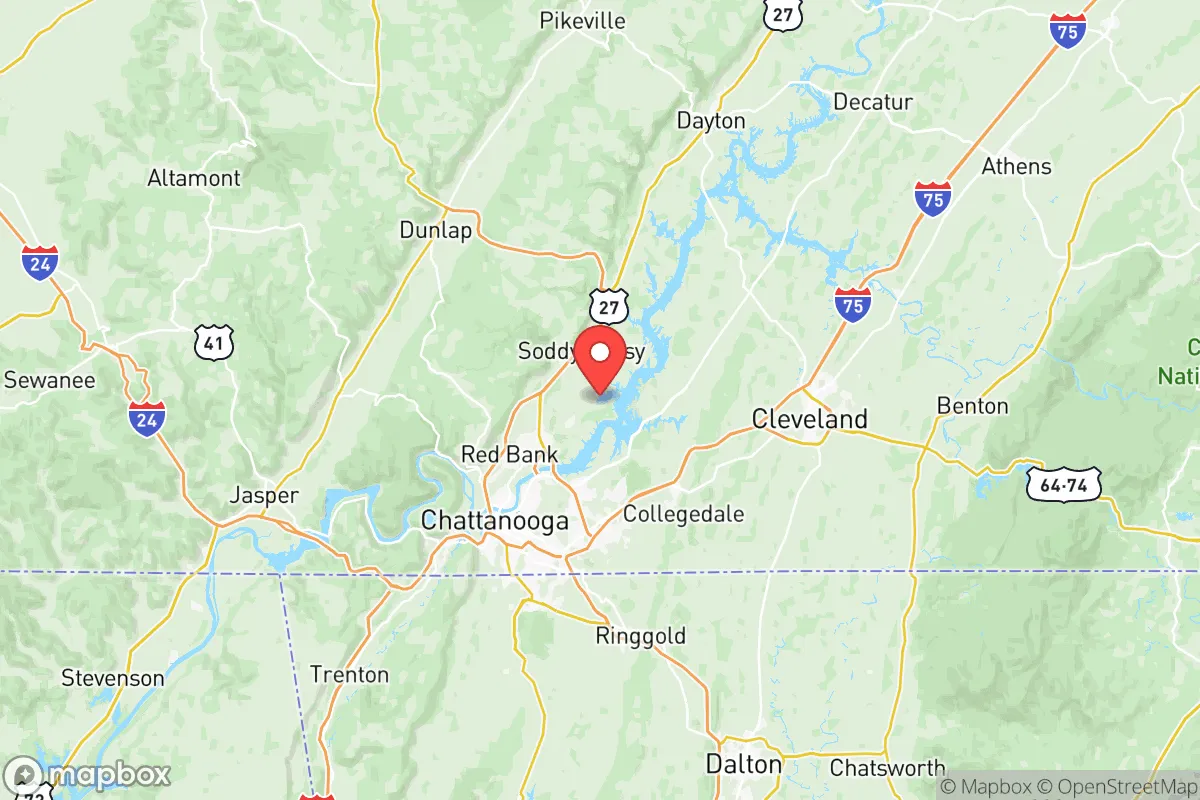
Hamilton County, Tennessee, is home to 370,913 residents, a population shaped by a distinct blend of Appalachian roots, Southern industrial heritage, and a growing suburban and exurban expansion centered on Chattanooga. The county is predominantly White (68.8%) with a significant Black population (17.4%) and a growing Hispanic community (7.6%), creating a demographic profile that is less diverse than the national average but more diverse than much of rural East Tennessee. The county’s identity is anchored by a strong sense of place, a relatively low cost of living, and a workforce increasingly tied to logistics, healthcare, and advanced manufacturing, attracting both families seeking stability and individuals drawn to the outdoor recreation of the Tennessee River Gorge.
Settlement & growth (pre-1960)
The land that became Hamilton County was originally inhabited by the Cherokee Nation, who controlled much of southeastern Tennessee until the early 19th century. The Cherokee had established towns and farmsteads along the Tennessee River, including the area known as Ross's Landing, which would later become Chattanooga. Following the Cherokee removal via the Trail of Tears in the late 1830s, the region was rapidly opened to White settlement, primarily by Scots-Irish and English migrants moving south and west from Virginia and North Carolina. These early settlers were drawn by the fertile river valleys and the promise of land grants, establishing small farming communities like Harrison (the original county seat) and Sale Creek.
The arrival of the railroad in the 1850s transformed Hamilton County from a rural outpost into a transportation and industrial hub. Chattanooga, strategically located at the junction of major rail lines, became a key supply center for the Confederacy during the Civil War and later a target for Union forces. The post-war period saw a wave of economic development, with the iron and steel industries taking root. This industrial boom attracted a new wave of migrants: freed African Americans moving from rural plantations into Chattanooga for work in foundries and rail yards, creating historic Black neighborhoods like St. Elmo and Alton Park. Simultaneously, European immigrants—primarily Germans, Irish, and Italians—arrived to work in the mills and on the railroad, settling in enclaves such as North Chattanooga and Red Bank.
The early 20th century brought further diversification. The establishment of the Tennessee Valley Authority (TVA) in the 1930s, with its headquarters in Chattanooga, brought a wave of engineers, administrators, and construction workers, many of whom were White professionals from across the South and Midwest. This period also saw the growth of the textile industry, which employed a largely White and Black workforce in towns like East Ridge and Collegedale. By 1960, Hamilton County’s population was overwhelmingly native-born, with a small but established Black community concentrated in Chattanooga’s urban core and a scattering of White ethnic neighborhoods in the surrounding towns.
Modern era (post-1965)
The 1965 Hart-Cellar Act had a relatively muted direct impact on Hamilton County compared to coastal or Sun Belt boom regions. The foreign-born population today stands at just 3.6%, well below the national average. However, the post-1965 era brought significant domestic migration that reshaped the county’s demographics. The decline of heavy industry in the Rust Belt, particularly from the 1980s onward, spurred a steady inflow of families from Ohio, Michigan, and Illinois, drawn by Chattanooga’s lower cost of living and emerging logistics sector. This domestic migration has been predominantly White, reinforcing the county’s existing racial composition.
The most notable demographic shift since 1965 has been the growth of the Hispanic population, which now accounts for 7.6% of the county. This community began to grow in the 1990s and 2000s, driven by employment in construction, landscaping, and food processing. Hispanic residents have concentrated in East Chattanooga and parts of Rossville (just across the Georgia line but part of the same metro area), as well as in Ooltewah, where new subdivisions and service-sector jobs have drawn families. The Asian population remains small, with East and Southeast Asian communities (1.1%) and Indian subcontinent residents (0.8%) forming modest but visible professional enclaves, particularly in Signal Mountain and Lookout Mountain, where many work in healthcare and engineering.
Suburbanization has been the dominant geographic trend since the 1970s. The construction of Interstate 75 and Interstate 24 spurred rapid growth in bedroom communities like Hixson, Soddy-Daisy, and Harrison, drawing families from Chattanooga’s urban core. This outward movement has been largely White, while the city of Chattanooga itself has seen a more diverse population, including a stable Black community (17.4% countywide) and a growing number of young professionals and retirees attracted to the revitalized downtown. The county’s college-educated population has risen to 37.0%, reflecting the growth of white-collar jobs in healthcare (Erlanger Health System), insurance (Unum), and logistics (Amazon, Volkswagen’s nearby plant).
The future
Hamilton County is projected to continue growing, driven by domestic migration from higher-cost states and the expansion of the Chattanooga metro area. The population is likely to become slightly more diverse, with the Hispanic share expected to rise steadily as families settle in suburban areas like Ooltewah and Apison. The Black population is expected to remain stable, with some movement from older urban neighborhoods to newer subdivisions in East Brainerd and Collegedale. The Asian and Indian communities, while small, are likely to grow slowly as the healthcare and tech sectors expand.
The county’s cultural identity is evolving from a purely Southern industrial past toward a more suburban, amenity-driven present. The influx of out-of-state residents is gradually moderating the region’s political and social conservatism, though Hamilton County remains reliably Republican in local and national elections. The biggest demographic challenge is the aging of the White population, which is slightly older than the Hispanic and Black populations, potentially leading to a slower growth rate for the White share over the next decade. New residential development is concentrated in the southeastern part of the county, along the Georgia border, and in the northern exurbs near Dayton and Dunlap, where land is cheaper and schools are perceived as strong.
For someone moving in now, Hamilton County offers a stable, growing community with a strong job market and a relatively low cost of living. The population is becoming more diverse, but at a measured pace, and the county’s cultural identity remains rooted in its Appalachian and Southern heritage. The key trend to watch is the continued suburbanization of the Hispanic and Black populations, which will gradually reshape the demographic map of the county’s outer towns and school districts.

* Values derived from national, state, county, city and local statistics and may differ in a specific area. Last updated: 2026-10-04T23:33:32.000Z
Narrative content on this page is AI-generated and may contain mistakes. Verify any details that matter before acting on them.
ReloMaps may earn a commission from affiliate links at no extra cost to you.

