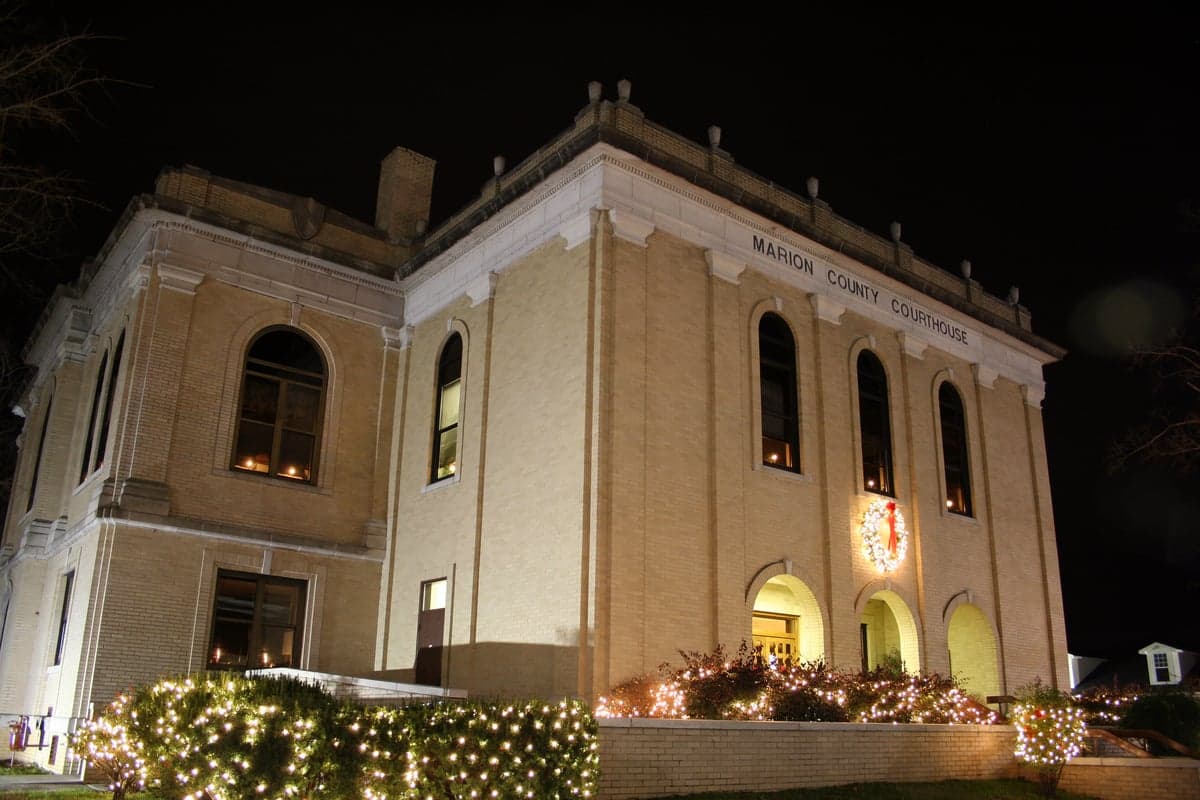
Photo: Wikipedia
Personal Sovereignty in Marion County
Viable for self-reliance. Generally workable, though some barriers may limit total independence.
What does Personal Sovereignty tell us?
Personal Sovereignty measures your capacity for self-reliance and independence with minimal government friction. Higher scores mean fewer barriers between you and the way you want to live... but it assumes you have the space you need and good neighbors.
What does this tell us?
Personal Sovereignty measures your capacity for self-reliance and independence with minimal government friction. Higher scores mean fewer barriers between you and the way you want to live... but it assumes you have the space you need and good neighbors.
State Policy
Energy independence: Importer (25% of energy produced in-state)
Personal Liberty
Homesteading

Personal Liberty Analysis
Marion County, Tennessee offers a notably high degree of personal sovereignty, grounded in Tennessee’s strong state-level preemption laws, low tax burden, and a culture of self-reliance that is more pronounced here than in many parts of the Southeast. The county’s regulatory environment is light-touch, particularly outside the small city limits of Jasper and South Pittsburg, where county zoning is minimal and property rights are broadly respected. For a relocation reader prioritizing autonomy, Marion County presents a practical balance of low interference and accessible land, though the specifics of gun laws, homesteading feasibility, and personal liberties vary meaningfully between the county’s rural stretches and its few incorporated towns.
Tax burden and regulatory posture: how light is the government footprint?
Tennessee’s absence of a state income tax on wages is the cornerstone of its tax-friendly posture, and Marion County adds a relatively low property tax rate to that advantage. The county’s combined property tax rate (county plus local school district) typically falls around $2.20 to $2.50 per $100 of assessed value, which is below the state average and significantly lower than neighboring Hamilton County (Chattanooga). There is no county-level sales tax surcharge beyond the state’s 7% base, and the overall effective tax burden on a median-priced home here is roughly 0.6% of market value annually. Regulatory oversight is minimal: the county has no countywide zoning ordinance, meaning that outside the city limits of Jasper, South Pittsburg, and Whitwell, land use is governed primarily by state health and building codes rather than local planning boards. This creates a permissive environment for home-based businesses, workshops, and agricultural structures without the permitting delays common in more regulated counties. The city of Jasper does enforce a basic zoning code and building permits, but even there, the process is straightforward and fees are low compared to urban Tennessee jurisdictions.
Self-defense and gun law specifics: what Tennessee’s permitless carry means here
Tennessee is a permitless carry state for handguns, effective since 2021, and Marion County fully reflects that legal environment. Any law-abiding adult 21 or older may carry a loaded handgun openly or concealed without a permit, and the county sheriff’s office does not impose any local restrictions beyond state law. The county is also a strong Second Amendment sanctuary area; the Marion County Commission passed a resolution in 2020 affirming its intent to defend gun rights against any state or federal infringement. For those who want a permit for reciprocity purposes, the Tennessee enhanced handgun carry permit requires an 8-hour class and a background check, and the sheriff’s office in Jasper processes applications efficiently, typically within 30 days. Stand-your-ground laws apply statewide, with no duty to retreat in any place where the individual has a legal right to be. Castle doctrine protections extend to vehicles and occupied structures. The practical effect for residents is that self-defense choices are almost entirely a matter of personal judgment, with minimal bureaucratic friction. The towns of Kimball and New Hope have no local gun ordinances, and the county’s rural character means that open carry in public spaces is common and socially accepted.
Self-reliance and homesteading viability: lot sizes, zoning, and off-grid feasibility
Marion County’s rural zoning absence and large available land parcels make it one of the more viable areas in southeastern Tennessee for self-reliant living. Outside the city limits of Jasper, South Pittsburg, and Whitwell, there are no minimum lot size requirements for agricultural or residential use, though state septic regulations effectively set a floor of about one acre for a conventional septic system. Many properties in the Sequatchie Valley and along the Tennessee River offer 5- to 20-acre parcels at prices well under $5,000 per acre, making small-scale homesteading financially accessible. Off-grid living is legally feasible: Tennessee has no state law prohibiting rainwater collection, composting toilets, or solar power systems, though any permanent dwelling must meet state building codes for structural safety. The county does not enforce any ban on tiny homes or RVs as primary residences on private land, provided they are not in a floodplain. The unincorporated communities of Haletown and Guild offer particularly low regulatory friction, with no homeowner associations or county planning oversight. However, residents should note that the Tennessee Valley Authority (TVA) has easement rights along the river, and any off-grid water or power systems near the river corridor may require TVA coordination. Overall, the county’s regulatory posture supports a high degree of self-reliance for those willing to handle their own water, waste, and power systems.
Personal liberties: parental rights, medical autonomy, speech, and property
Tennessee’s legal framework in 2026 strongly emphasizes parental rights and medical autonomy, and Marion County’s local culture aligns with that posture. The state’s parental bill of rights, enacted in 2022, gives parents explicit authority over their children’s education, healthcare, and religious upbringing, and the county’s school board in Jasper has not adopted any policies that conflict with that framework. Medical autonomy is broad: Tennessee has no state-level vaccine mandate for adults, and the county health department does not enforce any local mandates beyond federal requirements for school attendance. The state’s recent laws restricting certain medical procedures for minors (including gender-affirming care) are in effect here, and the local medical community in South Pittsburg and Jasper generally operates within those boundaries. Free speech protections are robust; the county has no local ordinances restricting political signage, leafleting, or public assembly, and the rural character means that property owners can display flags, signs, or political messages without HOA interference. Property rights are strongly protected: Tennessee’s Private Property Protection Act limits eminent domain to public uses like roads and utilities, and the county has not pursued any controversial takings in recent memory. The absence of countywide zoning means that property owners have wide latitude to use their land for residential, agricultural, or commercial purposes, subject only to state environmental and health regulations.
Compared to many areas of the country, Marion County offers a genuinely high degree of personal sovereignty, particularly for those who value low taxes, minimal zoning, strong gun rights, and parental autonomy. The trade-off is that this freedom comes with limited public services: the county’s road maintenance, emergency response, and school funding are all below state averages, meaning that self-reliance is not just a philosophical choice but a practical necessity. For a relocation reader who prioritizes independence over convenience, Marion County’s combination of Tennessee’s state-level protections and the county’s light local footprint makes it a strong contender, especially when compared to more regulated counties in the Nashville or Knoxville metro areas. The key is to choose land in the unincorporated areas—Haletown, Guild, or the Sequatchie Valley—rather than within the city limits of Jasper or South Pittsburg, where basic zoning and permitting add a modest layer of oversight. Overall, this is a place where personal sovereignty is the default, not the exception.

* Values derived from national, state, county, city and local statistics and may differ in a specific area. Last updated: 2026-10-19T03:30:23.000Z
Narrative content on this page is AI-generated and may contain mistakes. Verify any details that matter before acting on them.
ReloMaps may earn a commission from affiliate links at no extra cost to you.

