Photo: Wikipedia
Political ClimatePolitical Climate in Marion County
Showing district-level results — no local-only data available.
Local Political AnalysisPolitical Analysis of Marion County
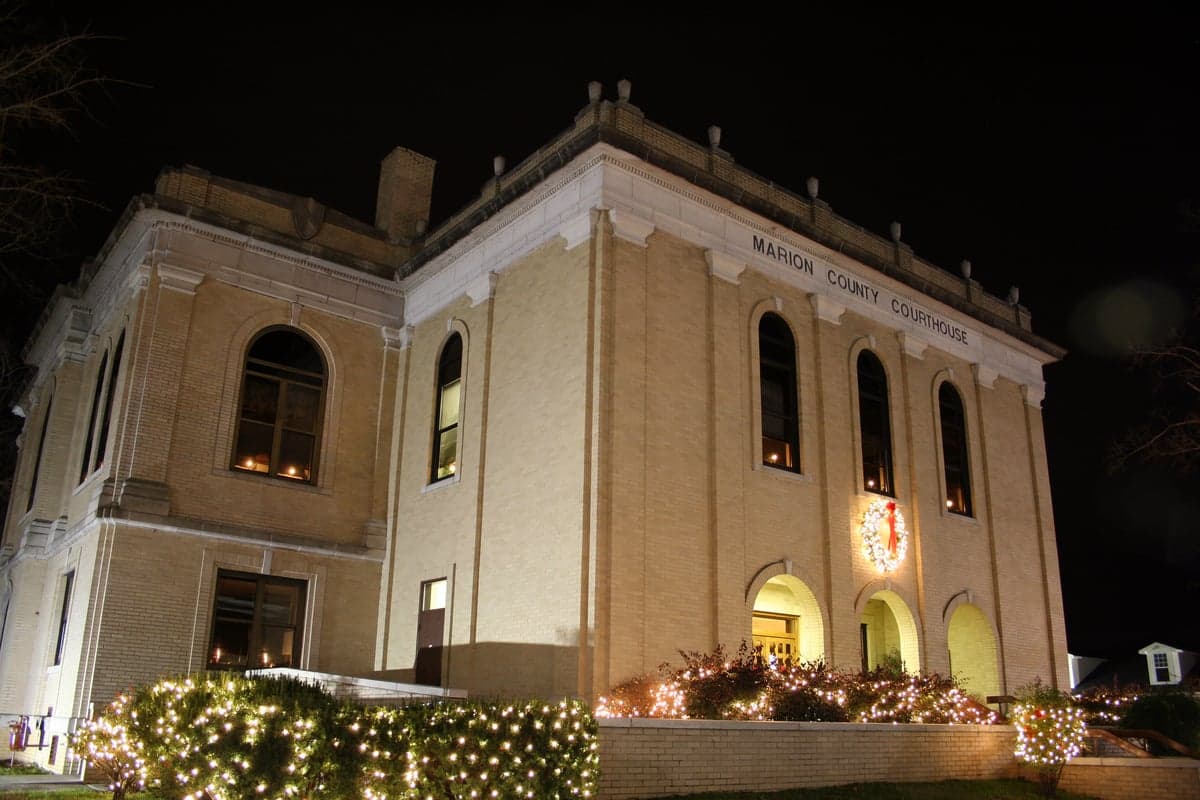
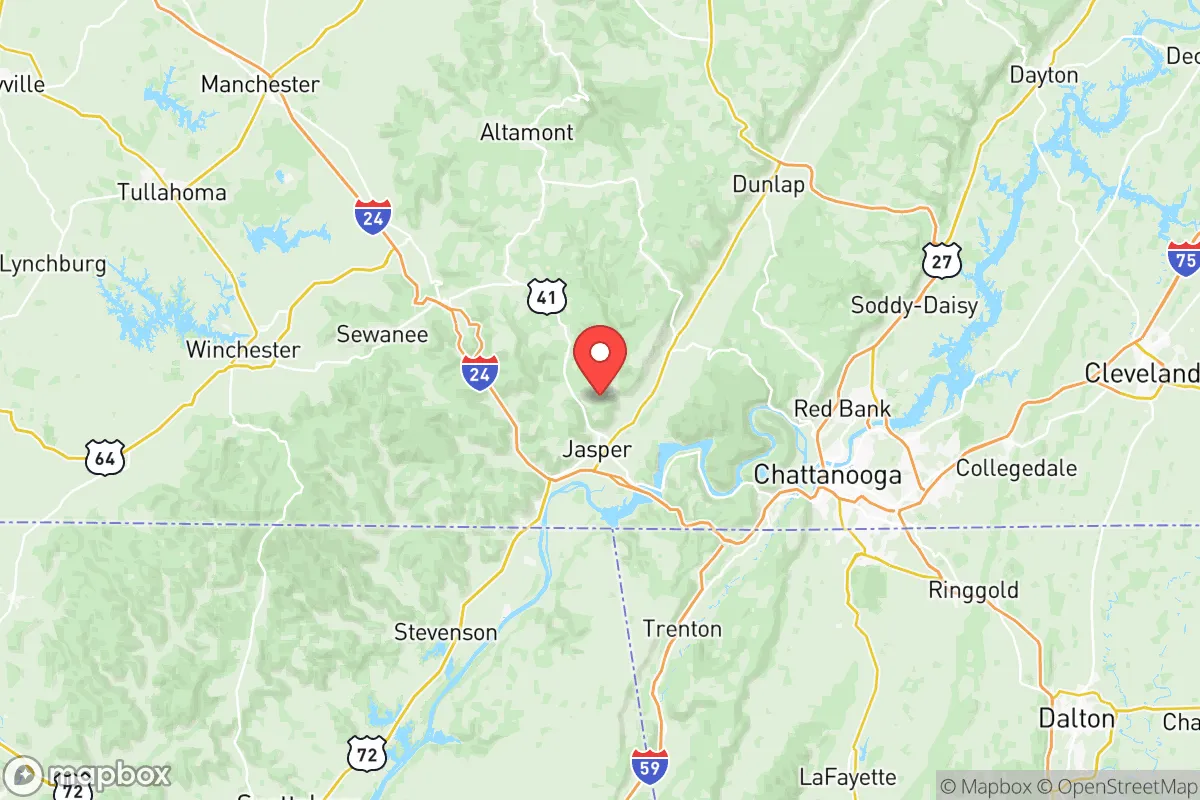
Marion County, Tennessee, is a reliably Republican stronghold with a Cook PVI of R+21, making it significantly more conservative than the state of Tennessee as a whole, which sits at R+13. This isn't a new development; the county has voted for the GOP presidential candidate in every election since 2000, often by margins exceeding 30 points. However, the political landscape isn't a monolith—you'll find real variation between the small towns, with some precincts showing a surprising Democratic tilt, particularly in the more rural, historically union-heavy areas around the county's southern edge.
How it compares
The eight-point gap between Marion County's R+21 and Tennessee's R+13 is substantial. To put it in perspective, while the state as a whole has been trending redder over the past decade, Marion County has moved even faster in that direction. The county's GOP advantage is roughly 50% larger than the state's, meaning a Republican candidate here can expect a much warmer reception than they would in, say, the Nashville suburbs or even the more moderate parts of East Tennessee. The swing precincts are few and far between, but they do exist. For instance, the precinct around Jasper, the county seat, is reliably red but can be competitive in local races, while the precincts covering South Pittsburg and Kimball have historically shown a stronger Democratic presence, often driven by union ties from the old mining and manufacturing industries. In contrast, the more rural precincts around Whitwell and Powells Crossroads are deeply conservative, often delivering 70-80% of the vote for Republican candidates.
What this means for residents
For conservative residents, the political climate is highly favorable. Local offices—from the county commission to the school board—are dominated by Republicans, and policy debates tend to center on fiscal conservatism, Second Amendment rights, and limited government. A conservative can expect their views to be the default in most public forums. For liberal residents, the reality is more challenging. They are a clear minority, and their political influence is largely confined to the aforementioned precincts in South Pittsburg and Kimball. While there is no active hostility, a liberal resident will find few elected officials who share their views on social or environmental policy. The practical effect is that progressive candidates rarely run, and when they do, they face an uphill battle. The county's political culture is deeply personal, though—people vote for the person, not just the party, and a well-liked local Democrat can still win a seat on the school board or as a constable, especially if they focus on local issues like road maintenance or school funding.
Culturally, Marion County's conservatism is rooted in a strong sense of self-reliance and a wariness of outside influence, which is a key distinction from the more suburban conservatism found in parts of Williamson or Rutherford counties. You'll see more "Don't Tread on Me" flags than "Make America Great Again" signs in some areas, reflecting a libertarian streak. Policy-wise, the county has been a leader in the state's push for school choice and has resisted any form of local income tax. The biggest cultural distinction is the county's relationship with the Tennessee Valley Authority (TVA) and the Nickajack Lake area—environmental regulations are often viewed with suspicion, seen as a threat to local property rights and the tourism economy. Looking ahead, the county's political trajectory seems set to stay the course, with the R+21 lean likely to hold or even deepen as the region continues to attract retirees and remote workers who are drawn to its low taxes and conservative values.

State Political ClimatePolitical Climate in Tennessee
State Political AnalysisPolitical Environment in the State
Tennessee is a solidly Republican state with a Cook PVI of R+13, meaning it votes about 13 points more Republican than the national average in presidential elections. The dominant coalition is a mix of rural and suburban conservatives, with the state having moved sharply rightward over the past 20 years—flipping from a reliably Democratic stronghold in the 1990s to one of the most reliably red states in the country. This shift was driven by the realignment of white working-class voters, the growth of the Nashville and Knoxville suburbs, and the near-total collapse of Democratic strength outside of Memphis and a few urban pockets.
Urban vs. rural divide
The political map of Tennessee is a textbook study in the urban-rural split. The state’s three major metro areas—Nashville, Memphis, and Chattanooga—are Democratic-leaning islands in a sea of red. Nashville (Davidson County) voted for Joe Biden by roughly 30 points in 2020, while Memphis (Shelby County) went for Biden by about 40 points. Chattanooga (Hamilton County) is more competitive but has trended left in recent cycles, with Biden losing it by only about 5 points. The rest of the state—places like Knoxville, Johnson City, Clarksville, and the vast rural stretches of West and Middle Tennessee—vote overwhelmingly Republican. The most Republican counties in the state, like Pickett and Van Buren in the Upper Cumberland region, routinely give GOP candidates 80-85% of the vote. The suburban ring around Nashville, particularly Williamson County (Franklin, Brentwood), is one of the most reliably conservative suburban areas in the country, voting R+30 or more in most elections. The divide is stark: drive 20 minutes outside any city center, and you’re in deep red territory.
Policy environment
Tennessee’s policy environment is defined by a low-tax, limited-government philosophy that has been consistently reinforced over the past decade. The state has no personal income tax on wages, a major draw for relocators, though it does tax interest and dividends (the Hall Tax) which is being phased out and will be fully eliminated by 2029. Sales tax is high—around 7% state rate, with local add-ons pushing it to 9.5% or more in some areas—making it one of the most regressive tax structures in the country. The regulatory posture is business-friendly, with a right-to-work law and no state-level minimum wage above the federal $7.25. Education policy is a mix: the state has a robust school choice program (the Education Savings Account pilot in Memphis and Nashville, expanded in 2023), but public school funding remains a perennial issue, with teacher pay below the national average. Healthcare policy is notably hands-off: Tennessee did not expand Medicaid under the ACA, leaving a coverage gap for about 300,000 low-income adults. Election laws are moderately restrictive: voter ID is required, early voting is available for two weeks, and the state has purged inactive voters from rolls. There is no same-day voter registration.
Recent policy direction
The last five years have seen Tennessee move aggressively in a conservative direction across multiple fronts. On gun and self-defense law, the state enacted permitless carry in 2021, allowing any adult 21 or older to carry a handgun openly or concealed without a permit. On parental and education rights, the 2022 “Don’t Say Gay” law (HB 800) restricts classroom discussion of sexual orientation and gender identity in K-8, and the 2023 “Age-Appropriate Materials Act” gives parents more power to challenge library books. On speech and privacy, the state passed a law in 2023 requiring social media platforms to verify the ages of Tennessee users and restrict minors’ access. On medical and bodily autonomy, Tennessee has one of the most restrictive abortion bans in the country—a near-total ban with no exceptions for rape or incest, effective from the moment of fertilization, passed in 2019 and triggered by the Dobbs decision in 2022. On property rights, the state has strong eminent domain protections and a “stand your ground” law that extends to property defense. On taxation, the Hall Tax phase-out is the biggest recent change, reducing the burden on retirees. On voting and ballot access, the state passed a law in 2023 restricting third-party ballot access and making it harder for independent candidates to get on the ballot. The overall direction is toward more individual liberty in some areas (guns, taxes, school choice) and more government restriction in others (abortion, speech, voting access).
Civil unrest & political movements
Tennessee has seen its share of political flashpoints, though large-scale civil unrest is rare. The most notable recent event was the Nashville school shooting in March 2023, which sparked a wave of protests at the state capitol demanding gun control measures—and led to the expulsion of two Democratic state representatives (Justin Jones and Justin Pearson) for violating decorum during a protest on the House floor. The expulsions drew national attention and were followed by special elections that returned both men to office. On the right, the Tennessee Firearms Association and local gun rights groups are highly active, particularly in rural areas. Immigration politics are a growing issue: the state passed a law in 2024 requiring local law enforcement to cooperate with federal immigration authorities, and there are no sanctuary cities. Election integrity controversies have been relatively muted compared to states like Georgia or Arizona, but the 2020 election did see some local GOP figures question results, and the state legislature has tightened voting laws. Secession or nullification rhetoric is fringe but present in some rural counties, usually tied to federal land management disputes. A new resident would notice the strong presence of political signage, especially in rural areas, and the occasional protest at the capitol in Nashville, but daily life is generally calm and politically homogeneous outside the cities.
Projection
Over the next 5-10 years, Tennessee is likely to remain solidly Republican, but the margins may narrow slightly in suburban areas due to in-migration. The state is one of the fastest-growing in the country, with much of that growth coming from blue states like California, New York, and Illinois. These new residents tend to be more moderate or even left-leaning, particularly in the Nashville and Knoxville suburbs. Williamson County has already seen its Republican margin shrink from R+40 in 2016 to about R+30 in 2020, and that trend is likely to continue. However, the rural and exurban areas are growing too, and the state legislature is likely to remain firmly in GOP control for the foreseeable future. The biggest wildcard is the abortion issue: if the state’s near-total ban continues to drive away young families and professionals, it could accelerate a demographic shift toward more moderate politics. But for now, the state’s political trajectory is one of stable, conservative governance with incremental rightward movement on cultural issues. Someone moving in now should expect to find a state that is deeply Republican in its institutions and culture, but with growing pockets of political diversity in the major metros.
For a new resident, the bottom line is straightforward: if you’re a conservative, you’ll find a state that aligns with your values on taxes, guns, education, and cultural issues, with a government that is actively pushing those priorities. If you’re a liberal, you’ll find a state where your vote is largely irrelevant in statewide elections, but where you can still find community in Nashville, Memphis, or Chattanooga—and where the cost of living and lack of income tax may offset the political downsides. The key is to choose your location carefully: the difference between living in Williamson County and living in Davidson County is the difference between living in a deep red suburb and a blue city, and that affects everything from school board politics to the availability of certain healthcare services. Tennessee is not a purple state and is unlikely to become one soon, but it is a state with real internal diversity, and a smart relocator will match their expectations to the specific community they choose.
* Values derived from national, state, county, city and local statistics and may differ in a specific area. Last updated: 2026-10-19T03:30:23.000Z
Narrative content on this page is AI-generated and may contain mistakes. Verify any details that matter before acting on them.
ReloMaps may earn a commission from affiliate links at no extra cost to you.

