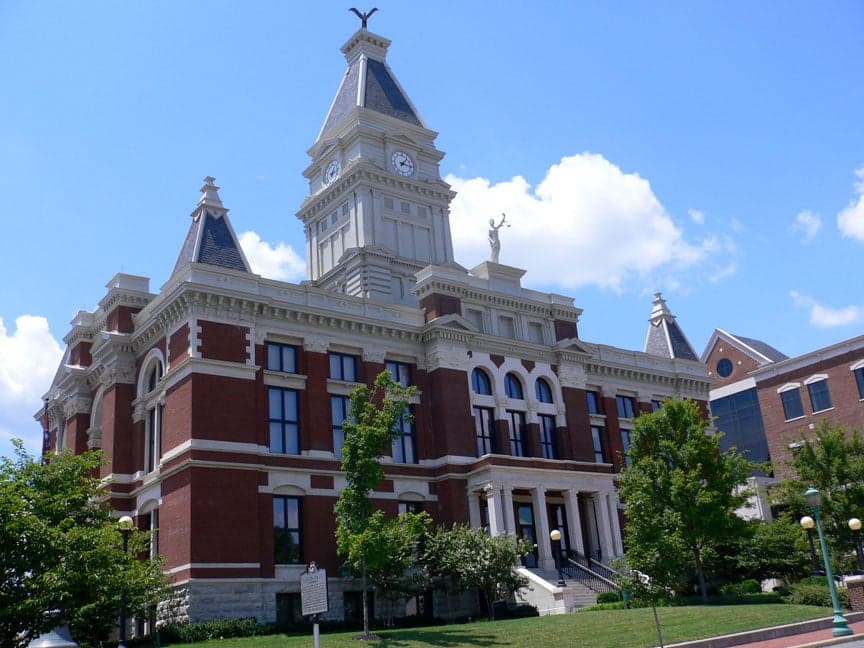
Photo: Wikipedia
Political ClimatePolitical Climate in Montgomery County
Showing district-level results — no local-only data available.
Local Political AnalysisPolitical Analysis of Montgomery County
Montgomery County leans solidly Republican with a Cook PVI of R+10, though it's a notch less red than Tennessee as a whole (R+13). The county's political center of gravity is Clarksville, where you'll find the most variation—precincts around Austin Peay State University and downtown have trended bluer in recent cycles, while areas like Sango, Rossview, and the rural stretches toward Woodlawn remain deeply conservative. The military presence at Fort Campbell brings in families from all over the country, which has nudged some precincts toward purple, but the county commission and school board still run on a reliably conservative platform. That said, I've watched the local GOP primary become more contested as newer residents bring different priorities, and there's a real concern that progressive activism is slowly gaining a foothold in city council races.
How it compares
Tennessee's statewide R+13 rating reflects a more uniformly conservative electorate outside the major metros. Montgomery County's R+10 means it's slightly more competitive, driven almost entirely by Clarksville's growth. Compare that to the rest of the state: rural counties like Stewart or Houston to the west vote R+30 or higher, while Davidson County (Nashville) is deep blue. Inside Montgomery County, the divide is between the urban core of Clarksville—where you'll see precincts like those near the university or the Gateway area occasionally flip—and the surrounding towns like Palmyra, Cunningham, and Woodlawn, which vote 70-80% Republican. The swing precincts are in the newer subdivisions along the I-24 corridor, where young families and military retirees mix. That's where the battle for the county's future is being fought, and where I worry about creeping government overreach if progressive candidates start winning those seats.
What this means for residents
For now, the county government still prioritizes low taxes, Second Amendment rights, and limited regulation—things that matter to folks who moved here to escape the chaos of bigger cities. But there are warning signs. The school board has seen debates over curriculum transparency and library content, with some members pushing for more "inclusive" policies that feel like a foot in the door for ideological overreach. Zoning fights in Clarksville have also raised eyebrows, with proposals that could limit property rights under the guise of "smart growth." On the plus side, Tennessee's preemption laws keep local gun control and mask mandates at bay, so your personal freedoms are still largely protected. But if you're paying attention, you'll notice the same playbook being run here that turned Nashville blue—neighborhood associations, activist groups, and out-of-state money targeting local elections. The long-term trajectory depends on whether the conservative majority holds the line or gets complacent.
Culturally, Montgomery County is a mix of Southern tradition, military discipline, and suburban sprawl—a combination that makes it distinct from the rest of Tennessee. You don't see the same deep-rooted rural conservatism you'd find in, say, Lawrenceburg or Cookeville; instead, there's a pragmatic, live-and-let-live attitude that can sometimes let progressive ideas slip through if nobody's watching. The biggest policy distinction is the heavy influence of Fort Campbell, which keeps the county focused on veteran services, military family support, and a transient population that doesn't always vote in local races. That's both a strength and a vulnerability—if the wrong people get appointed to planning commissions or school boards, the character of this place could shift faster than folks realize. For now, it's still a good place to raise a family without the government breathing down your neck, but I'd keep an eye on those precincts along the interstate.

State Political ClimatePolitical Climate in Tennessee
State Political AnalysisPolitical Environment in the State
Tennessee is a solidly Republican state with a Cook PVI of R+13, meaning it votes about 13 points more conservative than the national average. The dominant coalition is a mix of rural conservatives, suburban families, and a growing number of transplants from blue states who are drawn to the state’s low taxes and cultural values. Over the last 10–20 years, Tennessee has shifted noticeably rightward — the state legislature has become more conservative, the governor’s office has been reliably GOP, and even some historically Democratic areas have flipped. That said, the urban centers of Nashville and Memphis remain deep blue, creating a clear political fault line that any new resident should understand.
Urban vs. rural divide
The political map of Tennessee is a textbook study in contrast. Nashville (Davidson County) and Memphis (Shelby County) are the two major Democratic strongholds, each delivering 60–70% of their votes to Democratic presidential candidates. Knoxville and Chattanooga lean Republican but are more moderate than the surrounding countryside. The real engine of the state’s conservative majority is the vast rural and exurban territory — places like Jackson, Johnson City, and the sprawling counties around Nashville. Williamson County, home to Franklin and Brentwood, is one of the wealthiest and most reliably Republican counties in the nation, routinely voting 70%+ GOP. Rutherford County (Murfreesboro) and Montgomery County (Clarksville) are more competitive but still lean right, thanks to military families and suburban growth. The divide isn’t just about population density; it’s about culture. Rural Tennessee votes on guns, faith, and family, while urban Tennessee votes on social services and progressive governance. That split has only widened since 2020.
Policy environment
Tennessee’s policy environment is among the most conservative in the country. There is no state income tax — only a sales tax (around 7% state, plus local) and a flat 6.5% corporate tax. The legislature is a Republican supermajority, and Governor Bill Lee has signed a steady stream of conservative bills. Education policy includes a robust school choice program: the Education Savings Account (ESA) pilot expanded in 2023 to cover more counties, and a universal school voucher bill is on the table for 2025. The state banned abortion at conception with a trigger law that took effect after Dobbs, with no exceptions for rape or incest. Gun rights are strong: permitless carry (constitutional carry) became law in 2021, and there are no red-flag laws. Election laws require photo ID to vote, and the state ended no-excuse absentee voting after 2020. Tennessee also passed a law in 2022 prohibiting “critical race theory” in K-12 classrooms and another restricting transgender athletes in school sports. For a conservative family, the policy environment is largely aligned with traditional values — but the supermajority means there’s little room for dissent, and some worry about overreach on issues like local control.
Trajectory & freedom
Tennessee is becoming more free in several key areas, but the trajectory is not without concerns. On the plus side, the state has expanded gun rights (permitless carry), cut taxes (the grocery tax was reduced in 2023), and protected parental rights — the 2022 “Parental Bill of Rights” gives parents explicit authority over their children’s education and medical decisions. The state also passed a law banning vaccine passports and resisted federal COVID mandates aggressively. However, some conservatives worry about the growing influence of corporate interests in Nashville and the influx of out-of-state money that could shift the culture. Property rights are generally strong, but there have been fights over eminent domain for pipelines and development. Medical freedom is a hot topic: Tennessee banned gender-affirming care for minors in 2023, a move celebrated by many conservatives but challenged in court. The overall direction is toward more personal liberty in the traditional sense — less government intrusion on guns, schooling, and family decisions — but the state’s growing population and urbanization could test that trajectory.
Civil unrest & political movements
Tennessee has seen its share of political flashpoints. In 2020, Nashville experienced large Black Lives Matter protests, including a march on the state capitol and some property damage. The city’s progressive mayor and council have clashed with the state legislature over issues like homeless encampments and police funding. On the right, groups like Moms for Liberty are active in school board races, particularly in Williamson and Rutherford counties. Immigration politics are relatively quiet — Tennessee has no sanctuary cities, and the legislature passed a law requiring local law enforcement to cooperate with ICE. Election integrity remains a talking point: a 2020 audit found no widespread fraud, but the state tightened absentee ballot rules anyway. The most visible cultural battles in 2023–2024 have been over drag shows and library books — the legislature passed a law restricting “adult cabaret” performances on public property, and several counties have seen heated debates over book bans. A new resident will notice these tensions most in the suburbs, where school board meetings can get intense. In rural areas, the political climate is more homogeneous and less confrontational.
Projection
Over the next 5–10 years, Tennessee will likely remain a solidly red state, but the margins could narrow in the Nashville and Knoxville suburbs. In-migration from California, Illinois, and New York is accelerating — roughly 100,000 new people per year — and many of them are conservative-leaning, but some bring moderate or liberal views. The rural population is stable or declining, while the urban and suburban areas grow. This could make statewide races slightly more competitive, but the GOP supermajority is unlikely to be threatened. The biggest wildcard is the cultural war: if the state overreaches on issues like school curriculum or medical mandates, it could alienate moderate transplants. Conversely, if the state maintains its low-tax, high-freedom posture, it will continue to attract conservatives fleeing blue states. For someone moving in now, expect a decade of continued GOP dominance, with Nashville and Memphis remaining blue islands, and the suburbs becoming the battleground for the state’s future direction.
Bottom line: Tennessee offers a policy environment that aligns closely with conservative values — low taxes, strong gun rights, school choice, and parental authority. The urban-rural divide is real, but if you choose a suburb like Franklin, Murfreesboro, or Collierville, you’ll find a community that shares your priorities. Just be prepared for ongoing cultural fights in the legislature and local schools, and keep an eye on how the influx of new residents reshapes the political landscape. For a conservative family or individual, Tennessee is one of the safest bets in the country — but no state is immune to change.
* Values derived from national, state, county, city and local statistics and may differ in a specific area. Last updated: 2026-05-12T12:12:40.000Z
Narrative content on this page is AI-generated and may contain mistakes. Verify any details that matter before acting on them.
ReloMaps may earn a commission from affiliate links at no extra cost to you.

