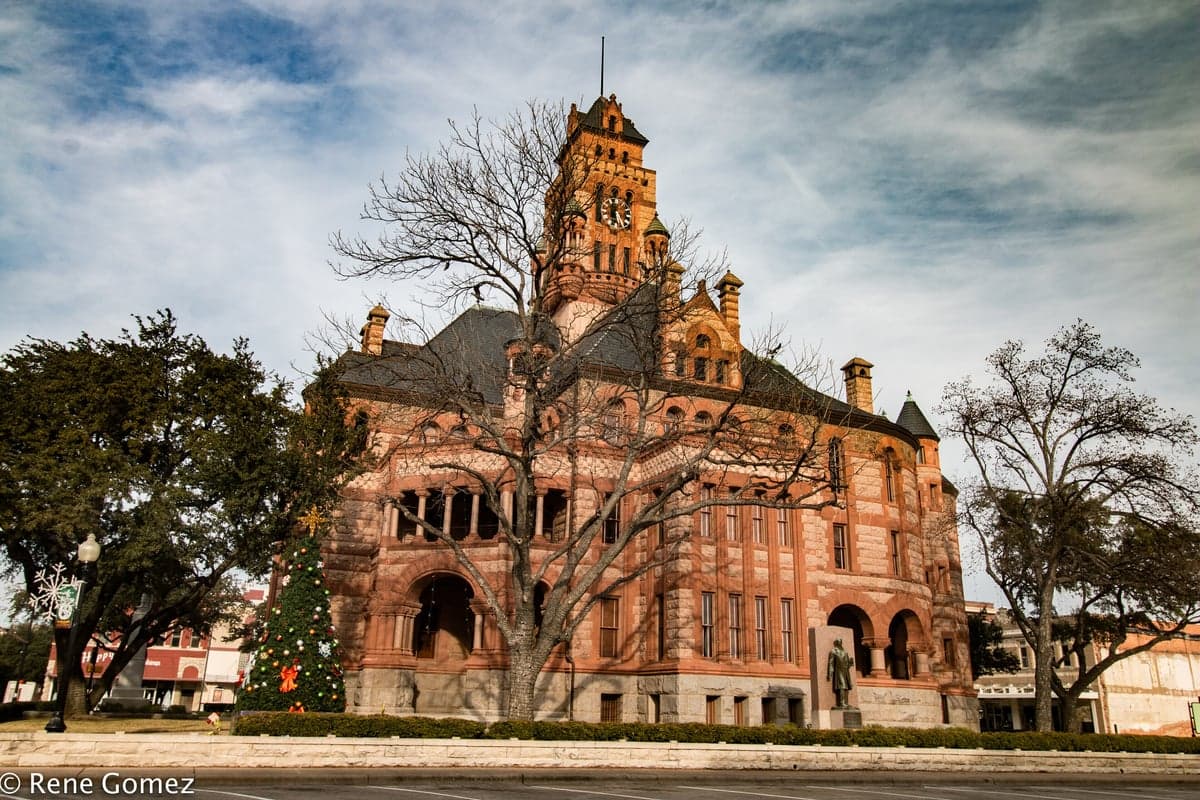
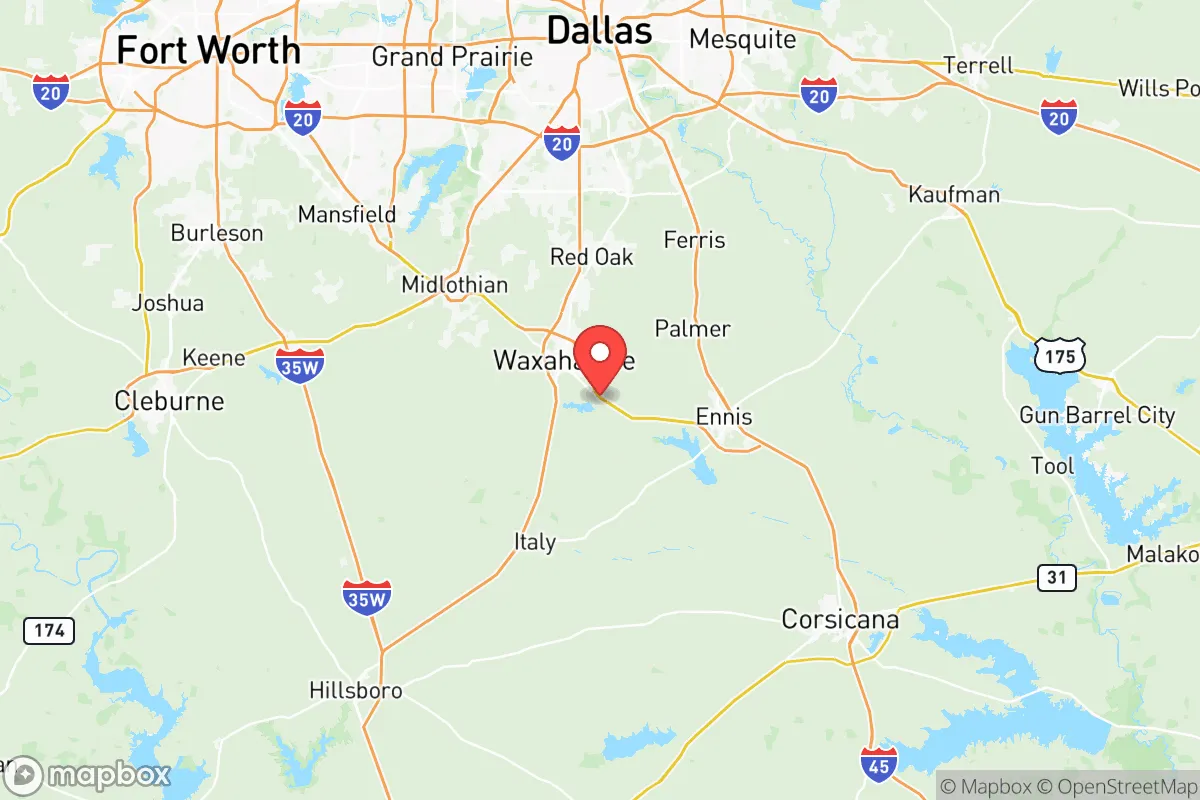
Photo: Wikipedia
Demographics of Ellis County
Affluence Level in Ellis County
A middle-class area roughly in line with national averages across income, home values, education, and employment.
People of Ellis County
The people of Ellis County, Texas today form a conservative-leaning, predominantly native-born population of 203,927 that is roughly half non-Hispanic white, slightly over a quarter Hispanic, and one-eighth Black, with very small East/Southeast Asian and Indian-subcontinent minorities. The county’s identity remains rooted in its historic agricultural and railroad heritage, now layered with Dallas-Fort Worth suburban spillover. Residents in towns like Waxahachie, Ennis, and Midlothian generally value local community, low taxes, and traditional social norms, giving the area a distinctly Texan character distinct from the hyper-diverse urban core thirty miles north.
Settlement & growth (pre-1960)
Long before European arrival, the Blackland Prairie of Ellis County was seasonal hunting territory for the Caddo Confederacy and later the Comanche, who resisted settlement well into the 1840s. Spanish and Mexican land grants covered the area but attracted little permanent colonist population. The first sustained wave of Anglo-American settlers arrived from the Upper South—Tennessee, Kentucky, and Missouri—in the late 1840s and 1850s, drawn by the rich, dark soil ideal for cotton cultivation. They founded Waxahachie (1846) as the county seat and built early farms and plantations along the Trinity River tributaries.
After the Civil War, emancipation shifted the labor base. Enslaved people who had worked cotton fields became freedmen, and many stayed as sharecroppers or small landowners. By 1870, African Americans made up roughly 40% of the county’s population—a share that has since declined. The arrival of the Houston and Texas Central Railroad in 1871 transformed Ennis into a cotton-shipping hub and attracted European immigrants, notably Czech Catholics and German Lutherans, who settled around Ennis and Italy (originally named Italy Cove, settled by Italian immigrants in the 1870s–1880s). These groups brought distinct farming traditions, churches, and a lasting cultural imprint—Ennis still hosts the National Polka Festival. A smaller wave of Italian immigrants, mostly from northern Italy, also came to work on farms and railroads, especially around Italy and Palmer.
Through the early 20th century, cotton remained king. The county’s population peaked near 55,000 in 1910, then declined as the boll weevil and Great Depression drove families to cities. The Dust Bowl of the 1930s had a milder effect here than in the Texas Panhandle, but some Okies and Arkansans did trickle in seeking agricultural work. After World War II, mechanization reduced farm labor demand, and many rural residents moved to Waxahachie or the growing industrial centers of Dallas and Fort Worth. By 1960, Ellis County’s population had fallen to about 35,000, still heavily Anglo and Black, with a modest Hispanic presence (mostly Mexican-American railroad and farm laborers).
Modern era (post-1965)
The 1965 Hart-Cellar Immigration Act had a muted immediate effect in Ellis County because the area lacked large urban immigrant economies. However, deeper national trends reshaped the county indirectly. Beginning in the 1970s, the expansion of the Dallas-Fort Worth metroplex pushed suburban development southward along Interstate 35E and US 287. Red Oak, Ovilla, and Midlothian transitioned from rural crossroads to bedroom communities, attracting white and some Black middle-class families seeking larger lots and lower taxes. This domestic in-migration—largely from Dallas County and other parts of Texas—more than offset rural depopulation.
Hispanic growth accelerated after 1990, driven by both Mexican-American natural increase and new immigration from Mexico and Central America. Many Hispanic residents settled in Waxahachie and Ennis, working in construction, landscaping, and the expanding logistics and warehouse sector along I-35E. By 2020, the Hispanic share reached 27.6%, up from roughly 8% in 1990. This community is not concentrated in isolated enclaves but integrated into older neighborhoods and newer subdivisions.
The African American share declined from its historic high but stabilized at 13.2%, with most Black residents living in Waxahachie and southern parts of the county. Some are longtime descendants of sharecropper families; others are professionals who moved from Dallas for suburban quality of life. East/Southeast Asian residents (0.5%) and Indian-subcontinent residents (0.2%) are small in number, largely clustered among professionals working in Midlothian’s industrial plants or commuting to Dallas. The foreign-born share overall is just 5.0%—well below the national average—reflecting the county’s status as a predominantly native-born, second-ring suburb.
Suburbanization has been the dominant force. Midlothian saw explosive growth (population over 40,000 in 2025, up from 7,500 in 1990), driven by large industrial employers (cement plants, a Cargill meatpacking plant) and new housing subdivisions. Red Oak similarly quadrupled in size. This growth has brought a more diverse economic base—healthcare at Baylor Scott & White in Waxahachie, education at Navarro College’s campus—and a steady influx of families with school-age children. College education rates remain moderate at 28.6%, reflecting the blue-collar roots of many residents, though professional relocations are raising that figure.
The future
Ellis County is on a trajectory toward continued population growth and gradual diversification, but strong cultural continuity will persist. The county is projected to exceed 275,000 by 2035, with most new residents coming from domestic migration—younger families and retirees leaving more expensive Dallas neighborhoods. Hispanic share is likely to rise toward 35% over the next two decades, driven by both natural increase and ongoing immigration from Latin America. The African American share is stabilizing, while East/Southeast Asian and Indian communities will grow only modestly, likely reaching 1–2% each, as most Asian immigrants prefer the denser suburbs north of Dallas.
Politically, the county leans reliably conservative, and the new arrivals tend to be moderate or right-leaning, reinforcing rather than diluting this cultural identity. There is no sign of tribalization into distinct enclaves; instead, suburban master-planned communities in Midlothian, Red Oak, and Waxahachie mix white, Hispanic, and Black households without strong segregation. Schools remain majority white and Hispanic, with growing ESL programs. The county’s identity—rooted in agriculture, railroad history, and now family-centric suburban life—is absorbing diversity without fundamental change. For a conservative-leaning individual or family considering relocation, Ellis County offers a stable, growing, and culturally familiar environment where traditional values hold broad appeal and demographic shifts are gradual, not disruptive.

* Values derived from national, state, county, city and local statistics and may differ in a specific area. Last updated: 2026-05-22T01:06:16.000Z
Narrative content on this page is AI-generated and may contain mistakes. Verify any details that matter before acting on them.
ReloMaps may earn a commission from affiliate links at no extra cost to you.

